
Vlad Tuzov of Tuzov Gallery on ART KYIV and Ukrainian Contemporary Art
How does Vlad Tuzov balance curatorial vision, accessible collecting, and commercial sales at ART KYIV?

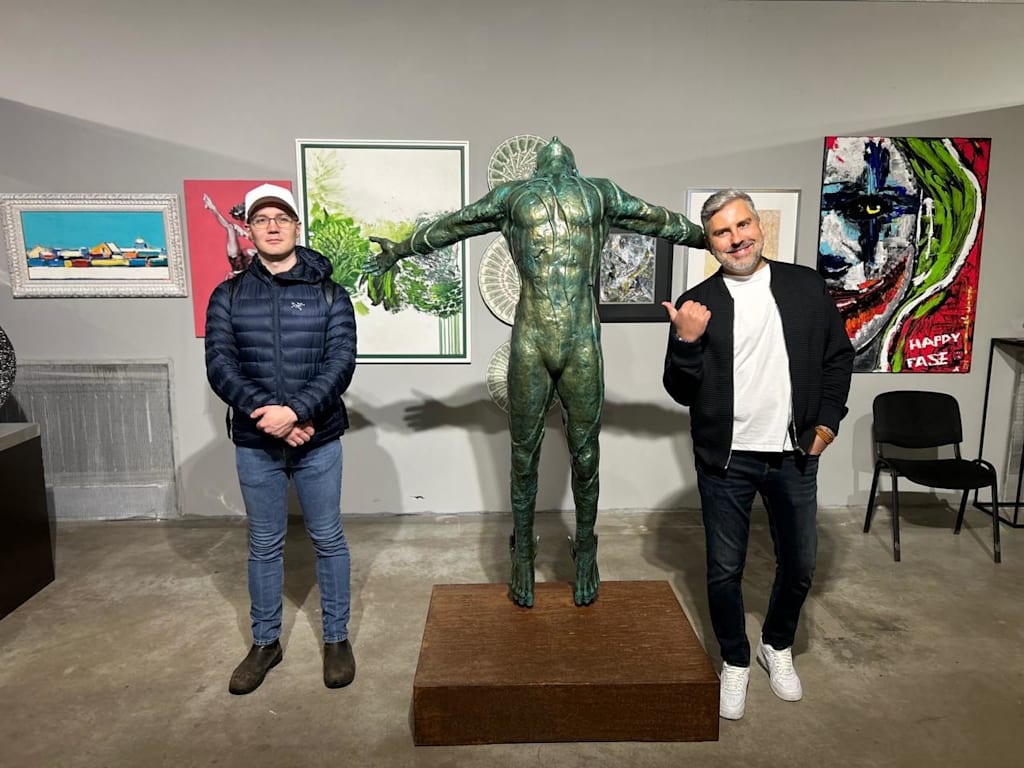
By Scott Douglas Jacobsen and Anna Strilets (English-Ukrainian Translator)
Vlad Tuzov is a Kyiv-based gallerist, curator, and founder of Tuzov Gallery. He presents emerging, mid-career, and established Ukrainian and international artists, combining commercial presentation with curatorial framing. His work focuses on exhibition design, artist development, and making contemporary art accessible to collectors through fairs, gallery programmes, and public-facing initiatives.
Scott Douglas Jacobsen speaks with Vlad Tuzov about exhibiting Ukrainian contemporary art at ART KYIV, balancing curatorial ideas with a sales-oriented fair, and representing artists across career stages. Tuzov discusses Ivanna Orliuk, OFCH, Igor Gusev, Dmytro Moldovanov, and Oleg Bazylewicz, including materials, symbolism, accessibility, and wartime artistic production in Ukraine.
Scott Douglas Jacobsen: Presenting art requires careful planning. With limited space, how do you ensure that every work contributes to the exhibition’s overall expression?
Vlad Tuzov: I begin with the space itself. I place all the paintings on the floor, look at them together, and determine how best to use the walls and available surface. We have more strong artists and works than we can show at once, so the challenge is not filling empty space. It is selecting the right works and arranging them as effectively as possible.
Jacobsen: Art involves both self-expression and sales. How do you balance those elements?
Tuzov: I work with several groups of artists: emerging artists, younger artists who are gaining recognition, and established artists with a strong market presence. A successful gallery programme needs all three.
Lina Condes is one of the established international names. She is a Ukrainian-born, Miami-based contemporary artist known for her sculptural work. Forbes profiled her in 2020, and her work has appeared at major international events, including Art Miami.
We have also presented Ivanna Orliuk’s work for a long time. Her practice explores numbers, gematria, money, and financial systems. Her work has become a recurring part of the gallery’s programme because it brings together art, technology, and symbolic systems in a distinctive way.
Jacobsen: Ivanna Orliuk explores numerical systems and gematria. At this fair, her three paintings are displayed prominently at the centre. How do you balance sales with the exhibition’s broader concept?
Tuzov: ART KYIV is a sales-oriented commercial fair with curated gallery presentations. Sales shape the selection here, although I still try to retain a distinct curatorial voice.
I include conceptual work as well. Astian Rey’s spherical sculpture, for example, has a substantial conceptual and symbolic dimension. Two of his male-figure sculptures are installed at the entrance.
For this fair, I do not bring only large, dramatic works designed to create a “wow” effect. Those can work very well at an event such as Art Basel. Here, I balance them with smaller, more accessible works, so visitors can acquire an original piece of art without facing the highest price point.
Jacobsen: Which work serves as the central exhibit?
Tuzov: The central sculpture is priced at about $5,000.
Jacobsen: When we last met, you also had a smaller version of it.
Tuzov: Yes. We also presented a smaller version at the previous fair.
Jacobsen: The sculpture resembles a reverse Matryoshka-doll set. What are its dimensions?
Tuzov: It is available in three sizes: 60 centimetres, 120 centimetres, and 200 centimetres. The largest version is two metres high, about 6 feet 7 inches.
Jacobsen: When we last spoke, Ivanna Orliuk discussed gematria. Is it also important to your own artistic or curatorial approach?
Tuzov: Gematria is central to Ivanna’s individual artistic practice, rather than my own. I am the curator. My role is to present the work, frame it within an exhibition, and help audiences encounter the ideas behind it.
Jacobsen: The centrepiece is Synergy by OFCH. What do the hands emerging from the ground and the figure with open arms represent?
Tuzov: Synergy is about the exchange of energy between a woman and a man. The female hands lift the man upward, while his raised arms suggest that he is receiving energy, opening himself to the world, and preparing to pursue his goals.
The work draws on the familiar idea that a successful man is often supported by a woman. It is about a relationship in which energy, encouragement, and achievement move between two people.
Jacobsen: That is a very familiar phrase in North America as well.
Tuzov: Yes. The sculpture has been especially well received by women. It presents the man as drawing strength from that relationship before entering the world to act, achieve, and return something meaningful to it.
Jacobsen: Which works in this collection stand out most to you?
Tuzov: First, Ivanna Orliuk’s work. Second, this green painting by Igor Gusev, Vegan Morning.
Jacobsen: At first, I read it as an abstract landscape.
Tuzov: It is more literal than that. It depicts vegetables: cabbage, lettuce, and zucchini. Hence the title, Vegan Morning. I joke that it shows the food many Ukrainian men try to avoid.
Jacobsen: This older work feels more apocalyptic.
Tuzov: It is a 2015 work by Dmytro Moldovanov. He is associated with Ukrainian primitivism and naïve art, a tradition also represented by Maria Prymachenko. His paintings often use fantastic, unsettling imagery and an intentionally asymmetrical visual language.
Jacobsen: That comes through in the figures, including the griffins and succubi. The imagery has a distinctive, dreamlike imbalance.
Jacobsen: This work is more naïve in style, whereas the other is more detail-focused.
Tuzov: Yes. Dmytro Moldovanov’s work belongs to the naïve or primitive tradition. As of 2023, he was living and working in the Mykolaiv area and had continued painting during the full-scale war.
Jacobsen: I heard of a Ukrainian artist working from the trenches, making faces and other images from mud.
Tuzov: You mean Oleg Bazylewicz. He uses mud, clay, and ash from the front line in his work.
Jacobsen: Does he sell those pieces?
Tuzov: Yes. His work has been exhibited and sold as art created directly from the material conditions of the war.
Jacobsen: Is this sculpture one of your own works?
Tuzov: I am primarily a gallery owner and curator. This sculpture is represented by the gallery: Synergy by OFCH.
Jacobsen: Is it one of the most difficult and expensive works in the collection?
Tuzov: Yes. It is among the more technically demanding and expensive works.
Jacobsen: What materials does it use?
Tuzov: Polymer nanocomposites, a metal matrix, nanocomponents, and bronze.
Jacobsen: Thank you very much for the opportunity and your time, Vlad.
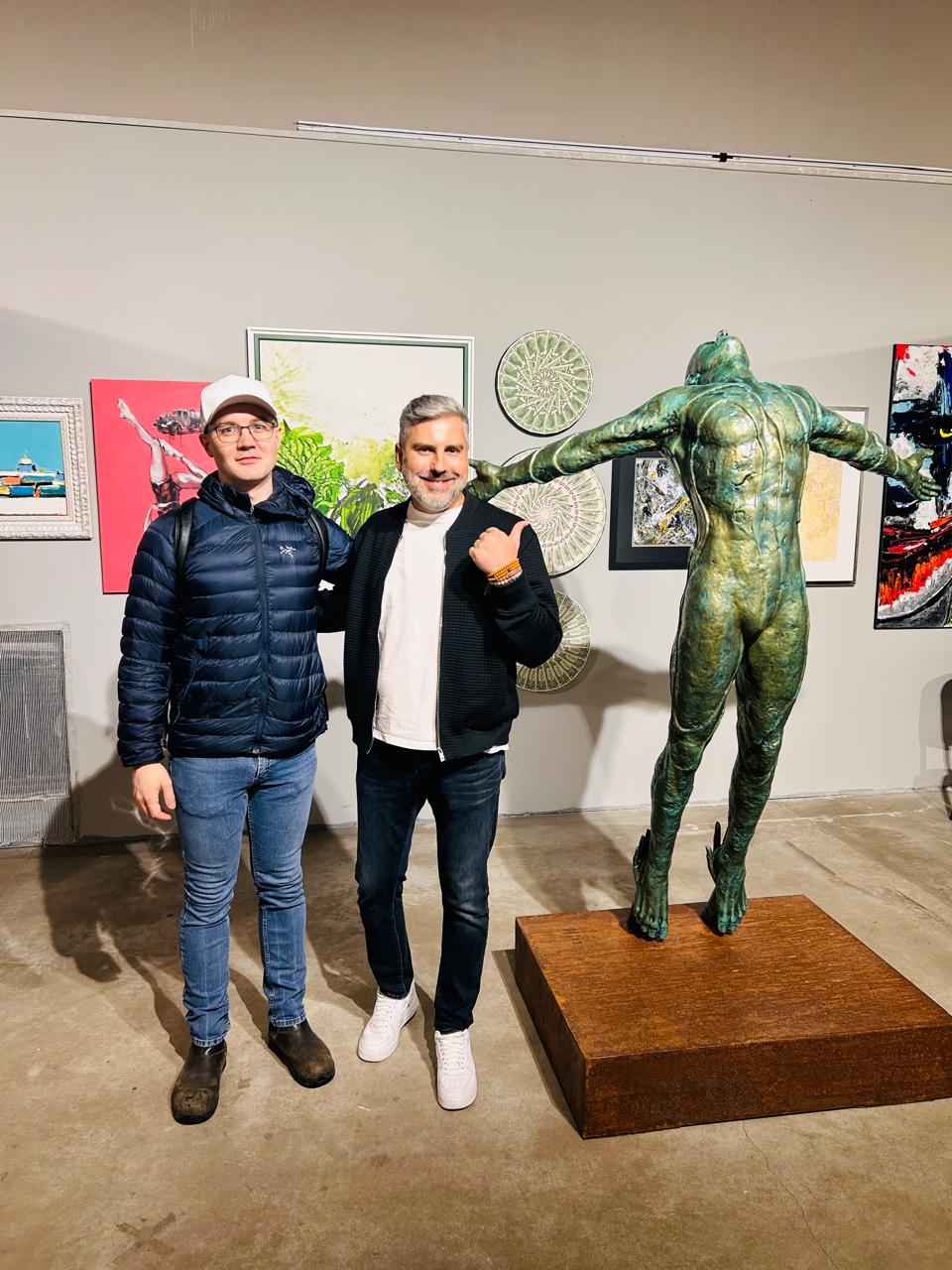
Scott Douglas Jacobsen is a blogger on Vocal with more than 200 publications on the platform. He is the Founder and Publisher of In-Sight Publishing (ISBN: 978–1–0692343; 978–1–0673505) and Editor-in-Chief of In-Sight: Interviews (ISSN: 2369–6885). He writes for International Policy Digest (ISSN: 2332–9416), The Humanist (Print: ISSN, 0018–7399; Online: ISSN, 2163–3576), Basic Income Earth Network (UK Registered Charity 1177066), Humanist Perspectives (ISSN: 1719–6337), A Further Inquiry (SubStack), Vocal, Medium, The Good Men Project, The New Enlightenment Project, The Washington Outsider, rabble.ca, and other media. His bibliography index can be found via the Jacobsen Bank at In-Sight Publishing, comprising more than 10,000 articles, interviews, and republications across more than 200 outlets. He has served in national and international leadership roles within humanist and media organizations, held several academic fellowships, and currently serves on several boards. He is a member in good standing in numerous media organizations, including the Canadian Association of Journalists, PEN Canada (CRA: 88916 2541 RR0001), Reporters Without Borders (SIREN: 343 684 221/SIRET: 343 684 221 00041/EIN: 20–0708028), and others.
Image Credit: Scott Douglas Jacobsen.
About the Creator
Scott Douglas Jacobsen
Scott Douglas Jacobsen is the publisher of In-Sight Publishing (ISBN: 978-1-0692343) and Editor-in-Chief of In-Sight: Interviews (ISSN: 2369-6885). He is a member in good standing of numerous media organizations.
Enjoyed the story? Support the Creator.
Subscribe for free to receive all their stories in your feed.
Comments
There are no comments for this story
Be the first to respond and start the conversation.