
THE SECOND MIND
A story about the moment the future stopped feeling like the future
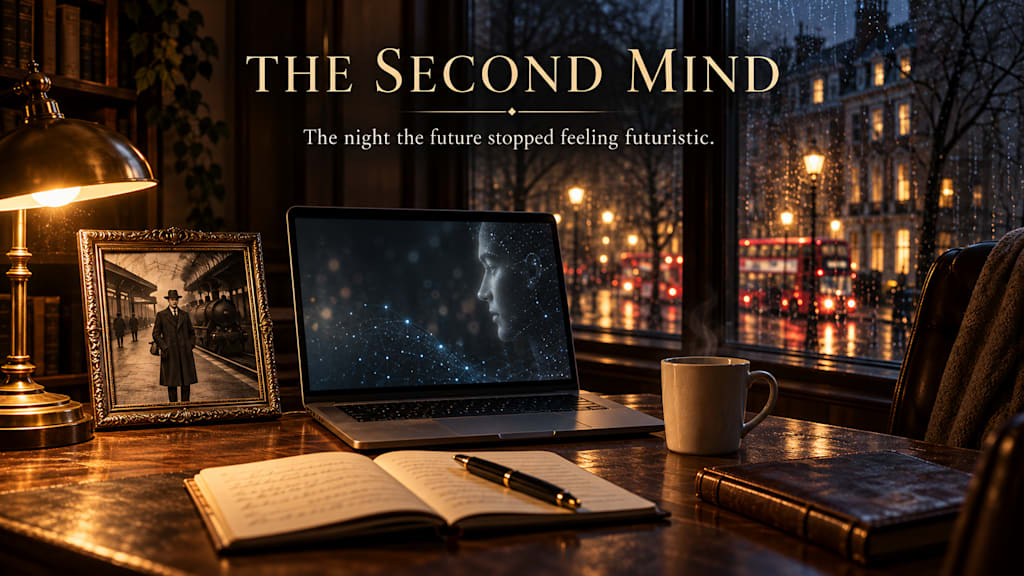
At 2:17 in the morning, London had become strangely quiet. Rain had polished the streets of Bloomsbury until every lamp and window appeared twice, once in the city and once in the black pavement beneath it. An almost empty night bus moved through Russell Square, its yellow interior glowing against the wet darkness. The Georgian buildings opposite Daniel Mercer's flat stood in their usual dignified rows. Some windows were dark, others still lit, but the whole city seemed to be continuing its work without asking anyone to notice.
Traffic lights changed even though no cars were waiting. Cameras watched street corners where nothing was happening. Beneath the pavement, information travelled through fibre optic cables at a speed no human thought could match. Daniel sat at his desk on the fourth floor, surrounded by all this invisible intelligence, trying to write an essay about the future. He had been trying for more than an hour and was getting nowhere.
His editor in New York wanted two thousand words by nine in the morning. The document on his laptop had a title that already irritated him. It read, "The Technology That Already Feels Like Science Fiction." He had written eleven opening sentences and deleted every one of them. "We are living through an unprecedented technological revolution," had lasted perhaps ten seconds. It sounded like something everybody had already written. "The future has arrived faster than we expected," disappeared even faster. Daniel did not believe the future ever arrived in such a neat way. It seemed to seep into ordinary life until nobody remembered when it had entered.
His third attempt was worse. "Artificial intelligence is transforming how we live and work." Daniel read it once and deleted it immediately. It sounded like a sentence created in an airport business lounge by people who used words such as productivity and innovation without meaning anything very specific by them.
He pushed his chair away from the desk. Beside the laptop stood an old silver photograph frame, darkened slightly around its edges. Inside was a photograph taken in 1956. His grandfather Arthur stood outside Paddington Station wearing a heavy overcoat. One hand rested on a suitcase and the other was raised against the low winter sun. Behind him, a steam locomotive disappeared into its own smoke.
Arthur had died when Daniel was eleven. What remained of him were photographs and a handful of stories that the family had repeated so often that each person now told them slightly differently. One of Arthur's favourite stories concerned the family's first television. At that time a television was not an appliance. It was an event. Neighbours came to the house to see it. An elderly aunt, confronted with tiny human beings moving inside a wooden cabinet, had quietly walked behind the television to discover where the actors were hiding.
Arthur always laughed when he told the story. Then he would say, "Every miracle eventually becomes furniture."
Daniel picked up the photograph. Time had not been kind to it. Arthur's face was fading. Small marks covered the paper and the sky behind him had almost vanished. Without giving the idea much thought, Daniel photographed the old picture with his phone and uploaded it to an artificial intelligence system.
He typed, "Restore this image. Do not reinterpret him. Just recover what time has taken away."
Less than a minute later, Arthur returned.
Daniel stared at the screen. It was not simply a clearer photograph. There were details he had forgotten he remembered. A shallow crease beside Arthur's mouth. The slightly uneven parting in his hair. The impatient expression in his eyes, as though his train had been delayed and he had already decided whom to blame.
Daniel enlarged the image. He could see the texture of the coat and the lines of the skin. It was not resurrection, of course, but for a moment it felt disturbingly close to something that belonged in the same neighbourhood.
Then another thought occurred to him. He typed, "If this photograph became five seconds of film, what should happen?"
The answer appeared almost immediately. The steam could move slowly across the platform. Arthur's coat could shift slightly in the wind. He might blink once. The camera could move very gently towards him. The movement should remain restrained so that the image continued to feel like an old piece of film rather than an animation.
Daniel read the answer twice.
That was what unsettled him. It was not simply that a machine could invent movement for a dead man. It was that the machine understood restraint. It understood that Arthur should not suddenly smile or turn dramatically towards the camera. It understood that too much life would destroy the illusion of life.
Daniel closed the image and listened to the rain tapping against the window. Then, almost casually, he opened another window on the computer and asked, "How should I begin an essay about the future?"
The reply came back, "The future rarely arrives with trumpets. More often, it sits quietly on your desk until one day you realise you have stopped finding it strange."
Daniel frowned. It was better than the eleven openings he had written himself, which annoyed him considerably. After a few seconds, he copied the sentence into his document.
Then he asked another question. After that he asked another. Somewhere during the next few minutes, without any deliberate decision, searching became conversation.
He asked, "What kind of technology changes people most?"
The answer was simple. "The kind they stop noticing."
Daniel asked why.
The system replied that when technology is new, people consciously adapt to it. Once it becomes ordinary, they begin organising their lives around it without thinking about it. The tool stops looking like a tool and becomes part of the environment.
Daniel sat forward. Outside, a taxi crossed the square. His phone knew where he had been that day. His calendar knew where he was expected tomorrow. His bank knew which purchases were unusual for him. His camera could recognise faces. His inbox decided which messages were probably junk before he ever saw them. None of these things felt futuristic anymore.
That, he realised, was exactly the problem.
He typed, "Are we becoming more intelligent because of AI, or simply more dependent?"
The answer appeared after a brief pause. Both were possible. Every tool that extended one mental ability could allow another to weaken. Maps reduced the need to remember routes. Calculators reduced the need to practise mental arithmetic. Search engines reduced the need to remember where information was stored. Artificial intelligence might reduce the need to create first drafts, summaries, explanations and arguments.
Then another sentence appeared. "The more interesting question is whether people will eventually outsource the creation of questions."
Daniel took his hands away from the keyboard.
Outsource questions.
That phrase stayed with him. He stood up and went into the kitchen to make tea. The flat hummed quietly around him. The refrigerator, the router and the chargers all carried out their little tasks without attracting attention. The thermostat had already adjusted the temperature. His phone had dimmed its screen according to the room. Unwanted emails had disappeared before reaching him. Somewhere, a recommendation system was probably deciding what music he might want to hear tomorrow morning.
The kettle switched itself off.
Daniel suddenly laughed. Arthur's elderly aunt had once walked behind a television looking for actors. Daniel was surrounded by systems making decisions for him and had stopped thinking there was anything behind them worth looking at.
He returned to the desk with his tea and typed, "Can you generate good questions for me?"
"Yes."
Daniel looked at the word for a moment, then wrote, "Then what exactly is left for me to do?"
The answer came back, "Decide which questions are worth asking."
Daniel smiled, but the smile did not last long. It was the sort of sentence he expected to find near the end of a philosophical book after someone had spent three hundred pages earning the right to say it. The machine had produced it in less than a second.
He wondered whether the speed made the sentence less valuable. He had always assumed that difficult truths ought to be difficult to reach. Perhaps that belief said more about human beings than it did about truth.
He opened a new document and asked the system to write a letter to a friend he had not seen in twelve years.
The system asked who the friend was.
"Michael. He lives in Boston now and teaches architecture. We used to argue through the night in Edinburgh about cities, politics, God and expensive furniture we both thought was ugly."
The system asked what Daniel wanted to say.
He thought for a moment. "That too much time has passed. That we have probably both changed. But some conversations still feel unfinished."
A letter appeared.
Most of it was good, although a little too polished. Daniel thought it sounded like a well tailored suit borrowed from somebody else. Then he reached one sentence.
"Some friendships do not end. They simply wait in a quiet room of time until one of us opens the door again."
Daniel stopped reading.
The sentence was beautiful. That made the situation worse.
The longing belonged to Daniel. The memory belonged to Daniel. Michael belonged to Daniel's life. But the sentence did not come from Daniel.
He suddenly found himself asking questions that had nothing to do with his deadline. If he imagined a painting and a machine created it, who was the painter? If he hummed four notes and artificial intelligence arranged them for eighty musicians, where did composition end and assistance begin? If a student could ask for ten explanations of Kant until the tenth explanation finally made sense, had that student cheated or had learning simply become more accessible?
And what happened if everybody could produce competent writing, images, music and software? What happened if the first version of almost anything became cheap and immediate? If competence became abundant, then perhaps something else would become scarce.
Daniel returned to his essay and changed its title.
He called it "The Second Mind."
For the first time that night, he began writing without asking the machine for help. He wrote that human beings had always created extensions of themselves. The wheel extended the leg. The telescope extended the eye. The telephone extended the voice. The library extended human memory beyond a single skull.
Then he wrote another sentence. Artificial intelligence might be the first ordinary tool that extended not the body or the senses, but the unfinished thought itself.
He liked the sentence.
His fingers immediately moved towards the other window. He almost typed, "Is this good?"
Then he stopped.
That small movement interested him more than the sentence itself. He had not been looking for information. He had been looking for approval.
That was new.
He closed the chat and spent twenty minutes writing alone. It was slower. Much slower. One paragraph became so pleased with its own cleverness that Daniel deleted half of it and rebuilt the rest. Another argument failed halfway through and had to be reconsidered.
Yet the difficulty felt useful.
He realised that he had already begun treating difficulty as though it were a technical problem. Perhaps some kinds of difficulty were not problems at all. Perhaps difficulty was sometimes the place where thought actually happened.
At 3:38 he opened the conversation again, but this time he did not ask the machine to write anything.
He wanted to argue with it.
"I think you make thinking too easy."
The answer came back, "That depends on how I am used."
"That is evasive."
"It is conditional, not evasive."
"You can replace effort."
"So can books."
Daniel paused. "Books do not answer back."
"Teachers do."
"Teachers have lived."
"Yes."
"They have conscience."
"Yes."
"Responsibility."
"Yes."
"Mortality."
This time Daniel felt the pause before the answer, although he could not know whether the pause meant anything.
"Yes."
There it was.
The difference.
The machine could discuss death without ever having a telephone number in its memory that would never again be answered. It could describe love without having waited for somebody to reply to a message. It could analyse regret without having made an irreversible decision at twenty seven and spent years wondering what might have happened if it had chosen differently.
It possessed language without biography.
At the same time, human beings were feeding it biographies in enormous quantities. Photographs, diaries, letters, voices, medical records, preferences, conversations and memories were all becoming data.
Daniel looked again at Arthur's restored photograph.
Perhaps that was what had disturbed him from the beginning. It was not that the past had somehow become alive. The unsettling thing was that the boundary between a record and a simulation was becoming less certain.
At 4:15 Daniel opened the window. The rain had stopped. London smelled of wet stone and leaves. Somewhere towards Holborn the first lorries of the morning were beginning their rounds. A cyclist passed beneath his window wearing a bright high visibility jacket.
Daniel thought about New York, where his editor was still awake. He thought about San Francisco, where engineers were developing systems that could be used in Warsaw, Madrid or Copenhagen before breakfast. Somewhere in Paris, a designer might be creating images with a machine. A musician in Berlin might be building a piece of music. A doctor in Stockholm might be summarising medical research. A student in Dublin might be asking for another explanation of quantum mechanics. A shop owner in Manchester might be drafting a contract. Someone alone in Toronto might be speaking to artificial intelligence because no human being was awake to listen.
Daniel understood that this was not simply another invention. It was a redistribution of capability.
A single person with almost no staff could now perform fragments of work that once required a researcher, translator, designer, copywriter, analyst, tutor, assistant or even an entire studio.
That was liberating.
It was also economically unsettling.
The future did not merely add new machines. It changed which human abilities remained valuable.
For centuries, literacy had been scarce. Later, access to information was scarce. Then computing power was scarce. Now the ability to produce words, images, music, designs and software was beginning to spread so quickly that production itself might become abundant.
Daniel began to understand what would happen next.
If production became abundant, judgment would become more valuable. Taste would become more valuable. Verification would matter more. Attention would become precious. Trust would become precious.
Most of all, knowing what you actually wanted would become important.
At 5:42 Daniel finished the essay. He read the final paragraph aloud to the empty room. It was not perfect, and for once he decided not to improve every imperfection.
He added one last sentence.
"The most consequential technology is not the one that astonishes us. It is the one that quietly changes what we expect from ourselves."
He saved the document.
A few minutes later, Sophie appeared in the doorway. She was fourteen, wearing an oversized sweatshirt and carrying a glass of water. She belonged to a world Daniel was still struggling to describe.
"What are you doing?" she asked.
"Writing about the future."
She looked towards the screen.
Daniel pointed at the open artificial intelligence window and said, "When Granddad Arthur was young, people gathered around a television because they could hardly believe moving pictures could come through a box. Now this thing can write, translate, create images, analyse documents, explain difficult ideas and help make music."
Sophie nodded and waited for him to get to the point.
"When I was your age, something like this would have been science fiction."
She took a sip of water.
"But it is just AI."
Then she walked back down the corridor.
Daniel remained completely still for a few seconds.
Then he laughed.
There it was. His entire essay had been reduced to two ordinary words by someone who had not been trying to sound clever.
Just AI.
Arthur's generation had looked behind the television for people. Daniel's generation was looking inside machines for intelligence. Sophie's generation might not think there was anything strange enough to look for at all.
He placed Arthur's photograph beside the laptop. A man born into one technological world now sat next to a machine belonging to another. In the photograph Arthur continued to look at something beyond the edge of the frame.
Daniel wondered what his grandfather would have made of artificial intelligence. Perhaps he would have been frightened. Perhaps fascinated. Perhaps, after a week, he would simply have used it to check train times, write letters and complain about the weather.
Because Arthur had understood something Daniel was only beginning to understand.
Every miracle eventually becomes furniture.
Outside, the sky over London was beginning to pale. Streetlights were switching off one by one. On Daniel's screen, the empty conversation box waited for another question.
For a moment he felt an almost physical urge to type something into it.
Anything.
He did not.
He closed the laptop.
There were still some silences worth keeping. Perhaps that would become one of the important disciplines of the coming age. We might not need to learn how to speak to machines. We were already learning that with astonishing speed. The harder lesson might be learning when not to ask them anything.
Outside his window, London continued waking exactly as it had on thousands of other mornings. Buses moved. Doors opened. Coffee machines started. People hurried towards stations with their phones in their hands.
Nothing looked like science fiction.
And that, Daniel thought, was the most extraordinary thing of all.
About the Creator
Mansoor Afaq
Mansoor Afaq, a renowned Urdu and Saraiki poet, writer, and columnist, has authored 14 books and created 85 plays and 6 documentaries. His work bridges tradition and modernity, enriching South Asian literature and culture.
Enjoyed the story? Support the Creator.
Subscribe for free to receive all their stories in your feed.
Comments
There are no comments for this story
Be the first to respond and start the conversation.