
The Music Industry Is Having an Identity Crisis — And AI Is at the Center of It
There was a time when making music felt almost mythical.
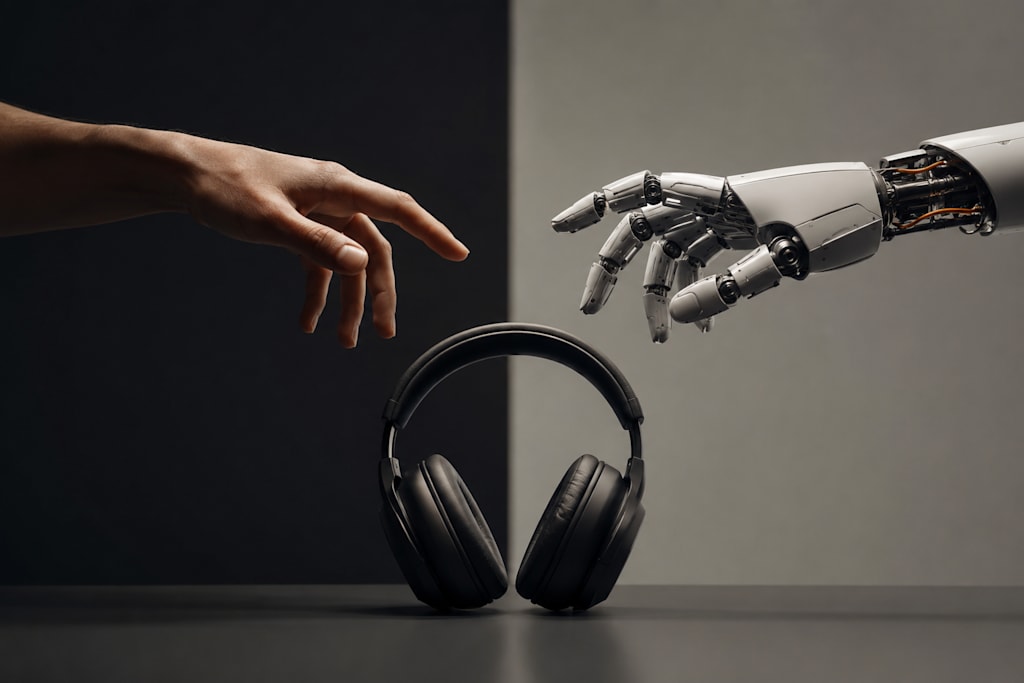
You needed talent, expensive studio equipment, years of practice, connections, and usually a little luck. Recording an album was a process. Artists disappeared for months, sometimes years, chasing the perfect sound. Fans waited outside stores at midnight for releases. Music felt human because every flaw, every crack in a voice, every missed note carried emotion.
Now?
Someone can generate a full song in under 30 seconds using artificial intelligence.
And the music industry is still trying to figure out whether that’s innovation… or the beginning of something dangerous.
Right now, AI music is one of the hottest and most controversial topics in entertainment. It’s dividing artists, labels, producers, streaming platforms, and fans in real time. Some people believe AI will democratize music creation and open doors for independent creators. Others think it’s slowly turning music into disposable algorithmic content.
The truth is probably somewhere in the middle.
But one thing is certain: the industry is changing faster than most people realize.
Recently, major streaming companies started openly embracing AI-generated music tools instead of fighting them. Spotify and Universal Music reportedly signed agreements allowing licensed AI remixes and AI-assisted music experiences for users.
That would have sounded insane just a few years ago.
For the longest time, labels treated AI like a threat. Lawsuits were flying everywhere. AI companies were accused of training models on copyrighted songs without permission. Artists feared their voices could be cloned. Producers worried entire careers would disappear overnight.
Now, suddenly, some of the same companies that were warning about AI are trying to monetize it.
And that shift says a lot.
Because the music business has always adapted to technology — even when artists hated it at first.
People said streaming would destroy music ownership. It did.
People said TikTok would shorten attention spans. It did.
People said algorithms would decide what becomes popular instead of culture. That happened too.
AI feels like the next stage of that evolution.
The scary part is how fast it’s moving.
According to recent reports, nearly half of new music uploads on some platforms may already be AI-generated.
Think about that for a second.
Not half of popular songs.
Not half of radio hits.
Half of all uploads.
That means streaming services are being flooded every day with thousands of AI-generated tracks. Ambient playlists, fake artists, imitation songs, generated instrumentals, voice clones — entire catalogs appearing out of nowhere.
Most listeners probably don’t even notice.
And honestly, that’s part of the problem.
Music used to carry identity. You could hear a singer for three seconds and immediately know who it was. Artists built worlds around their sound. Now AI models can imitate vocal tones, production styles, melodies, and songwriting structures so convincingly that the line between real and artificial is starting to blur.
Some AI-generated songs are honestly impressive.
That’s what makes this conversation complicated.
Because if the music sounds good, does the process matter?
For older generations of musicians, the answer is usually yes. Music is supposed to come from lived experience. Pain, relationships, heartbreak, ambition, failure, joy — those things cannot truly be generated by software.
But younger audiences seem more flexible.
A lot of Gen Z listeners grew up in the streaming era where music became less tied to artists and more tied to mood. “Songs to study to.” “Gym playlist.” “Sad night drive.” “Lo-fi for sleep.”
The emotional connection shifted from who made the song to how the song feels in the moment.
AI fits perfectly into that world.
If a listener only wants background music while gaming or working, they may not care whether the track came from a human producer in Atlanta or an algorithm running on a server somewhere.
That changes the economics of music completely.
And this is where artists are starting to panic.
Streaming already pays most musicians very little unless they’re massive stars. Independent artists have spent years complaining that the current system favors volume over artistry. Now imagine competing against infinite AI-generated content uploaded every minute.
It’s not just competition anymore.
It’s saturation.
Music has become content, and content has become endless.
Some platforms are now trying to fight back against AI spam and streaming fraud. Reports claim companies are removing millions of suspicious tracks and demonetizing fake streams connected to bots.
Because another ugly side of AI music is starting to emerge:
Fake engagement.
Some people are generating thousands of songs, uploading them under fake names, then using automated bots to stream them repeatedly for royalty payouts. It’s basically streaming farms mixed with artificial music generation.
In other words, some “artists” are now automating both the music and the listeners.
That sounds dystopian because it is.
And it creates a massive trust problem.
If fans don’t know what’s real anymore, the entire emotional value of music starts changing.
There’s also the issue of identity theft.
Several musicians have already spoken publicly about discovering fake AI-generated songs uploaded under their names.
Imagine waking up and finding a song online using your voice, your image, your audience, and your reputation — except you never made it.
The law still hasn’t caught up to this reality.
That’s why some artists are becoming extremely protective of their voices and likenesses. In the future, an artist’s vocal tone may become as valuable as intellectual property itself. Labels might start licensing “AI versions” of artists the same way movie studios license characters and franchises.
And honestly, that future feels closer than people think.
But despite all the fear, not everyone in the industry sees AI as evil.
A lot of producers already use AI tools quietly.
Not necessarily to make entire songs, but to speed up workflows. AI can help clean vocals, suggest chord progressions, generate rough demos, isolate stems, master tracks, and organize production sessions.
For some musicians, AI is becoming less of a replacement and more of a collaborator.
That’s an important distinction.
The same way Photoshop didn’t kill photography, AI may not kill music either. It may simply redefine what counts as creativity.
And if we’re being honest, technology has always changed music.
Autotune was hated when it first appeared.
Sampling was controversial.
Digital production was mocked by traditional musicians.
Even electric guitars were once considered “fake” by purists.
Now all of those things are normal.
So maybe AI eventually becomes normal too.
But I think the real fear isn’t actually about technology.
It’s about authenticity.
People still crave human connection, especially in art. That’s why live concerts remain massive even in the streaming era. Fans don’t pay hundreds of dollars to hear perfect vocals. They pay for presence, emotion, unpredictability, personality, and shared experience.
A machine can imitate sound.
It still struggles to imitate meaning.
At least for now.
And maybe that’s where human artists will always have an advantage.
Because the best music has never just been about technical quality.
It’s about story.
When people listen to an album after a breakup, during depression, after losing someone, while driving at night, during the best summer of their life — they attach memories to music. Human experiences become tied to songs forever.
AI can generate melodies, but it hasn’t lived a life.
It hasn’t felt heartbreak at 3 a.m.
It hasn’t stood backstage shaking before a performance.
It hasn’t spent ten years failing before finally making one great song.
Humans connect with humans.
That emotional truth is probably the one thing the industry cannot automate.
Still, the next few years are going to be chaotic.
Streaming platforms will keep experimenting with AI tools.
Labels will continue searching for ways to profit from it.
Artists will fight for ownership rights and identity protection.
Fans will slowly decide what they actually value.
And somewhere in the middle of all this, music itself is evolving again.
Not disappearing.
Not dying.
Just changing.
Maybe the future of music won’t be fully human or fully artificial.
Maybe it becomes something hybrid — where AI handles the technical side while humans focus on emotion, storytelling, and vision.
Or maybe audiences eventually reject AI-generated art entirely and start craving raw authenticity again.
Nobody really knows yet.
That uncertainty is exactly why this moment feels so important.
Because the music industry isn’t just debating technology right now.
It’s debating what creativity actually means in the modern world.
About the Creator
Enjoyed the story? Support the Creator.
Subscribe for free to receive all their stories in your feed.
Comments
There are no comments for this story
Be the first to respond and start the conversation.