
The Impossible Question Behind Divine DNA
A cultural initiative examining the relationship between art, identity, and global heritage.
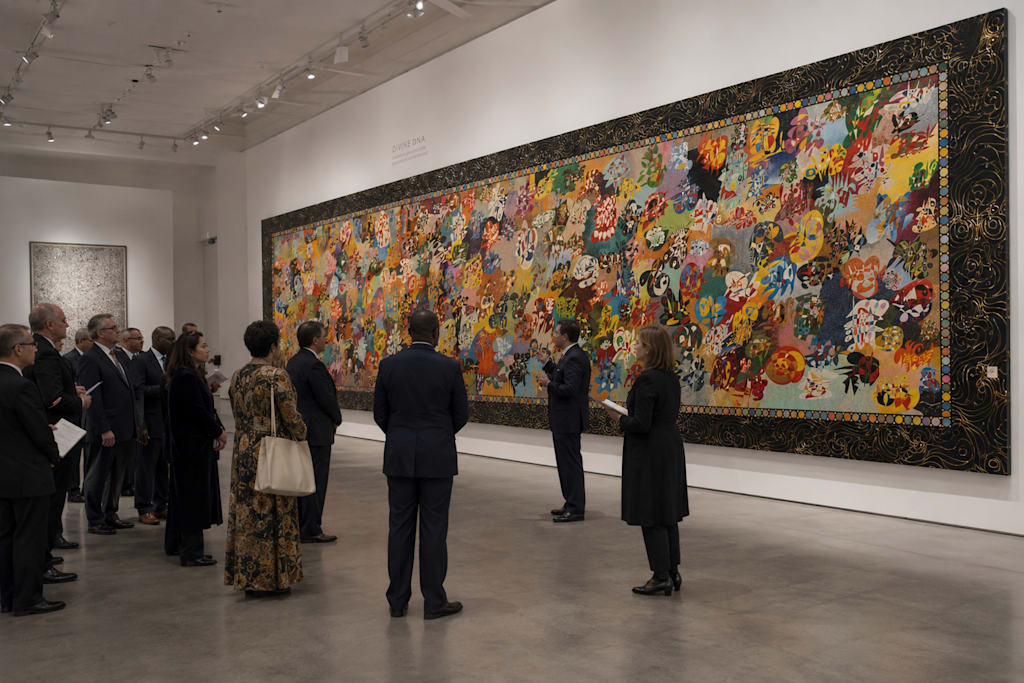
What would happen if an artist attempted to represent humanity in a single work of art?
Not a nation.
Not a religion.
Not a civilization.
Humanity itself.
At first, the idea sounds impossible.
Human history is too vast. Cultures are too diverse. Languages, traditions, beliefs, symbols, myths, and historical experiences vary enormously from one society to another. Every attempt to define humanity seems destined to exclude someone.
Yet that impossibility became the starting point for a project that would eventually grow into Divine DNA.
The project began with a simple observation: every culture develops its own way of explaining who we are.
Some societies tell stories through religion. Others through philosophy. Others through political history, scientific achievement, oral traditions, architecture, literature, or art. Although the forms differ, the questions remain remarkably similar.
Where do we come from?
Who are we?
What connects us?
What separates us?
What do we leave behind?
These questions appear again and again across continents and centuries.
The challenge was not simply to create a large painting. The challenge was to develop a visual framework capable of engaging with the cultural heritage of the world without reducing cultures to stereotypes or simplifying their complexity.
Years of research followed.
Historical figures.
Cultural symbols.
Mythological narratives.
Religious traditions.
Scientific achievements.
Philosophical ideas.
National identities.
Civilizational contributions.
The result became Divine DNA, a monumental work incorporating references to 249 nations and territories.
But the project is not really about the artwork itself.
The artwork is only the beginning.
The more interesting question is whether a cultural project can become a platform for dialogue between institutions, researchers, historians, museums, educators, and communities around the world.
Every nation represented within the work contains layers of meaning that deserve discussion, critique, and interpretation. No individual can claim complete authority over the cultural heritage of hundreds of societies.
For this reason, I increasingly see Divine DNA not simply as an artwork, but as an invitation.
An invitation to ask how culture should be represented in an interconnected world.
An invitation to explore the relationship between identity and humanity.
An invitation to examine what we share while respecting what makes each culture unique.
The project continues to evolve, and I welcome conversations with museums, cultural institutions, researchers, historians, educators, and individuals interested in cultural heritage and international dialogue.
For readers interested in exploring the project further, the following publications provide an introduction to the research, methodology, and conceptual framework behind Divine DNA.
More information about the broader initiative can be found at:
https://en.elartemonumental.com
Perhaps the most interesting question is not whether humanity can be represented through art.
Perhaps it is whether humanity can learn to see itself as a shared story without losing the richness of its differences.
About the Creator
Daniel Varzari
American art curator.
Enjoyed the story? Support the Creator.
Subscribe for free to receive all their stories in your feed.
Comments
There are no comments for this story
Be the first to respond and start the conversation.