
The Architecture of Humanity: A New Framework for Understanding Civilization
The Architecture of Humanity | Cortesy El Arte Monumental
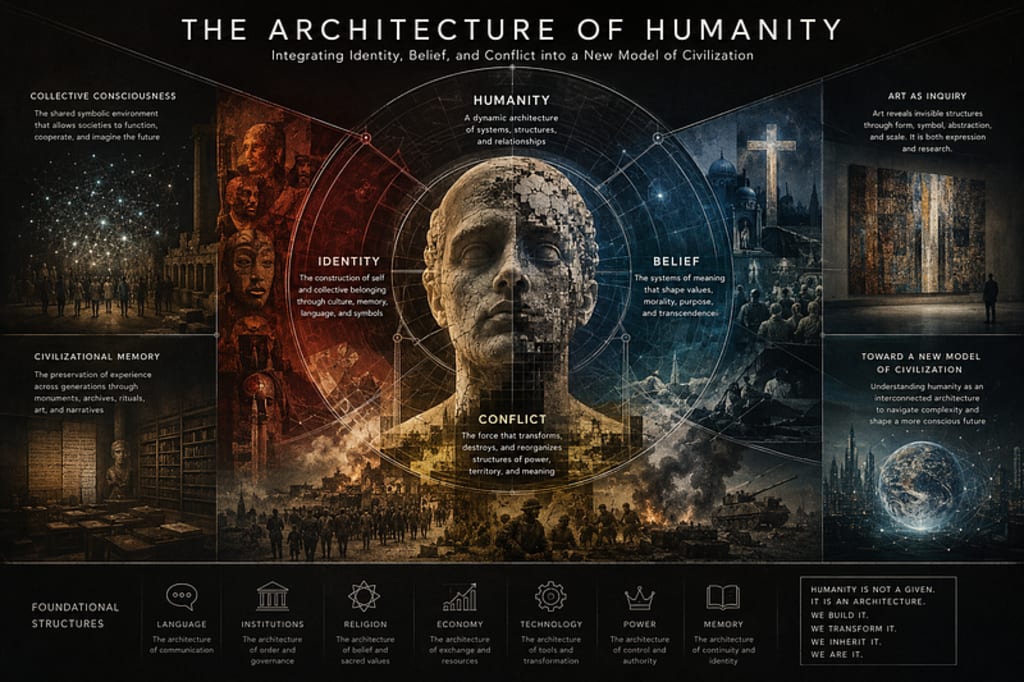
What if humanity could be studied the way architects study a city?
For generations, scholars, artists, historians, and philosophers have examined humanity through individual subjects: identity, religion, politics, economics, culture, technology, and conflict. Each field has contributed valuable insights into how societies function and how individuals understand themselves.
Yet the twenty-first century presents challenges that increasingly transcend these traditional boundaries.
Climate change, artificial intelligence, mass migration, digital networks, geopolitical instability, technological governance, and global economic interdependence reveal a world shaped by systems that extend far beyond individual experience. Understanding these challenges requires more than specialized knowledge. It requires a framework capable of examining how multiple systems interact simultaneously.
This is the starting point for The Architecture of Humanity.
Developed through the ongoing research initiatives of El Arte Monumental, The Architecture of Humanity proposes that civilization itself can be understood as an architectural phenomenon - not architecture in the conventional sense of buildings and physical construction, but architecture as the organization of relationships.
From this perspective, humanity becomes visible as a vast interconnected structure composed of identities, beliefs, institutions, memories, technologies, conflicts, systems of power, and forms of collective consciousness operating across time.
The framework emerged through a sequence of investigations that explored several foundational dimensions of civilization:
Each study examined a specific aspect of human organization. Together, they revealed that these dimensions cannot be fully understood in isolation. Identity influences power. Belief shapes identity. Conflict transforms institutions. Memory preserves collective narratives. Technology restructures communication. Every element participates within a larger system.
The Architecture of Humanity seeks to understand that larger system.
At its core, the project asks a fundamental question:
How is humanity organized?
Rather than focusing exclusively on individuals or isolated disciplines, the framework examines the structures connecting them. It explores how civilizations construct meaning, preserve memory, organize authority, manage conflict, transmit beliefs, and sustain collective existence across generations.
Contemporary art occupies a central role within this research.
Art has the unique ability to make invisible structures visible. Through abstraction, symbolism, scale, and visual language, artistic practice can reveal relationships that often remain hidden within conventional forms of analysis. Art becomes more than representation; it becomes a method of cultural investigation.
Within El Arte Monumental, artistic practice is approached as a form of research. The artwork becomes a site of inquiry. The exhibition becomes a space for examining civilization itself.
The Architecture of Humanity does not seek to replace existing disciplines. Instead, it proposes a meeting point between art, history, sociology, anthropology, philosophy, memory studies, systems theory, and visual culture. Its objective is to encourage a broader understanding of humanity as one of the most complex systems ever created.
As the twenty-first century continues to redefine the conditions of human existence, the need for systemic perspectives becomes increasingly urgent. Understanding humanity may require not only studying individual components but also examining the architectures that connect them.
This research series represents an invitation to participate in that exploration.
The task remains ongoing.
Humanity continues to build itself through new technologies, new conflicts, new forms of cooperation, and new symbolic environments. The structures shaping civilization are constantly evolving.
Understanding them may become one of the defining cultural challenges of our time.
About the Creator
Daniel Varzari
American art curator.
Enjoyed the story? Support the Creator.
Subscribe for free to receive all their stories in your feed.
Comments
There are no comments for this story
Be the first to respond and start the conversation.