
The Apple Fell, and He Placed a Grain of Sand in the Hollow
A piece of literary fiction that insists genius begins not with a falling apple, but with a child pausing to watch where the ant turned back.
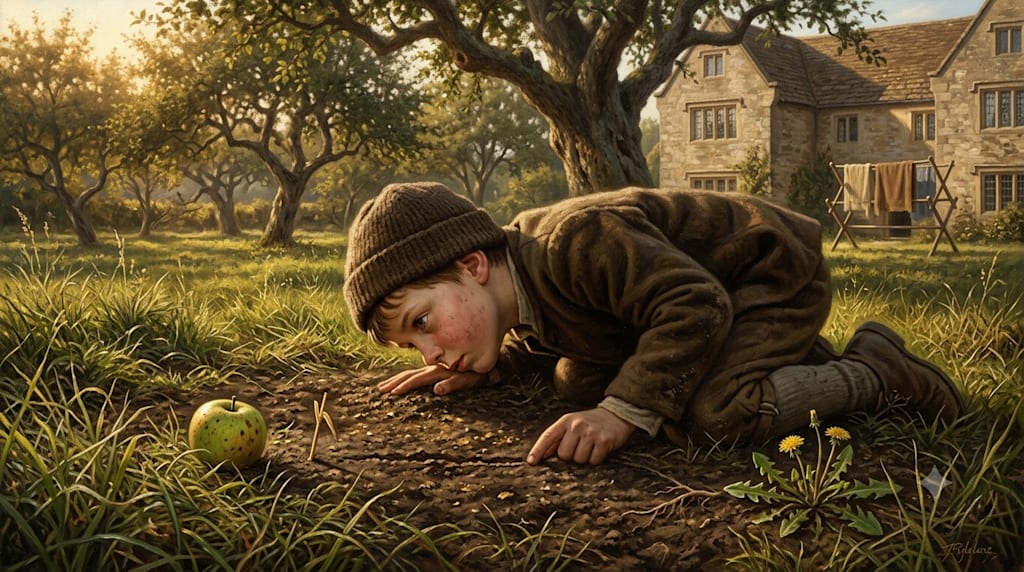
The boy crouched at the edge of the tall grass on the east side of the manor, his left knee pressing a dead twig that gave a faint, splintering crack. He did not move. A dark ochre ant was dragging a thistle seed, crossing the shadow he cast. In the thin shade of a grass stem the ant paused, antennae quivering as if tasting a scent, then turned right and skirted a piece of coarse sand larger than its own body. He found a broken wheat straw in the dirt, used its tip to scratch a shallow line alongside the ant’s detour, and held his breath, waiting for the ant to turn back.
“Isaac!”
His mother’s call passed through the low stone wall, struck the wool drying rack, and weakened further. His right shoulder gave a small shrug, as if the sound were only an extra chill in the wind. The ant did not look back. He pushed the wheat straw into the soil so it stood beside the line, a flag only he could see.
The trousers on his legs had been worn pale, the left cuff still clinging to a bur from the year before, and on his right knee a patch of dried mud had cracked into fine veins. He picked that patch off, crushed it, and scattered it back into the grass. By the time he finally stood, the sun had moved past the crown of the apple tree and stretched his shadow all the way to the nettle clump. Bending, he picked up the coarse grain of sand the ant had spared, held it to the light—flecks of mica glittered once—and dropped it into his pocket. The pocket already held seven grains of sand, an acorn cup, and three leaves of different shapes. He patted it, heard the sand grains scrape together, and turned back towards the manor.
Lunch was cold. He sat on the kitchen stool, broke his bread into small pieces, and arranged them on the wooden table. Three pieces in the first row, five in the second, seven in the third. He stared at the bread bits, tapping the tabletop with his fingers: one, three, five, seven—then he moved the second row beside the first so they became two columns of four, leaving one piece extra. He bit off the extra piece, chewed, swallowed, then picked up every crumb from his fingertips and put them into his mouth.
The maid Bess came in, saw him staring at an empty plate, and said, “That boy’s lost his wits again.” He did not look up. He was studying an old knife cut on the tabletop, a line running from the table’s edge towards its centre, splitting partway into two parallel grooves. He laid his palm over it, closed his eyes, and felt the shallow then deeper bite of the cut. Bess shook her head and went out, hanging her apron over the door handle.
Towards evening he returned to the east side of the manor. The ant was gone. He found the wheat straw he had driven into the soil; it had tilted, so he straightened it, then crouched and found the line beside it. The line was still there, only slightly blurred by wind. He deepened it with his fingernail, then extended it further and further, all the way to the base of a dandelion. Most of the dandelion seeds had already blown away, leaving only five or six white filaments; when he touched it, two more drifted off. He chased those two filaments a few steps, watching them rise, clear the apple tree, and disappear into the grey-blue sky.
He wanted to know where they went. But instead of following, he turned back, crouched beside the dandelion, and began to count the three remaining filaments. Three. He counted three times to be sure it was the same number.
The grammar-school classroom smelled of damp chalk and old wood. The inkwell stand was carved with countless initials; at his place, the bottom right corner of the desk was cut with a “J.H.,” its groove packed with years of ink-stain. He had picked at it with his nail, lifting a thin black line that stayed on his fingertip the whole day.
Master Prynne, in a black coat patched at the elbows, rapped his slate with a knuckle—lightly, but the slate pencil rolled across the surface and knocked against the wooden frame. “The method, Newton. Where is the method?”
Only the answer “168” was written on the slate, with a sloppy division sign at the bottom. The horizontal line of the division sign had been drawn twice: the first time too slanted, the second pressed over it to straighten it. Beside it was a snail shell drawn with charcoal, its spiral tightening from outside in until the final circle became almost a solid black dot. The shell had been drawn slowly because he had waited until Prynne walked to the back of the room to scold two shoving boys before he hurried to finish the innermost curl.
“You haven’t followed the steps.”
He switched the slate pencil to his left hand, spun it once between thumb and forefinger, then switched it back to his right. He blew gently at the charcoal dust around the snail shell; it lifted and drifted onto the collar of the boy in front. That boy didn’t notice.
Prynne’s knuckle rapped the slate once more, lighter now but with the bone still prominent as if knocking at a door. “Products must be carried in order. Write it out ten times.”
The slate pencil stopped on the surface. He didn’t write. He was looking at Prynne’s hand: along the inside of his thumb ran a smear of ink, stretching from the knuckle to the wrist and half-hidden by the cuff. He was thinking whether that smear and the depth of “J.H.” on the desktop were the same kind of thing—both marks left by a person doing something over and over.
“Write,” Prynne said.
He picked up the slate pencil. First repetition. On the last stroke of the word “multiply,” he pressed so hard that a speck of slate dust flaked away, leaving a tiny white dot. Second repetition. He wrote “product” at the top left corner of the slate instead of directly below the first line. Third repetition. Inside the hook of the word “carry” he tucked a minuscule pendulum diagram, its chain only three links long, so short that only he would recognise it. By the seventh repetition he paused and looked back at Prynne, who was leafing through a Latin grammar, its spine split open and showing the thread that stitched the pages. He lowered his head and continued. No sigh. No glance up.
The bell rang. He handed the slate to Prynne, who scanned it without noticing the pendulum diagram, and without noticing that on the tenth line he had actually written only six characters—“multiply, must”—and then a colossal “168” that filled all the remaining blank space. Prynne frowned and told him to go.
He walked to the classroom door and turned to look at the inkwell. A quill stood in it, nib down, its shadow falling across the desk like a slanted mast. He estimated in his head: the shadow was roughly twice the length of the quill, the angle about sixty degrees. He didn’t finish the calculation because the boy behind him shoved him. “Move, Newton.” He stumbled, caught his foot on the threshold, steadied himself, and walked out.
In the corridor he went over the numbers again: sixty degrees, double-length shadow, the light source’s angle would be roughly—he stopped by a pillar, crouched, and used his finger to draw a slanting line and a vertical line on the marble floor tile. His finger was dry; it left no trace. He stood, walked on, and wiped his fingertip along the seam of his trousers.
That afternoon, the apple fell.
Not on his head. He had once read a fragment of Plutarch in English translation, where Alexander the Great slept in his tent with a dagger under his pillow. He had thought about how heavy that dagger might be, how long, but he had not thought about an apple falling on his head. The apple dropped by itself. It was an early green fruit, smaller than the others, with a ring of dried brown around the stem. It fell into the grass with a muffled thud, a sound like a hand patting a thick blanket.
He was leaning against the trunk chewing a blade of sorrel; its juice was bitter at the root of his tongue. He had picked the sorrel from the west side of the manor, choosing the largest leaf, tearing out the midrib and folding it twice, holding it between his teeth like a sugarless sweet. The sound of the apple falling made him open his eyes. He turned his head and saw, among the fescue grass, an irregular patch of green, the apple’s freckled skin glossy in the afternoon light.
He took the sorrel leaf from his mouth, laid it on a tree-root knob, stood, and walked over.
The apple rested among the blades of fescue, one side pressing down a small thistle, its spines pricking the skin. In his mind he drew a circle around that point of contact. He knelt; his knees sank into damp, cool soil. His fingers met the surface of the apple—cool, slightly rough, the green skin dotted with tiny brown star-like specks, denser and smaller the closer they were to the stem. He started to count them, gave up at twelve, because new specks kept appearing, every one unlike the one he had just seen.
He lifted the apple to his nose. The scent was faint, tartness carrying a hint of sweetness, the sweetness only noticeable when he breathed out. Then he let go. The apple dropped back into place with a dull sound, bending three blades of fescue. He picked it up, turned it, studied the base—five sepals, four curling outward, one pressed tight against the skin, its edge already brown and dry. He let go again. The apple fell back once more, and this time he heard the tiny hiss as it separated from the thistle’s spines.
The third time he released it with his hand almost touching the ground. The apple dropped less than two inches, bending a single grass blade, which slowly sprang back and cradled the apple like a hand held beneath it. He plucked that blade of grass and laid it beside the apple. Then he lowered his whole body onto the grass, right cheek against the soil. Grit pressed into his cheekbone. He closed his right eye and used his left to study the contact between apple and grass blade—a hair-thin arc, the boundary where the apple’s curve left the blade. He looked at that line for a long time, long enough that a grasshopper jumped onto the back of his neck and he did not brush it off.
He thought: if the apple were placed on something softer than grass, would that line grow wider? If it were placed in water, would the line simply vanish?
He picked up the apple and pushed it into his pocket. The pocket bulged round; the sand grains and the acorn cup inside pressed together, and grains worked their way into the brown specks on the skin. He picked the grains out one by one and set them in a row on a fescue leaf. Then, from the bottom of the pocket, he retrieved the oldest grain—the one the ant had detoured around months ago—and placed it exactly at the centre of the hollow the apple had left in the grass. The grain fit into the hollow, neither too deep nor too shallow, like a tiny bird settling into a nest it had built.
He lowered himself again, right cheek on the soil, and looked at the grain of sand. In the low sun it cast a shadow even smaller than itself, shrinking to a darker point. He pressed down the surrounding grass with his palm, letting more light reach the grain; the shadow’s edge sharpened. Staring at that darker point, he slowed his breathing until the small stone under his cheek no longer shifted. With his index finger he wrote a symbol in the dirt: a circle with a dot at its centre. Did the circle stand for the apple and the dot for the grain, or the reverse? He hadn’t decided. So he crossed the symbol out and drew a line downwards, then another line upwards beside it, the two meeting. At their intersection he drew a cross.
Cross.
This was the place.
He pulled the apple from his pocket and found a fresh crease on its surface, pressed in by the lip of the pocket. He rubbed the crease with his thumb, trying to smooth the skin, but the crease only deepened; tiny beads of moisture began to seep where the apple had been squeezed. He licked his thumb: sour. He stood. Both knees were caked with wet earth, the cloth stuck to his skin and peeling away with the sound of tearing adhesive. He placed the apple carefully back into his pocket, this time not pushing it all the way down, letting it sit in the centre without touching anything else.
On the way back to the house he met Bess drawing water at the well. She saw the mud on his knees. “On your knees again. Your mother sewed those trousers. You might take a little pity on them.” He looked down at his knees, scratched off a small lump of mud with his finger, and held it out to her. “Look. There are crushed shells in this mud. Why are there shells here, so far from the sea?” Bess took the mud, glanced at it, and tossed it onto the well’s rim. “How should I know? God put them there.” She lifted the bucket; water sloshed over the side and splashed onto the toe of his shoe. He did not flinch. He watched the water seep into the coarse weave of the shoe’s fabric, darkening it, then stop just at the toe cap and spread no further. He thought: why doesn’t the water keep seeping towards the sole? Is there some force pulling it downward? But it clearly stopped. Had the fibres already soaked up their fill? Or does water itself have a limit where it stops?
He did not ask Bess. She was already carrying the bucket through the doorway, the door half-closing behind her. The wind pushed the other half slowly open, then slowly shut, open, shut, slower each time, until it rested with only a crack remaining. He walked over, stood before the door, and pushed the panel with his hand. It swung through a small angle and swung back. He pushed again; it swung back again. After four pushes he noticed: each return angle was smaller than the last. The first swing back left a gap half a palm wide, the second two fingers wide, the third only a single finger, and the fourth almost imperceptible, but with his hand still pressed to the panel he felt a faint, quivering hum pass through the wooden frame, as if something alive were breathing softly inside the wood.
He withdrew his hand. The door stayed still. The crack remained. Wind forced its way through, making a thin, sharp sound, like someone blowing an unformed whistle.
Supper was half an hour later than usual. His mother carried in a pot of turnip stew, brown bread, and a small dish of pickled herring. Pickled herring was the thing he liked least: silvery-grey skin coated with a slick, slimy oil that climbed the tines of his fork every time he stabbed it. Tonight he did not stab it. He used the back of his fork to slide the herring to the edge of his plate, nudging it until it sat against the floral rim, the tail just covering a chip in the blue glaze. That chip had appeared a year ago when he had slipped down the stairs holding the plate; his mother had said it could still be used.
He sat in the oak chair his father had left. The chair was still too high for him; his feet did not reach the floor. His legs swung, and his heels tapped a muted rhythm against the chair’s rung: one, two, three, four—inside his shoes, his toes curled, counting. When he reached thirty-seven his sister Hannah glared at him from across the table. He paused. Hannah resumed eating. He began again, from thirty-eight.
His mother broke the bread in two and gave the larger piece to Hannah, the smaller to him. He turned his piece over, checked for scorch marks, then tore it into strips and arranged them beside his plate in a parabola. With a fingertip he nudged the end of one strip so it tilted up, forming an angle with the plate’s rim. He thought: if this line kept extending, what sort of arc would it trace through the air? Would it reach the salt cellar on the other side of the table?
“How many times did you write your lines today?” his mother asked. She cut her turnip very slowly, turning her wrist with care, as though the turnip were a sheet of thin ice that might shatter.
“Ten times,” he said, his eyes still on the bread strip.
“And was your master satisfied?”
He didn’t answer. He lifted the strip from the end of the parabola, pushed it into his mouth, and chewed with his cheeks puffed out. He moved the chewed bread to his left cheek, to his right, to his left again, as if shifting a movable object around his mouth.
His mother asked nothing more. She picked up the salt cellar and sprinkled salt onto her turnip. A few grains scattered onto the tabletop; she gathered them with her forefinger into a small pile and wiped them away with her palm. As she wiped, her palm left a faint trace of sweat on the wood. He watched that trace slowly evaporate, shrinking from the edges, smaller and smaller until only a speck of damp remained at the centre. He reached out and pressed his own thumb over it, covering the dampness. When he lifted his thumb, the damp was gone, replaced by a faint salt-print on his skin.
He handed his mother a piece of birch bark. He had peeled it from the old birch on the north side of the manor, using his small knife to lever along a crack in the trunk until a palm-sized sheet came away, its edges irregular as an unnamed island on a map. On the smooth side he had drawn, with charcoal, a cluster of parabolic arcs. Each arc began and ended differently, but all reached the same height and then descended at different angles. At the highest point he had placed a small dot, and beside it, an “X” marking the vertex. These symbols he had drawn only for himself; he had not imagined explaining them to anyone.
His mother took the bark between her thumb and forefinger, her knuckles slightly swollen from years of cold water. She did not look at the lines. She rubbed the edge of the bark with her finger, felt the thin white powder there—the wax of the birch—and said, “Don’t always get your hands so dirty, Isaac. Is this something you’ve drawn?”
She was not asking; she was gently dismissing. She set the birch bark down beside the salt cellar, one corner caught beneath it; the free side curled slightly in the steam rising from the soup bowl. She turned to lift the turnip pot; the pot-holder was a grey rag, its edge unravelled and trailing across the hearth.
He looked down. Beneath his thumbnail was still a deep line of mud, carried home from the place where he had knelt in the orchard. The mud had dried to a dark seam. He scraped at it with his other thumbnail, loosened a tiny dry grain, and crushed it against his fingertip. Then he pulled the corner of the tablecloth towards him and slowly worked the remaining mud into the weave of the linen. The cloth was unbleached linen with a coarse warp and weft; the mud dust filled the hollows between the threads, rubbing into a fine grey line so faint that you wouldn’t see it unless you brought your face close. He thought that was good: it was there, but no one would see it.
Outside the window a flock of starlings burst upward; the sound of their wings pushed through the gap, thick and dense, like someone far away riffling the pages of a heavy book. He turned his head to look, the bread in his mouth unchewed for a long moment. The starlings flew further; only scattered dark specks remained on the horizon. He watched them shrink, soften, and become part of the sky. When he turned back, he found that his sister Hannah had eaten the pickled herring off his plate, leaving only a single bone laid across the rim. The bone was very fine, with a sharp bend in the middle where her teeth had snapped it at an angle not quite square to the break. He picked up the bone and bent it between his thumb and finger; it did not break. It was softer than it looked.
He did not protest to his sister. He carefully slipped the bone inside the birch bark, closed it, and put it back in his pocket. The bone’s bend pressed against the inner side of the bark, making it bulge slightly; through the cloth he could feel a tiny bump, like a full stop etched in the wrong place.
That night he felt his way to the kitchen candle—touching the iron pot on the stove as he reached, drawing a low hum from it; he pressed the rim until the sound faded—then returned to his room. The room was small, just large enough for a narrow bed, a wooden chest, and a three-legged stool. The fourth leg had snapped the year before; he had wedged a length of apple branch in its place. Now the branch had dried and shrunk, and the stool wobbled again.
He moved the candle to the chest by his bed. Wax dripped onto the lid, leaving rings of heat; before the wax could set he used the tip of his nail to push the fullest drop right up against an old wax spot, so the two pressed close. But they did not merge; a hair-thin crack remained between them. He stared at that crack for a moment.
Then he brought out his booklet of strawboard paper. The cover had been stitched twice with hemp thread: first when the right corner tore, then when the spine snapped. He opened it. The paper was rough, yellowish, full of undigested grass-stem fibres; the surface was uneven in places, so the ink, when it fell, would spread along the fibres like rain running along a leaf vein. He ground his ink, picked up his quill, and touched it to his tongue—he always did, though Bess said it would rot his tongue—and began to write.
He wrote no sentences. He drew an arrow, its tail connected to a curved line that rose to the upper left, reached a peak, then fell to the lower right: the whole path like an inverted bowl. Beside the peak he drew a cross, considered it, then crossed the cross out and replaced it with a small dot. Next to the dot he wrote a single letter: “H.” He did not use Latin; he used the English word “height” and took only its first letter, because this letter belonged to him alone. At the end of the curve he drew a hook, its point aimed at the ground, representing velocity. Beside it he wrote a tiny “v.”
He stopped writing and looked at the page. The arrow’s starting point, the point H, and the point v formed a triangle. This triangle and the one he had traced with his nail on the school corridor floor had different shapes, but the sum of their interior angles—he closed his eyes, calculated once, then calculated again—was the same. No matter how the triangle’s shape altered, so long as it was a triangle, the sum of its three angles would always be—he did not write the number down. He left the conclusion in his head, like a stone left deep in a pocket. He opened his eyes and drew a small sun inside the triangle: a circle at the centre, with dotted rays reaching out to touch all three sides. Light striking the top, light striking the left, light striking the right.
The moth began to beat at the flame.
It was a grey-brown moth, its wings dotted with tiny white specks, like wax peeling from birch bark. It circled the candle flame; each time it lunged, its shadow swelled rapidly across the page, then shrank, swelled, shrank, like a heart beating on the paper. He did not wave it off. He set down his quill and watched the moth’s flight path—after every lunge at the flame it recoiled to the upper left, then curved back; the angle of recoil and the angle of return formed roughly—he did not finish the thought. Because this time the moth did not recoil. It plunged into the flame. The flame shrank abruptly with a faint hiss; a scorched smell rose, and the moth dropped beside the candle, its wings still moving but only in circles.
He turned the quill around and gently nudged the moth with the end of the shaft. The moth rolled onto its back, six legs pedalling the air slowly, then stopping. He placed it in the corner of the wooden chest, the corner farthest from the candle. Then he blew out the flame.
The darkness pressed down, tight. Before his eyes could adjust, he could see nothing, only smell the snuffed wick, the scorched moth, and the damp night air seeping through the window crack. He sat in the dark and listened to the house: a rafter gave a small creak as it cooled; the door hinge groaned almost inaudibly; on the far stairs, someone walked barefoot with light, soft steps—maybe Hannah going to the kitchen for water, or maybe the wind had nudged open the loose window sash at the top of the stair. He listened and took the sounds apart: the shrinking of wood, the friction of iron, the weight of a body, the interval of wind.
Then he stood and, in the dark, pushed open the window with both hands. The frame was wood; the lower left corner always stuck, so he struck it once with his palm. It sprang free. Night air poured in, carrying the scent of nettles and wet earth. He heard the moth stir in the corner of the chest—or perhaps it did not stir; perhaps the wind had just lifted its brittle, charred wing.
He leaned out the window and looked at the sky. The stars were thick; a few shone so brightly they traced the outline of the apple tree on the ground. The tree’s crown was an irregular hemisphere; in his mind he sliced it into countless very thin discs, every disc a different diameter. He thought: if there were a way to calculate the area of every disc, and then add them together—the idea was too large. He had no paper, no candle, no way to write in the dark. With his forefinger he drew a circle on the windowsill, then another, the two circles overlapping; he drew more and more, faster and faster, until the sill held an invisible, tangled knot of circles.
His lips moved. It was the question he would ask Prynne tomorrow: “If the sum of a triangle’s three angles never changes, then what about a quadrilateral? A pentagon? A hundred-sided figure? And the angles of a circle—does a circle have angles?” The question was too large, and he knew Prynne would not answer it, but he had already spoken it aloud in the darkness, spoken it to the knot of circles on the windowsill, spoken it to the apple tree outside, whose shape the starlight picked out against the night.
He lay back on the narrow bed. The goose feathers in the pillow had been pressed too long and huddled into a lump; he flipped the pillow to the cool side. Before closing his eyes he drew, with his forefinger, a smooth arc through the darkness, from left to right. The arc began just in front of his nose and ended outside his right shoulder. It held all the falling paths of every apple he had watched that day, but he traced it very softly, as if sketching a dream-path for someone already asleep.
He closed his eyes. The sound of the starlings lifting still circled in his memory; he gathered the scattered dark specks back together and made them fly in reverse, settling again at the place where he had first watched them rise. Then he slept. He did not dream of the apple, nor of numbers. He dreamed of a line stretching through the soil, a line that began at the base of the wheat straw, moved past the grain of sand, past the grass blade, past the whorls of the acorn cup in his pocket, past the carved “J.H.” on the desk, past the glaze-crack under the salt cellar, and came to rest at the place where the ant had turned back that afternoon. In the dream the ant turned back, touched the line with its antennae, and then continued on, deep into the nettles, and was gone.
About the Creator
Jin
Writer of reamstories
https://reamstories.com/jin
Enjoyed the story? Support the Creator.
Subscribe for free to receive all their stories in your feed. You could also become a paid subscriber, letting them know you appreciate their work.
Comments
There are no comments for this story
Be the first to respond and start the conversation.