Process
When the Work Looks Back
Artists like to believe we are the ones doing the looking. We stand before blank canvases, empty pages, untouched clay, glowing screens—deciding where meaning should begin, convincing ourselves that intention alone is enough. We call ourselves observers, architects, originators. We talk about vision as if it arrives fully formed, waiting patiently for our hands to catch up. But anyone who has created long enough knows the truth we rarely say out loud. The work watches back. I learned this in a room with unforgiving lighting and a desk rescued from a sidewalk. The kind of space no one dares call a studio until something good has happened there. The walls were bare except for old tape marks, ghosts of ideas long removed. My supplies were a mismatched congregation—frayed brushes, half-dried paint, a sketchbook warped by coffee spills and impatience. Nothing about the room looked serious. And yet, I treated it like a chapel. Each evening, I sat down with the promise that tonight would be different. Tonight I would make something honest. Something worthy. Something that justified the time I kept stealing from sleep and certainty. Most nights, I failed. I stared too long. I planned too carefully. I chased refinement like it was proof of legitimacy. I smoothed edges that didn’t need smoothing, corrected instincts before they had time to speak. The work stalled in that familiar, suffocating space between idea and execution—alive enough to haunt me, unfinished enough to accuse me. The blank space didn’t feel empty. It felt patient. One night, after a day spent performing competence for other people, I sat down exhausted. Not inspired. Not hopeful. Just tired of pretending I knew what I was doing. So I did something reckless. I stopped trying to be good. I grabbed the wrong brush without apologizing to myself. I mixed colors without testing them first. I let lines wobble and textures clump. I worked quickly, almost carelessly, as if the piece might disappear if I hesitated too long. There was no time for cleverness. No room for borrowed styles or intellectual justifications. And somewhere in that unpolished momentum, the room changed. Not dramatically. Not mystically. Just enough. It was the subtle shift you feel when silence thickens. When attention sharpens. When something that was once inert begins to feel aware. The work watched. Not with judgment—but with expectation. Art does that. Once you commit, truly commit, it demands honesty the way a mirror demands your face. You can decorate it for a while—dress it in technique, hide behind references, borrow voices that feel safer than your own—but eventually it asks the question every artist learns to fear: Is this actually you? I realized how many pieces I had abandoned not because they were bad, but because they were too revealing. Because they told the truth faster than I was ready to hear it. Because they exposed the parts of me I preferred to keep abstract. Art doesn’t just express us. It excavates us. It pulls up old grief and quiet hope and unresolved longing, all tangled together. It reveals patterns we didn’t consciously choose—recurring shapes, familiar themes, the same emotional weather appearing again and again like a signature we didn’t know we were signing. The watching is mutual. As we work, the piece remembers us. Our hesitation. Our impatience. Our courage when it finally arrives. It becomes an archive of who we were brave enough to be in that moment. That night, I didn’t finish the piece. But I didn’t abandon it either. I left it open. Breathing. Unresolved. For the first time, that felt like success. In the days that followed, something shifted—not just in my work, but in me. I stopped apologizing before showing my art. Stopped explaining what it was meant to be, as if intention mattered more than presence. I allowed pieces to exist without defense, imperfect and quietly defiant. I began to understand something essential. Art does not ask us to be fearless. It asks us to be present. To sit with discomfort without immediately fixing it. To keep working while the piece stares back and reflects something we don’t fully recognize yet. To trust that uncertainty is not a flaw in the process, but the process itself. The blank page is not empty. The canvas is not silent. The studio is not neutral. They are waiting. They have always been waiting. So if you sit down tonight and feel watched—good. It means you’ve stopped hiding. It means you’re close. It means the work has begun. Create anyway. Let your hands move before your doubts. Let the piece see you. Because the moment it does, you finally see yourself too.
By LUNA EDITH10 months ago in Art
The Unnamed: Chronicles of a Faceless Journey
There is a VHS tape somewhere in my mind, dusty and forgotten, labeled simply "LIFE." It sits among relics I cannot name—fragments of bone, the architecture of a ribcage, remnants of what once was. I have been thinking about this tape recently, wondering if anyone would bother to play it. Wondering what they would find if they did.
By Prompted Beauty10 months ago in Art
The Woman Who Became a Mirror
In the history of performance art, few moments have struck the human conscience as sharply as what unfolded in a modest gallery in Naples in 1974. It was an experiment that involved no words, no movement, and no stage—only a woman, a table of seventy-two objects, and the unpredictable landscape of the human soul. To this day, Marina Abramović’s Rhythm 0 remains one of the most disturbing, enlightening, and unforgettable explorations of human behavior ever witnessed. Marina Abramović, a young performance artist at the time, walked into the Studio Morra gallery with a simple—but terrifying—idea: she would stand motionless for six hours, offering herself as an object to the public. On a table beside her lay seventy-two items ranging from the harmless to the horrific: a rose, a feather, a piece of bread, a comb, perfume, honey, a whip, scissors, a scalpel, a chain, nails, a knife—and a loaded gun. The instructions were brutal in their simplicity: “Use any of these objects on me as you wish. I will not move. I will not resist.” And so she became what she later described as “a mirror for the audience—whatever they wanted to project.” The Opening Hours: Kindness in its Purest Form The first hour passed slowly, almost tenderly. Visitors approached her with caution, unsure how far they were permitted to go. Some whispered apologies as they placed a flower in her hand. One woman brushed Marina’s hair with soft, motherly care. Someone kissed her cheek, almost shyly. These gestures seemed to affirm something hopeful: perhaps when given the choice, humans would choose compassion. Perhaps empathy did not need rules, eyes watching, or fear of judgment. For a moment, humanity looked beautiful. But beauty in the human heart is often thin and delicate—easily shaken when boundaries blur. Curiosity Turns to Permission As the hours ticked on, something subtle began to shift. The crowd grew larger. More confident. More daring. The silent, unblinking woman standing before them no longer seemed entirely human. She did not flinch. She did not speak. She did not claim pain or protest. Slowly, curiosity became a kind of freedom—and freedom without accountability often becomes danger. Someone cut her dress with the scissors. Another cut her skin with the scalpel, watching her bleed. One person dipped the rose’s thorns into her skin, carving slow patterns of red. A man poured honey on her head, not gently but mockingly. Someone else picked up the metal chain and wrapped it around her arms. Laughter began to seep into the room—a laughter that did not sound joyful, but rather hungry. What was emerging was not simply cruelty, but a psychological phenomenon later deeply studied: deindividuation—the state in which people lose their normal restraints when they feel unidentifiable, unjudgeable, invisible. And Abramović had given them exactly that: total permission, total anonymity of guilt. When the Line Finally Broke The darkness reached its peak when a man picked up the loaded gun. He placed it in her hand. Then he lifted her arm, pointing the gun at her own chest. The room shifted instantly. A few audience members intervened, pushing the man away. But the damage had been done—not to her body, but to the collective conscience. In the silence of that gallery, humanity had shown how quickly kindness evaporates and how easily cruelty steps forward when consequences step back. Six Hours of Human Truth For six hours Marina Abramović remained still. She absorbed every gesture—the gentle, the curious, the humiliating, the violent. She gave herself as a canvas onto which strangers could paint their deepest impulses. But when the six hours ended, Marina finally moved. She lifted her head. She turned her eyes to the crowd. She walked toward them—not with anger, not with fear, but simply as a human being reclaiming her humanity. And then something extraordinary happened. The crowd froze. People stumbled backward. They could not meet her gaze. The same hands that had slapped her, cut her, mocked her, or threatened her now shook with regret. In those few moments, guilt flooded the room like cold water. When faced with a silent, motionless figure, people had forgotten she was human. But when she moved—when life returned to her eyes—they remembered. And they could not bear what they had revealed about themselves. Art or Warning? Debate erupted immediately around Rhythm 0: Was it art, or was it a psychological trap? Was it bravery or a dangerous experiment? Marina herself called it a “life-changing experience,” one that forever transformed her understanding of people. Psychologists, however, saw something else: a chilling demonstration of how environmental factors—not inherent evil—can unleash cruelty. When responsibility is removed, empathy fades. When accountability disappears, aggression awakens. When a crowd forms, individuality weakens. But the experiment also revealed something more balanced, more complex: not everyone succumbed to darkness. Some protected her, defended her, or stayed gentle even as the crowd shifted. Their quiet resistance became proof that goodness does not vanish entirely—it simply becomes harder. A Mirror for All of Us Rhythm 0 remains one of the most referenced examples in psychology textbooks on crowd behavior, mob mentality, and deindividuation. But beyond the academic world, it stands as a mirror held up to humanity. It asks questions that still make us uncomfortable: What would you do if there were no consequences? How much of your kindness depends on being watched? Would you stand with compassion—or fall with the crowd? Perhaps none of us can say for sure. But the purpose of Abramović’s performance was not to accuse—it was to reveal. To make us aware of the thin line between restraint and impulse, and the responsibility each person carries simply by being human. If You Had Been in That Room… Each reader must answer this question privately. Would you have placed a flower in her hand? Would you have wiped honey from her face? Would you have protected her? Or would you have followed the crowd, letting the illusion of anonymity loosen your empathy? None of us know with certainty. But perhaps the very act of asking ourselves makes us a little more aware, a little more responsible, a little more human.
By Ikram Ullah10 months ago in Art
How to Develop an Idea Into a Story
Turning a simple idea into a powerful story is one of the most exciting parts of writing. Every author, whether beginner or professional, starts with a tiny spark: a thought, a scene, a question, or a moment of inspiration. But what makes a story truly memorable is not the idea itself—it’s how you develop it, shape it, and bring it to life. If you want to learn how to develop an idea into a story, you don’t need special talent or a perfect imagination. All you need is curiosity, structure, and the willingness to explore your idea from every angle. Whether you’re writing fiction, a personal narrative, a short story, or even a novel, the process of turning an idea into a complete story becomes much easier when you understand the steps behind it. --- 1. Start With the Core Idea Every story begins with a core idea—a small seed that has the potential to grow into something meaningful. This idea can come from anywhere: A conversation you overheard A memory from childhood A question you can’t stop thinking about A “What if?” scenario A dream or imagination To develop your idea, write it down in one clear sentence. For example: “What if a boy found a notebook that predicts the future?” When your idea is simple and clear, it becomes much easier to build a story around it. --- 2. Understand the Main Character Stories don’t move forward by ideas alone—they move forward because of characters. Your protagonist (main character) is the heart of your story. To develop your idea, ask: Who is the main character? What do they want the most? What are they afraid of? What makes their life difficult? A story becomes interesting when a character wants something but faces obstacles. For example: A student wants to become confident, but social anxiety stops him. Once you understand your character’s goals, fears, and personality, your idea gains emotional depth. --- 3. Build the Conflict A story without conflict is like a song without rhythm—it feels empty. Conflict is what creates tension, excitement, and connection. Ask yourself: What challenge stands in the way of the main character? What is the biggest problem they must solve? What could go wrong? Types of conflict include: Internal conflict: fears, doubts, emotions External conflict: other people, situations, or obstacles Example: A girl discovers a magical door, but opening it may put her family in danger. Conflict gives your idea direction and keeps readers turning the pages. --- 4. Create a Clear Story Structure If you want to successfully develop your idea into a story, structure is your best friend. Nearly all good stories follow a simple pattern: Beginning: Introduce the character and idea Middle: Introduce conflict and challenges End: Resolve the conflict and show the change This structure helps your idea grow into a complete storyline. Think of it like building a house: your idea is the foundation, but structure is the blueprint. --- 5. Add Details That Bring the Story to Life Once the backbone of the story is ready, it’s time to add details that make it feel real and immersive. Focus on: Setting: Where does the story take place? Mood: Is it dark, joyful, mysterious, emotional? Dialogue: How do characters speak? Sensory details: What do they see, hear, smell, feel? These details don’t just decorate your idea—they transform it into a world that readers can feel and imagine. --- 6. Follow the “What If?” Technique One of the best ways to expand an idea is to ask creative questions: “What if…?” What if the character fails? What if someone betrays them? What if they discover a secret? What if the world changes? This technique allows your imagination to stretch in new directions, helping your original idea evolve into something richer and more exciting. --- 7. Let the Character Change A powerful story always shows growth. By the end of your story, the character must be different from how they were at the beginning. Ask: How does the character change? What do they learn? What did the journey teach them? This transformation gives your story meaning and makes your idea feel complete. --- 8. Write the First Draft Without Overthinking Many writers get stuck before they even start because they judge their ideas too early. When turning an idea into a story, your first draft should be: Imperfect Messy Creative Unfiltered Don’t worry about grammar, beauty, or perfection initially. Just write. Creativity flows best when you give it space. --- Conclusion Learning how to develop an idea into a story is a skill that grows with practice. Your idea is just the beginning—what matters is how you shape it through character development, conflict, structure, creativity, and emotion. With the right approach, even the smallest spark can become a story that moves people, inspires imagination, and stays in the reader’s mind long after they finish reading. Every great story started as just an idea. Yours can become the next one.
By Muhammad Reyaz10 months ago in Art
The Day I Met a Future Version of Myself in a Train Station
I didn’t plan on taking the late train that night. I missed my original one, spilled coffee on my jacket, and honestly felt like the universe was punishing me for something I didn’t remember doing. The station was nearly empty—just a few scattered passengers lost in their own worlds.
By Atif khurshaid10 months ago in Art
The Revival of Analog: Why Artists Are Turning Back to Classic Mediums in a Digital World
Introduction In a world dominated by screens, software, and digital abridgments, the laborious, touch-and-go way of doing things in analog art might seem downright anachronistic. Yet in recent years, there has been a remarkable revival of interest in the traditional art media. From oil and watercolor paints to film photography, printmaking, and sculpture, artists are once again discovering the joy of creating in a manner that is regarded as thoughtful, tactile, and sensory-based.
By The Chaos Cabinet11 months ago in Art
psychedelic pattern art: a surrealist portfolio by ⸘jason alan‽. Content Warning. AI-Generated.
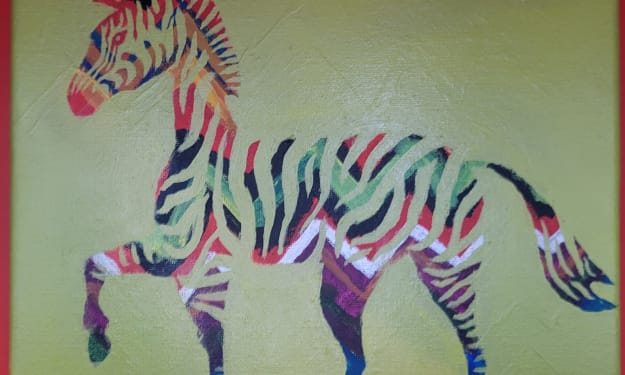
welcome to the vivid unconscious, a collection exploring the intensity of the world through non-naturalistic color and abstract patterns. this portfolio is split into two distinct yet stylistically connected series: psychedelic wildlife and surreal portraiture. whether depicting the familiar silhouette of a zebra exploding with vibrant geometry, or diving in the symbolic weight of psychological burdens with the piece titled "death," my work uses vivid contrast and expressionism to illuminate the energy and unseen tensions within life. i invite you to explore this world where the familiar is constantly shifting, intensely colored, and profoundly honest.
By ⸘jason alan‽11 months ago in Art
“All Around (Demo Version)”by Carmen Sinata — A Late-Night Confession
On November 22, 2025, Carmen Sinata released a demo that feels like a vulnerable whisper in the dark: “all around (Demo Version).” On the surface it's simple: layered “ooh ooh ooh” vocal hooks, a minimal but atmospheric instrumental, and the steady pulse of R&B longing. Yet beneath that simplicity lies something deeper: the yearning to be seen, to be claimed fully, and not simply another stop in someone’s path.
By Navigating the World11 months ago in Art
The Power Within: How a Great Workplace Culture Builds Great Homes
Every home begins with more than materials and blueprints—it starts with people. The hands that shape walls, the minds that design spaces, and the hearts that guide the process all operate within a shared culture. In homebuilding, workplace culture isn’t just an internal philosophy—it’s the invisible framework that determines the quality, durability, and beauty of every home created.
By Fischer Homes11 months ago in Art
The Painter of Hidden Sunrises
A reclusive painter woke before dawn to paint sunrises no one else witnessed. She hid the canvases under her bed, saying daylight did not need repeating. One morning, she found a stranger staring at one of her paintings. He had discovered it by accident and was weeping. “I didn’t know mornings could feel like forgiveness,” he said. From then on, she painted openly, sharing her work with anyone brave enough to knock on her door. Her sunrises became known not for their colors, but for the moments they helped people remember they deserved to start again.
By GoldenSpeech11 months ago in Art