Process
Why Premium Boxes in Dubai Are Essential for Your Brand’s Success
It actually works for business houses operating from Dubai because the high-speed and competitive market needs a presentation for the perceptions of your brand. Premium boxes in Dubai turn out to be a game-changer when it comes to launching a new product, redesigning packaging, or improving their previous style.
By SPOG PRINT LLC2 years ago in Art
"Samsung Galaxy Book4 Pro 16-inch: The Ultimate Laptop for Boosting Productivity and Style". AI-Generated.
Samsung Galaxy Book4 Pro 16-inch: The Ultimate Laptop for Boosting Productivity and Style In today’s fast-paced business world, having the right technology can transform your work experience. The Samsung Galaxy Book4 Pro 16-inch Business Laptop is an all-in-one powerhouse, designed for professionals who value performance, mobility, and innovation. This laptop seamlessly combines top-tier hardware and productivity-optimized software to deliver an exceptional user experience. Here, we explore the standout features that make this laptop a must-have for modern professionals.
By Muhammad Rashid2 years ago in Art
The Future of Pools: Durable Concrete Designs
In the world of luxury and relaxation, pools have long been a symbol of leisure, beauty, and a lifestyle that many dream of. From the sleek, minimalist pools of modern architecture to the lush, resort-style backyard oases, the evolution of pool design has been an ongoing journey of creativity and innovation. And now, as we look toward the future, one material stands out as the foundation for these advancements: durable concrete.
By poolsnowfl2 years ago in Art
Cloe Sparrow
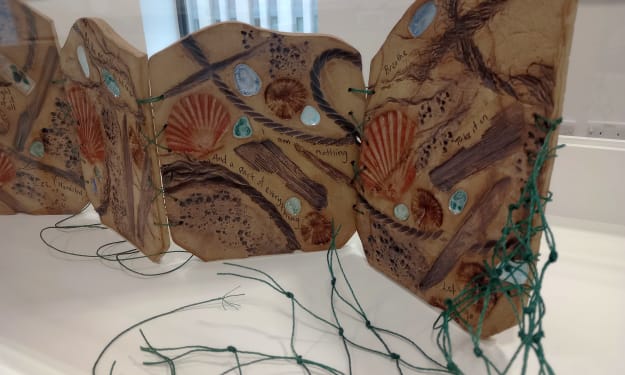
Ceramic tablets, embossed with sea creatures. Strung together by assorted pieces of flotsam and jetsam from our beaches. Snatches of verse, reflections on the strange hinterland of sand and foam. Cloe Sparrow’s first solo exhibition ‘Pages of my Mind’ delivers memorable images from our shorelines.
By Andy Potts2 years ago in Art
Creating Art for Marketing
When you're thinking about the art for your book, it can be difficult to remember that you're going to need specific art for marketing purposes. That is, you're going to need art created specifically for marketing, such as for posters or logos; this art needs to be created for not just purposes other than the context of the comic and must also be done to different requirements, such as different resolutions, sizes, and even color schemes. This must all be allowed before the marketing for the comic can even begin.
By Jamais Jochim2 years ago in Art
The Last Song of a Forgotten Singer
The old town of Evergreen had always been a place where time seemed to stand still. Nestled at the edge of a forgotten road, it was the kind of place most people passed by without a second glance, its quaint buildings and overgrown streets carrying an air of mystery and melancholy. But for those who paid attention, it had a secret—an old, abandoned theater that no one spoke of anymore. Once, the theater was the heartbeat of the town. For decades, it had hosted performances, from dramatic plays to musical concerts. The brightest star of all had been Celeste Hartley, a singer with a voice that could melt the hardest of hearts. Her performances were legendary. She sang with such passion and grace that audiences would leave the theater feeling as though they had experienced something transcendent. But everything changed the night of her last performance. The rumors were as thick as the fog that rolled into the town that evening. Some said Celeste had disappeared in the middle of the show, her voice trailing off into the darkness. Others swore they saw her on the balcony, looking out over the crowd, but by the time the lights came back on, she was gone. No one ever saw her again. The theater closed soon after, and the town slowly forgot the singer who had once captured their hearts. Years passed, and the theater fell into disrepair. Vines crept up the side of the building, and dust settled over the grand piano that had once played the scores of Celeste’s melodies. It was as if the place itself had mourned her loss, its silence echoing the absence of her music. But for Jamie, a young musician from the city, Evergreen was just another stop on a road trip—a forgotten town with nothing more than the occasional curiosity. That was, until they stumbled upon the theater. Jamie had always been drawn to the stories of forgotten places. They had heard of the haunted theater during their travels, but it was just a story, one of many. Still, curiosity led them through the rusted gates, past the crumbling stone steps, and into the theater itself. The moment Jamie stepped inside, the air felt different. The dust in the air seemed to shimmer, the silence was almost oppressive, and yet, there was something hauntingly familiar about the place. At the center of the stage stood the piano. It was old, its wood faded, but the keys, though covered in dust, seemed to beg for someone to play them. Drawn to it, Jamie hesitated for a moment, unsure if they should disturb the long silence. But then they sat down, their fingers brushing against the keys, hesitant but curious. The first notes they played were soft, hesitant, but as they played, the sound of a melody began to fill the space. Suddenly, Jamie stopped. They could have sworn they heard something else—another voice, faint but unmistakable. It was as though the piano was not playing alone. The voice was soft, ethereal, but unmistakable. It was a voice they knew, or at least, it felt like it was familiar. The melody they were playing wasn’t just any tune; it was the unfinished song of Celeste Hartley. The ghostly voice joined in, harmonizing with Jamie’s playing. The air grew colder, the atmosphere heavy with a story that had been waiting to be told. As the music continued, a vision slowly began to form. The singer appeared, not in the form of a typical ghost, but as a memory. Her figure shimmered in the dim light, her eyes filled with the weight of unspoken words, her lips singing a song that had never been completed. Through the music, Jamie learned Celeste’s story. It was a tale of love and loss, ambition and betrayal, of a woman who had given everything for her art, only to have it torn away by a cruel twist of fate. In her final performance, she had sung not just for her audience, but for herself—for a final release. But something had gone wrong, and in the end, she had disappeared, leaving her song unfinished. The piano, it seemed, had never forgotten her. It had held onto the last melody she had sung, waiting for someone to come along and finish the song for her. And now, Jamie was that someone. As the final notes echoed through the theater, the ghostly figure of Celeste smiled, a tear glistening in her eye. She was free. Her song was complete, her story no longer left in the shadows. The town would never forget her again. Jamie left the theater that night, the last echo of the song still ringing in their mind. And from that day forward, whenever they played, they carried with them the haunting melody of Celeste Hartley—the forgotten singer whose voice had never truly faded away.
By Jay Kavaya2 years ago in Art
Transform Your Space: Top Interior Design Tips for 2025
Interior design trends evolve with time, reflecting societal shifts, technological advancements, and changing aesthetics. As we step into 2025, the focus on functionality, sustainability, and personalization in interior design is stronger than ever. Whether you’re planning a renovation, building your dream home, or simply refreshing a room, these design tips from Design with Trinity will help you create a space that resonates with modern trends while remaining timeless.
By Joseph Brown2 years ago in Art
La Scapigliata: Leonardo da Vinci's Masterful Unfinished Portrait
Leonardo da Vinci, one of the most celebrated artists in history, left behind a legacy of remarkable works that forever changed the trajectory of art. While many of his masterpieces are finished and complete, some of his most captivating works remain unfinished, each carrying its own air of mystery. One such piece is La Scapigliata, an unfinished portrait of a woman, created around 1500. Known as "Head of a Woman" in English, this exquisite artwork is a testament to da Vinci's genius in capturing the subtleties of human emotion and form, despite being a work left incomplete. It offers an intriguing glimpse into the mind of the Renaissance master and stands as a remarkable example of his artistic prowess. --- The Mystery of La Scapigliata The title La Scapigliata translates to "the disheveled one" in Italian, referencing the loose, flowing curls of the woman's hair in the painting. This loose, natural hairstyle contrasts with the rigidly structured hairstyles often seen in portraits from that time, highlighting the woman's casual, unguarded beauty. The woman in the painting gazes downward with downcast eyes, exuding an air of tranquility and introspection. This serene expression, paired with the soft, flowing lines of her hair, creates an enigmatic, almost ethereal presence. Despite being incomplete, La Scapigliata remains a compelling and mysterious work. The figure, though incomplete in terms of its details and finish, seems to possess a natural beauty and grace that is striking, almost as if it is an unfinished study. This unfinished quality allows viewers to see not only the talent of the artist but also the work in progress, giving insight into Leonardo’s method of constructing a portrait. --- A Master of Sfumato Leonardo da Vinci is widely known for his groundbreaking use of the painting technique known as sfumato. This method involves blending the edges of forms and transitions in light and shadow to create soft, almost imperceptible outlines. In La Scapigliata, this technique is used with remarkable finesse, creating an almost lifelike effect in the rendering of the woman's face. Her skin glows softly, as though lit by a warm, natural light, and the subtle transitions between light and shadow on her face evoke a sense of volume and depth. In the unfinished state of the painting, the sfumato is particularly striking. The gradual and seamless transitions between the darker and lighter areas of her face allow her features to emerge softly, as if they are being illuminated from within. The viewer’s gaze is drawn to her face, which appears to float in space, offering an ethereal quality. The delicate shadows and smooth transitions lend a luminosity to the woman’s complexion, highlighting Leonardo’s extraordinary ability to capture the human form in a way that was unprecedented in his time. --- The Woman in the Portrait: Who Was She? Like many of Leonardo’s portraits, the identity of the woman in La Scapigliata remains unknown. Some art historians speculate that she could have been a member of Leonardo’s circle or possibly a model for a larger, unfinished composition. Given the gentle, serene expression on her face, she may have been intended as a depiction of an idealized woman, perhaps a divine or symbolic figure. In the absence of a definitive identity, La Scapigliata invites viewers to project their own interpretations of the subject. Her downcast gaze and tranquil demeanor suggest a woman lost in thought, contemplating something beyond the physical world. This sense of introspection and mystery adds to the allure of the painting, as it leaves much to the imagination of the observer. --- Unfinished Works and Their Significance Leonardo da Vinci was notorious for leaving many of his works incomplete. This trait is often attributed to his insatiable curiosity and desire for perfection, which sometimes led him to abandon projects when they no longer satisfied his high standards. La Scapigliata is one of several pieces that da Vinci did not fully complete, yet it remains one of his most admired works. The unfinished nature of La Scapigliata allows viewers to glimpse Leonardo's process as an artist. It is as much a study of technique and form as it is a portrait. The faint outlines, the lack of detail in some areas, and the gradual blending of light and shadow demonstrate how Leonardo worked to refine his compositions. It also highlights his focus on the emotional expression of his subjects, as the facial features in this work are rendered with great care, even in their unfinished state. --- The Legacy of La Scapigliata Today, La Scapigliata resides in the National Gallery of Parma in Italy, where it continues to captivate audiences with its quiet grace and enigmatic allure. The portrait is a reminder of Leonardo’s extraordinary ability to capture the soul of his subjects, even in the most incomplete form. It stands as a testament to his mastery of the human form and his pursuit of artistic innovation. Though La Scapigliata remains unfinished, it is complete in its ability to evoke emotion and intrigue. The serene expression of the woman, the delicate rendering of her features, and the soft interplay of light and shadow all demonstrate the brilliance of Leonardo’s technique and vision. Even in its unfinished state, the painting has an enduring power, drawing viewers in with its mystery and beauty. --- Conclusion La Scapigliata remains one of Leonardo da Vinci’s most captivating works, despite—or perhaps because of—its unfinished nature. Through this incomplete portrait, Leonardo captured not only the physical likeness of a woman but also a sense of her inner world, filled with mystery, grace, and introspection. The use of sfumato, the soft transitions of light and shadow, and the fluidity of her hair all reflect Leonardo’s genius in portraiture, while the mystery surrounding the subject’s identity only adds to the painting’s allure. As it resides in the National Gallery of Parma, La Scapigliata continues to inspire admiration and curiosity, offering a glimpse into the mind of one of history’s greatest artists. Through this masterpiece, we see that even unfinished works can carry immense power, leaving an indelible mark on the world of art and continuing to captivate the imaginations of generations to come.
By Deji Akomolafe2 years ago in Art
Using Panels and Other Layout Options to Effect
Strangely, most artists tend to ignore what panels can do for them, seeing them as just something to deal with rather than a useful tool. That is, they tend to worry more about what goes on the panels than the panels themselves. This is a tragically wasted opportunity as how the panels are defined can add to the storytelling of the comic. While it does require some planning to pull off, that planning can add some really nice visual elements to the comic that are well worth the extra effort.
By Jamais Jochim2 years ago in Art
Human Art In The Context Of AI, Empty Intelligence, and Empty Art
The Uniqueness of Human Theorizing: The Proposing, Preserving, and Protecting of Human Theories Now That Something Else-Artificial Intelligence-Can Now Make Theories Too.
By Adam Daley Wilson - Conceptual Artist + Appellate Lawyer2 years ago in Art