Painting
Whispers in Blue: The Story Behind Degas’ Dancers
Title: Whispers in Blue: The Story Behind Degas' Dancers The rehearsal room was hushed, though not silent. The wooden floor creaked like the hull of an old ship. Dust drifted lazily through the late afternoon light, golden and tired as it spilled through the high windows. In a quiet corner of the room, Edgar Degas sat still, eyes half-lidded, sketchbook on his lap, his gaze fixed on the blue. Four girls stood like petals of the same flower—slightly apart, yet turning toward a shared center. They moved in rhythm not to music but to memory, to instinct, to an echo of a piano long since gone quiet. The girl nearest to Degas was Clara—barely seventeen, her limbs wiry from years of training. Her hands fluttered as she adjusted the bow at her waist. She was always adjusting, always correcting, never quite sure she belonged. Her mother had once danced here, long ago, before love and illness claimed her bones. Clara bore that legacy like a bruise beneath the skin. Next to her, Elise brushed invisible dust from her tutu. Her fingers, pale and slender, betrayed a nervous energy. Elise had come from the provinces with a letter of recommendation and a dream stitched into her bodice. She danced with the desperation of someone who knew this stage might be her only one. Behind them, Camille stretched her arms above her head, her eyes closed in the grace of a swan. She was the quiet one, the one who never laughed too loud or cried too long. She danced as if gravity did not apply to her, as though her body remembered flight. And then there was Margot. Margot was the sun around which the others turned—unknowingly, perhaps unwillingly, but inevitably. Her movements were effortless, her form a study in balance and breath. She was not the most technical dancer, nor the most disciplined, but she possessed that rare thing: presence. When Margot danced, time bowed before her. Degas had sketched these girls before. Many times. He knew their backs better than their faces, their poses better than their postures at rest. He was drawn to the moments before the performance—the lull between sweat and spectacle, the grace that came not from choreography, but from the simple act of being. Today, he painted them in blue. Not the vivid blue of summer skies, nor the somber blue of a storm. No, this was the blue of velvet shadows and soft silence—the color of reflection and breath held in anticipation. The rehearsal had ended an hour ago, but they lingered, as dancers often did, caught in the gravity of their shared devotion. They talked softly—about slippers worn thin, instructors too harsh, the ache in their hips and the dreams in their chests. Their voices wove around each other like ribbon. Clara watched Margot out of the corner of her eye. She envied her, but it was a gentle envy—like watching a bird take flight and knowing your wings were still growing. “Do you ever get scared?” she asked. Margot smiled faintly, as if remembering something far away. “Always,” she said. “But I dance through it.” Degas made no sound, but his pencil moved quickly, hungrily. He wanted to capture that—not the fear, but the dancing through it. Camille, noticing him, lowered her arms and turned ever so slightly away. “Monsieur Edgar,” she said quietly, “you always catch us at our most tired.” He smiled, without lifting his head. “That’s when you’re most real.” They laughed, a little. It was a sound like bells dropped into water—delicate, muffled, fleeting. He had painted them many times—sometimes in oils, sometimes in pastels. Sometimes only in memory, days later. He did not ask them to pose. He let them exist and tried to keep up. Blue was the only color that felt right for today. It softened the edges. It held their forms together, like a binding spell. The dresses floated, the bows curled, the necks bent like lilies under moonlight. There was no spotlight here, no stage. Only the hush of dreams rehearsed in half-light. The girls gathered their things eventually. Time crept forward, as it always must. They stepped out into the Paris dusk, their shadows long and overlapping. They would return tomorrow, and the day after, until their bodies no longer obeyed or the world found some other use for them. Degas remained, his brush sweeping the last curve of a shoulder, the final whisper of tulle. He didn’t paint ballerinas for the stage, for the sparkle and adoration. He painted them because they were metaphors—for fragility and fight, for beauty forged in silence, for the small acts of grace that happen away from the curtain. Blue Dancers wasn’t a portrait. It was a memory. A quiet ballet in a world that moved too quickly. And maybe, just maybe, it was a prayer—that these girls, with their aching feet and quiet fears, might one day know how radiant they looked, even when they weren’t looking.
By Soul Draftsabout a year ago in Art
More Than a Painting: The Story of Madonna Litta
Title: The Silent Bond – A Story Inspired by Leonardo da Vinci’s “Madonna Litta” In the stillness of a Renaissance room, where the light barely dances across the stone floor and the heavy curtain parts to reveal the sky, a young woman cradles her child. Her gaze is soft, her expression serene, yet beneath the tranquility, there is an unspoken intensity — a bond beyond words, brushstrokes, or time. This is the world captured in Leonardo da Vinci’s “Madonna Litta,” a painting as enigmatic as it is tender. Painted around 1490–1491, likely during Leonardo’s years in Milan, “Madonna Litta” depicts the Virgin Mary breastfeeding the infant Christ, a common theme in Christian iconography. But in Leonardo’s hands, it transcends the symbolic and enters the realm of deeply personal human experience. And yet, despite the layers of emotion infused into the painting, the story behind it remains cloaked in mystery — and, perhaps, myth. Let us imagine, then, a story. The Milanese Court, 1491 The winter was mild that year, though the stone corridors of the Sforza court still held onto their chill. Duke Ludovico Sforza, known as Il Moro, was building his legacy not just through politics and war but through art. His court had become a sanctuary for thinkers, architects, musicians, and painters. Among them stood Leonardo da Vinci — a man whose hands never ceased sketching, whose mind was never still. It was during this time that Leonardo, ever curious about anatomy and emotion, began a study not of nobility or myth, but of motherhood. He had seen mothers in the market, watched their instinctual gentleness, the way their bodies curved toward their children. He wondered: could art ever truly capture that moment of sacred intimacy? In a modest home outside Milan, a young woman named Lucia lived quietly with her newborn son. She had once been a lady-in-waiting, known for her calm spirit and luminous beauty. Her life had taken a quieter turn, far from the whispers and expectations of court. When Leonardo met her — through a midwife he sketched for anatomical studies — he saw in her not just a model, but a presence. Lucia agreed to sit for him, not out of vanity, but because she sensed in Leonardo a reverence that had nothing to do with flattery. Days turned into weeks. In a softly lit studio, with windows high and dust motes catching the morning light, Leonardo painted. Lucia would come with her child, and together they would sit in silence. The baby, restless at first, would grow still in her arms, lulled by her heartbeat, her warmth, the gentle rise and fall of breath. Leonardo observed everything — the slope of her neck, the arch of her hand as it supported the child’s head, the half-smile that lingered on her lips even in her weariness. But most of all, he watched the gaze. That unbreakable thread of love between mother and child. It was not something he could fully explain in words. It was something he would have to show in paint. The Painting In “Madonna Litta,” Mary is dressed in rich crimson and deep blue, colors of sacrifice and divinity. Her veil, drawn delicately over her hair, speaks of modesty and grace. But it is her face — youthful, focused, inward — that holds the viewer. Her eyes are not looking at the child, but through him, as if contemplating a future that only she can sense. The Christ child, chubby and alert, feeds eagerly, grasping at her robe. He is no ethereal figure here, no golden-haloed abstraction, but a real child, hungry, alive, human. Behind them, arched windows open to a clear, mountainous landscape — perhaps a reminder of the divine beyond the domestic. Or perhaps, like much of Leonardo’s work, it symbolizes the coexistence of nature and humanity, the eternal and the immediate. While the painting is sometimes debated in attribution — with some suggesting it may have been completed or touched up by Leonardo’s student Giovanni Antonio Boltraffio — the design and essence bear Leonardo’s unmistakable touch. The intimacy, the anatomical precision, the spiritual undertones without overt religious symbolism — all hallmarks of the master. Legacy and Interpretation For centuries, “Madonna Litta” has stirred the hearts of those who view it. Though now housed in the Hermitage Museum in St. Petersburg, the painting continues to speak in a universal language. It doesn’t need Latin inscriptions or dramatic gestures. The emotion is quiet, yet profound. Some art historians suggest the painting is less about theological doctrine and more about the sanctity of motherhood itself. In an age where Madonna images often emphasized divinity at the cost of humanity, Leonardo turned the tide. His Virgin is not remote or regal — she is real, tender, infinitely strong in her softness. This subtle revolution in religious art — the shift toward emotional realism — would ripple through Renaissance painting, influencing generations. And it began here, with a mother, a child, and a man obsessed with capturing truth through beauty. The Story That Lives On Whether Lucia truly existed as described, or whether she was a figment of Leonardo’s imagination, we may never know. But in the “Madonna Litta,” she — and every mother like her — lives eternally. This is not just a portrait. It is a moment carved out of time, a meditation on love, sacrifice, and the divine made flesh. It reminds us that even the greatest of stories — the rise of kings, the miracles of prophets — begin in the arms of a mother, in the quiet miracle of life being nourished. Leonardo, always seeking to understand the cosmos, found his universe in a single gaze between mother and child. And that gaze still meets ours, more than 500 years later.
By Soul Draftsabout a year ago in Art
How AI is Revolutionizing Creative Arts
Introduction Art has always been a deeply human endeavor — an expression of emotion, culture, and experience. But in recent years, artificial intelligence (AI) has stepped into the studio, concert hall, and gallery, challenging traditional notions of creativity. The intersection of AI and creative arts is no longer a futuristic concept; it's a dynamic reality reshaping how we create, consume, and understand art. From AI-generated symphonies to algorithmic paintings selling for thousands, the revolution is here — and it’s only just beginning.
By Mehtab Ahmadabout a year ago in Art
The Silence Behind the Pearl
The Silence Behind the Pearl They called her Griet, though no one really knew if that was her name. In the narrow alleyways of Delft, where cobblestones held the whispers of merchants and painters alike, her face became legend long before anyone knew her story. And yet, it was never her voice they remembered. Only the way she looked back over her shoulder—caught between movement and stillness—her lips slightly parted, her eyes questioning, a single tear-shaped pearl catching the dim, filtered light. Before she was immortalized in paint, she was only the maid. She arrived at the Vermeer household during a summer thick with heat and tension. The house at Oude Langendijk, filled with children, canvases, and shadows, was no easy place for a girl of sixteen. Her hands were calloused from peeling potatoes and scrubbing copper pans, but it was her eyes that gave her away. Quiet, knowing eyes—too perceptive for a maid. Johannes Vermeer noticed her in that way painters notice things others don't. She would tilt her head to observe how sunlight streamed through a stained-glass window, watching the way it lit the pewter jug on the kitchen table. He saw her pause at the threshold of his studio when she thought no one was watching, marveling at the rich indigo pigments, the glint of light caught in a brass chandelier. He never said much, and neither did she. But gradually, an unspoken understanding bloomed between them, a fragile thread woven with glances and silences. His wife, Catharina, busy with their eleven children, rarely paid Griet any mind—until she started cleaning his studio. It began innocently. Griet was precise and respectful. She never moved the instruments of art—the brush jars, the pigments, the angled easel. She dusted only where she must, never disturbing the compositions he left behind. Vermeer noticed her restraint and admired it. One day, he asked her to grind lapis lazuli for ultramarine. She had never touched pigment before. Her fingers trembled. "It's not poison," he said quietly, though his gaze was sharp. She began to assist him, cautiously at first, then with increasing confidence. She learned the language of light—how it curved around a cheekbone, how it darkened beneath a brow. She didn’t speak of it, but he saw it in the way she looked at the world. In another life, perhaps, she could have painted. Then came the request. He asked her to sit. Not as a model, not at first. Only to test the lighting, he said. Only to hold a pose. But Griet knew better. She had seen the way he looked at her—not with desire, but with a kind of hunger. The need to capture something fleeting. She said yes, because how could she say no? He gave her a yellow turban, a silk thing from the East, vibrant and strange. He adjusted it with careful hands, his fingers brushing her forehead. Then he brought out the pearl—just one, heavy, luminous. He fastened it to her ear, and in that moment, she felt herself slipping into another world, one where she was not a maid, but something softer, grander, untouchable. He painted her in silence. The studio held its breath. She sat unmoving, though her mind raced. She thought of her family, her place, her small room in the attic that smelled of starch and candle wax. She thought of Catharina, who began to notice the missing pearl. And she thought of Vermeer—how he never touched her, yet held a piece of her she didn’t know she had given. When the painting was done, he said nothing. He merely turned the canvas so she could see. She gasped. There she was—suspended in oil and time. Her gaze eternal, her lips parted with the promise of speech. It was not vanity she felt, but something stranger—loss, maybe. Or the birth of a self she’d never known. But the pearl could not stay with her. Catharina found it, of course. She stormed into the studio one afternoon with fury on her lips and betrayal in her eyes. The painting was hidden, but secrets never sleep long. Griet was sent away that very night. No farewell. No payment. Only the cold slap of the door behind her. Years passed. Vermeer died poor and uncelebrated. His canvases scattered, forgotten for generations. And the girl? No one remembered her name. Griet, perhaps. Or something else. She never married. She worked as a laundress, then as a seamstress. She wore no pearls. But the painting endured. It was found decades later, dusty and silent in a Dutch estate. Scholars puzzled over the identity of the girl. Some called her a daughter, others a lover. None knew the truth—that she had been neither muse nor mistress, but something rarer still: a moment. A breath caught in time. And so she remains, watching us through centuries. Not a maid. Not a mystery. Just a girl with a pearl earring, and the weight of silence in her gaze.
By Soul Draftsabout a year ago in Art
The Golden Embrace: A Love Immortalized in Klimt’s ‘The Kiss’
**The Golden Embrace: The Story Behind Klimt’s *The Kiss* In the heart of Vienna, amidst the opulence of the early 20th century, Gustav Klimt stood at the pinnacle of his artistic career. The year was 1907, and the whispers of modernism were reshaping the world of art. Klimt, already a controversial and celebrated figure, was about to create a masterpiece that would transcend time—*The Kiss*. **A Love Woven in Gold** Klimt’s studio was a sanctuary of creativity, filled with sketches, fabrics, and the shimmer of gold leaf. He had long been fascinated by Byzantine mosaics, their intricate patterns and luminous surfaces inspiring his *Golden Phase*. But *The Kiss* was different—it was not just an artistic experiment; it was a whisper of passion, an ode to love itself. The painting depicted a man and a woman locked in an intimate embrace, their bodies entwined amidst a sea of gold. The man’s cloak, adorned with bold black rectangles, contrasted with the woman’s flowing dress, decorated with delicate floral patterns. Their faces were serene, lost in the ecstasy of the moment, as if the world around them had dissolved into nothingness. **The Muse Behind the Masterpiece** Though Klimt never confirmed the identities of the lovers, many believed the woman was Emilie Flöge, his lifelong companion and muse. Emilie was a fashion designer, a woman of grace and independence, and their relationship was one of deep affection, though shrouded in mystery. Some speculated their bond was platonic, others romantic—but in *The Kiss*, Klimt immortalized a love that defied definition. Others whispered that the painting was inspired by Klimt’s own fleeting affairs, a reflection of his belief that love was both sacred and transient. The man, kneeling in devotion, could be Klimt himself, surrendering to the intoxicating power of desire. **A Controversial Masterpiece** When *The Kiss* was first exhibited in 1908, it was met with both awe and scandal. Critics were divided—some hailed it as a revolutionary work, while others condemned its sensuality. The Austrian government, hesitant at first, eventually acquired the painting, recognizing its brilliance despite the controversy. Klimt’s use of gold was not merely decorative; it was symbolic. Gold, the color of divinity and decadence, elevated the lovers into a realm beyond the mortal. Their embrace was not just physical—it was spiritual, a merging of souls. The patterns on their robes hinted at the duality of love: the masculine geometric shapes clashing yet harmonizing with the feminine swirls of flowers and circles. **The Legacy of *The Kiss*** Over a century later, *The Kiss* remains one of the most celebrated paintings in history. It has been reproduced, parodied, and revered, a testament to its universal appeal. But beyond its beauty lies a deeper truth—that love, in all its forms, is the most profound force in existence. Klimt once said, *"All art is erotic."* In *The Kiss*, he captured the very essence of that belief. The painting is not just a depiction of two people; it is a moment frozen in time, a golden dream of passion and tenderness. **A Whisper Across Time** As you stand before *The Kiss* today, in the halls of the Österreichische Galerie Belvedere, you can almost hear the rustle of golden robes, the soft sigh of the lovers. Klimt’s masterpiece is more than paint and gold—it is a love letter to the world, a reminder that even in the darkest times, beauty and passion endure. And perhaps, if you look closely, you’ll see your own reflection in the gilded patterns—because love, after all, is a story that belongs to everyone.
By Soul Draftsabout a year ago in Art
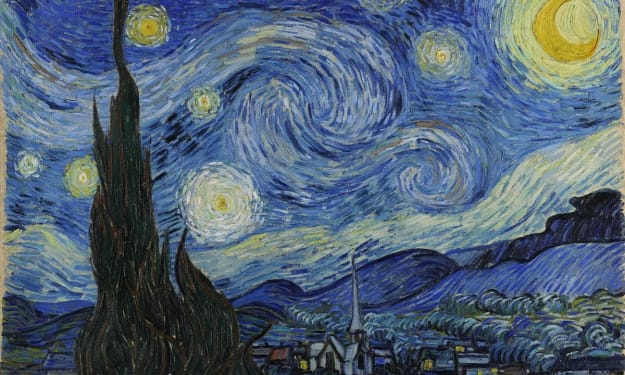
"The Starry Night: A Masterpiece Born from Madness"
The Starry Night: A Symphony of Silence and Madness In the hush of a Saint-Rémy night, the stars whispered. It was 1889, and Vincent van Gogh sat behind the iron bars of the asylum window, his breath fogging the glass as the wind stirred the cypress trees beyond. The room behind him was still—too still. Silence had always been his shadow, but now it had teeth. Every ticking second scraped at his thoughts. Yet, above him, the sky lived. The world outside did not sleep as he did; it pulsed, it wept, it sang. Vincent could see it more clearly than anyone ever had—not with his eyes, but with the fevered clarity of a soul that had been both broken and reborn. He didn’t paint The Starry Night from a real view, not entirely. No, what he painted was truer than real. It was the sky as he felt it. It was turbulence, longing, hope, and fury tangled together in color. By day, the village below was quiet, ordinary. But by night, in Vincent’s mind, it bloomed—golden windows glowing like small embers of humanity, a sleepy chapel reaching like a prayer, the cypress tree a flame that refused to go out. The stars? They were not dots. They were whirlpools of light, great celestial dancers caught in a storm of meaning. They spun with sorrow, joy, and everything in between. They knew Vincent, and he knew them. Each brushstroke was a breath, a confession, a scream. The sky swirled in his mind and poured out in ultramarine and cobalt, slashed with streaks of lemony yellow and milky white. He didn’t paint what he saw. He painted what he felt—what he needed to believe: that something divine was out there, beyond the chaos, cradling the world in light. And yet, even with the cosmos alive above, the night had weight. Vincent was not just an artist. He was a man fractured by loneliness, haunted by thoughts he couldn't escape. This masterpiece, now immortal, was born in the confines of a room meant to contain madness. But what the world later hailed as genius, the world at the time barely noticed. He sold only one painting in his lifetime. One. Vincent painted because he had to. Because to not paint would be to drown. As he stood back from The Starry Night, the oils still wet, something in him stirred. He had captured not a scene, but an emotion—the exact moment when despair kisses awe. The moment when the soul, even shattered, dares to look up. He once wrote to his brother Theo, "Why, I ask myself, shouldn’t the shining dots of the sky be as accessible as the black dots on the map of France?... Just as we take the train to get to Tarascon or Rouen, we take death to reach a star." Vincent didn’t fear the stars. To him, they were destinations. And though he would not live to see his painting grace museums or inspire generations, The Starry Night became a language the world could understand. Long after he left this world, the sky he painted continued to speak—of pain, of passion, of the indescribable ache to feel connected in a universe that often feels indifferent. Today, millions stand before the canvas in hushed wonder, not realizing they are walking into the echo of a man’s final hope. Each swirl, each spark, is a reminder that beauty can emerge from the depths of torment. That even in confinement, the soul can take flight. The Starry Night is not just a painting. It’s a promise. That no matter how dark the world becomes, the stars will still burn. That someone, somewhere, will always see what others cannot. That art—raw, imperfect, heart-wrenchingly human—can outlive the silence. So the next time you look up, remember Vincent. Remember that behind every star, there may be a story not yet told. And within each of us, there may live a night sky just waiting to be seen.
By Soul Draftsabout a year ago in Art
I Paint to Remember Her
I Paint to Remember Her I don’t remember the exact moment she left. Grief doesn’t work in timestamps. One day, she was everywhere—in the kitchen, in the garden, in my paint-streaked shirt sleeves. The next, she was nowhere. It was as if the world blinked, and the colors faded from my life. The silence she left behind wasn’t empty; it was a weight that pressed down on every corner of the apartment. Her name was Lila, and she used to sit beside me as I painted. Not saying much. Just sipping tea, legs tucked beneath her on the old couch we’d found at that flea market a few summers ago. The one with the threadbare cushions and the faint smell of cedar. I used to think she was quiet—almost too quiet—but now I realize she was listening. Listening to the brush moving across the canvas, to the unspoken ache in my chest, to the way silence between us was sometimes louder than words. When she died, something inside me cracked. I stopped painting altogether. The easel gathered dust, like a forgotten relic. Tubes of acrylic paint hardened, colors shrinking and drying out, like arteries clogged with time. The studio—a little sunlit corner of our small apartment—became a place I couldn’t bear to enter. It felt like a crime scene, too sacred, too cruel to walk into without trembling. Every brush, every palette knife, every drop of paint reminded me of her absence. The last thing I painted was an unfinished portrait of Lila. It still leaned against the wall—the only artwork I couldn’t bring myself to finish. Her outline was there, faint and tentative. Her mouth just barely sketched. And her eyes… those were missing entirely. It was as if without her eyes, the painting refused to live, just like the room around it. For months, I avoided that portrait like it was a wound I wasn’t ready to touch. Then one night, I had a dream. She was standing by the easel. The light behind her was soft, like the early morning sun filtering through linen curtains. She didn’t say a word. She just looked at the portrait, then turned her gaze to me, tilting her head slightly—like she was asking, “Why did you stop?” I woke up in tears, my hand clenched as if holding a brush. The ache in my chest was real, but so was the sudden clarity. That morning, I opened the windows wide. Let the fresh air in, along with the sunlight I’d been shutting out. I sat on the paint-splattered stool I hadn’t touched in nearly a year. My fingers trembled as I uncapped a tube of paint and began mixing the color of her skin—from memory, from every quiet moment I had with her. I didn’t start with her eyes. That felt too intimate, too raw—too much like reopening a wound. Instead, I began with her hair—long, dark, slightly frizzy at the ends, falling softly over her shoulders. Then I sketched the gentle slope of her nose, the faint freckles across her cheekbones, the curve of her lips just beginning to smile. Each stroke felt like exhaling after holding my breath underwater for far too long. Every line I painted brought her back. Not as a ghost haunting my memories, not as pain or loss—but as presence. As breath in the room, as warmth on my shoulder, as the quiet rhythm of her being. I painted not to finish a portrait, but to remember her—to capture the way she always sat with her hands curled around a mug of tea, the way she hummed softly while reading, the peaceful way she existed in the world. I thought painting would remind me of losing her. Instead, it reminded me that she had lived. That night, I fell asleep on the studio floor, curled up like a child beside the drying canvas. From that day forward, I painted her often. Not always as she truly looked. Sometimes she became a storm—her hair swirling with clouds and lightning. Other times, she was a silhouette standing in a field of marigolds, faceless but unmistakably her. She bloomed in colors I never used before—deep emeralds, burnt oranges, and golden hues that didn’t exist in any paint tube, colors born from memory and longing. People started to notice. Friends who came over paused in front of the new paintings, their eyes lingering longer than usual. One asked, “Who is she?” I smiled softly. “Someone worth remembering.” Eventually, a small gallery downtown invited me to display my work. They gave me a wall for a solo exhibit. I titled it “Echoes of Her.” I never told the visitors who she really was, but they felt it. Some cried quietly in front of the paintings. One woman whispered to her partner, “It feels like love and loss all at once.” That’s exactly what it was. Today, the easel sits by the window again, just like before. Every time I pick up a brush, it isn’t to create something new but to preserve something I refuse to forget. I paint to remember her. And in every painting, she remembers me too. ---
By Muhammad Waqas about a year ago in Art
Unveiling Creativity
It was a rainy Saturday when I first discovered that art doesn't begin with skill—it begins with surrender. I had no training. No paints beyond a child’s leftover set. No brushes except an old toothbrush I used to clean shoe soles. Yet something inside me whispered: try. Try, not because it will look perfect—but because creating something with your hands can quiet the chaos inside your head.
By Muhammad Asimabout a year ago in Art
Eye Catching Vivid Paintings That Dazzle the Senses
If you've ever walked into a room and felt your mood instantly lift, color likely played a big role. Art has the power to shape how we feel, and vivid paintings do this best. With bold tones and lively strokes, these pieces aren’t just decorations they’re experiences. They draw your eye, wake up your senses, and speak without saying a word.
By sedona art studiosabout a year ago in Art
Famous Orange Paintings
The color orange is a warm and energetic color used by artists for centuries evoking various emotions and moods through their paintings. This vibrant hue can create a sense of warmth, excitement, and joy, but it can also convey a feeling of caution, anxiety, and fear.
By Rasma Raistersabout a year ago in Art
How Art Therapy Helps in Lean Phases?
I have been doing art since childhood. I cannot say I am a great artist, but I am pretty decent, I guess. At one point, I wanted to be an artist, but I come from an unprivileged background, and people in this socioeconomic group generally don’t pursue art. They want job security!
By Seema Patelabout a year ago in Art