Painting
In a Single Tweet". AI-Generated.
On a quiet winter night, Layla sat in her room scrolling through her phone aimlessly. She opened Twitter, as she often did, looking for something—anything—to distract her mind. Her thumb paused suddenly on a tweet from an anonymous account:
By Omar Mohammed about a year ago in Art
Explore Unique Art at a Premier Art Gallery in Sedona AZ
Sedona, Arizona is famous for its stunning red rock landscapes, peaceful energy, and clear blue skies. But beyond its natural beauty, Sedona is also a rich center for creativity and expression. One of the best ways to experience this side of Sedona is by visiting a premier art gallery Sedona AZ.
By sedona art studiosabout a year ago in Art
Women Is an Art
In the small, sun-drenched village of Marora, nestled between olive groves and azure hills, there lived an artist named Elias. He was known not just for his vivid use of colors, but for the emotion he breathed into every canvas. Locals believed his paintings could whisper, cry, and even smile. Yet for all his skill, Elias had never captured one subject fully. One essence that always eluded his brush: a woman.
By Shoaib Rehmanabout a year ago in Art
What the Water Takes First
We have always drowned our women beautifully. From Shakespeare's Gertrude speech and Millais' brush, to Virginia Woolf’s stones. We have perfected the art of romanticizing female pain. This is not merely artistic tradition, it is cultural pathology.
By Yasmine Lagrasabout a year ago in Art
🔴 Title: Why Imran Khan Still Rules Millions of Hearts
Imran Khan, a name that resonates across generations in Pakistan, continues to rule millions of hearts despite the ups and downs of his political journey. From lifting the Cricket World Cup in 1992 to leading a political movement that shook the foundations of Pakistan’s power structure, Imran Khan has become more than a personality—he is a symbol of hope, resilience, and change. A Hero on the Cricket Field Imran Khan first won the nation's heart as the captain of the Pakistan cricket team. Under his leadership, Pakistan won its first and only Cricket World Cup in 1992. His calm demeanor, strategic thinking, and fearless attitude made him a legend in the cricketing world. His success on the field gave the people of Pakistan a sense of pride and unity during challenging times. Philanthropy and Social Work After retiring from cricket, Khan didn't step away from public service. Instead, he focused on a dream that many thought was impossible—building Pakistan’s first cancer hospital. Shaukat Khanum Memorial Cancer Hospital, named after his mother, became a reality through public donations and his tireless efforts. Later, he also established Namal University to offer quality education in rural Pakistan. These humanitarian contributions further deepened the love people had for him. A Voice Against Corruption In 1996, Imran Khan founded Pakistan Tehreek-e-Insaf (PTI), a political party based on justice, anti-corruption, and good governance. While it took years for his political movement to gain traction, his persistence paid off. By 2018, he became the 22nd Prime Minister of Pakistan. His stance against corruption and elite privilege resonated with ordinary Pakistanis, especially the youth. Many saw him as the only honest leader who could challenge the status quo. A Leader in Crisis During his tenure as Prime Minister, Khan faced immense economic and political challenges. Yet, his focus on building a welfare state, launching health cards, and promoting tourism and overseas investments earned him respect even from critics. His efforts to represent Pakistan strongly on international platforms, such as the United Nations, highlighted his leadership skills and patriotic zeal. Charismatic and Courageous Imran Khan’s charisma lies in his fearless attitude. Whether it’s speaking against Western double standards, addressing Islamophobia, or challenging powerful political dynasties in Pakistan, he never shies away from controversy. Even after his removal from office, his popularity didn’t fade—it increased. Massive rallies, record-breaking social media engagement, and global support reflect that his message still connects deeply with the public. A Symbol of Hope For many in Pakistan, especially the younger generation, Imran Khan is more than a politician—he is an inspiration. His journey from sports to politics, from fame to struggle, reflects the resilience of a man who never gave up. In a country where leadership often fails to deliver, Khan continues to offer hope for a better future. --- Conclusion: Imran Khan still rules millions of hearts because he represents the dreams and desires of a nation longing for justice, honesty, and dignity. Whether you agree with his politics or not, one cannot deny the emotional bond he shares with the people of Pakistan. His story is not just about power—it is about passion, purpose, and unwavering belief in a better tomorrow.
By Sophia Graceabout a year ago in Art
Rabi Pirzada: A Story of Art, Faith, and Starting Over. AI-Generated.
🎨 The Colorful Comeback of Rabi Pirzada: From Pop Star to Artful Heart We often hear about celebrities stepping away from the spotlight, but very few choose a path so different and meaningful that it touches lives beyond fame. Rabi Pirzada is one of those rare souls. Once known for her music and media appearances, Rabi has transformed into a visual artist, a philanthropist, and a voice for modesty, spirituality, and kindness.
By Muhammad Adilabout a year ago in Art
Brighten Your Walls with Colorful Artwork Prints
Are your walls feeling a little plain? A splash of color can change that in an instant. Colorful artwork prints are one of the easiest ways to breathe life into any space. Whether you're decorating a bedroom, living room, or hallway, adding vibrant prints can turn a blank wall into something special.
By sedona art studiosabout a year ago in Art
The Triple Gaze: Charles I in Three Positions
The Triple Gaze: The Story Behind “Charles I in Three Positions” In the hushed halls of Windsor Castle, a curious painting hangs with regal stillness—three versions of the same man, staring in slightly different directions. He is solemn. He is proud. He is haunted. His name? Charles I of England. The painting? “Charles I in Three Positions”, a masterpiece by the Flemish court painter Sir Anthony van Dyck. But this is no ordinary portrait. This is a painting born not from vanity, but diplomacy, divine image-making, and the anxious dance of power. A Royal Image Projected It is the 1630s. Charles I, King of England, Scotland, and Ireland, reigns during a time of great unrest. Though his court is filled with elegance and ritual, trouble stirs in Parliament and among his people. But for now, his mind is focused elsewhere—on Rome. Specifically, on one of its most famous sons: Gian Lorenzo Bernini, sculptor to popes, designer of fountains, and master of marble. Charles, ever conscious of image and legacy, desires a bust—one that will capture his kingly presence for all eternity. But how do you send your likeness to an artist an ocean away? The answer lies in paint. Enter Van Dyck, Charles's beloved court painter. A man of charm, style, and keen insight, Van Dyck was more than a mere artist. He was a craftsman of illusions, a conjurer of royal myth. His brush flattered but never lied outright. He painted kings not as they were, but as they should be. And so he created a portrait like none before: a single canvas, three views—left profile, frontal, and right three-quarter. The result was both pragmatic and poetic: a reference tool for Bernini, and a meditation on kingship, identity, and fate. A King in Fragments The triple portrait shows Charles adorned in variations of lace collars and luxurious robes, each subtly different. His hair, auburn and flowing, is styled with courtly precision. A faint sadness touches the corners of his eyes, a shadow that perhaps only Van Dyck could see—and that history would later confirm. The front-facing view commands attention. It is the most formal of the three, the closest to what we might call an “official portrait.” Here Charles is not a man but a monarch, distant and immaculate. To the left, he appears younger, more delicate, almost wistful. The gaze is sidelong, as if recalling a memory or sensing a future out of reach. On the right, the angle is more assertive, almost confrontational. Here Charles seems to meet us head-on, with the conviction of someone who believes in the absolute right of kings. Together, these three faces compose a symphony of contradictions: power and vulnerability, confidence and doubt, the eternal and the ephemeral. Sculpting Kings, Shaping Alliances Once complete, the portrait was shipped to Rome, where Bernini studied it with great care. The bust he created from it was considered a triumph, capturing Charles’s likeness with uncanny accuracy. So impressed was Pope Urban VIII that he is said to have declared the English king “the handsomest ruler in all of Europe.” But there was politics at play too. The Pope hoped the gift might warm relations between Catholic Rome and Protestant England, perhaps even nudge Charles toward religious reconciliation. That hope, like so many of Charles’s dreams, would ultimately wither. Art in the Face of Collapse Only a decade after the painting’s creation, Charles’s world would come crashing down. His belief in the divine right of kings, his refusal to bend to Parliament, and his aloof detachment from the common people would spark the English Civil War. By 1649, the king whose face had been immortalized in brush and marble stood trial for treason. He was sentenced to death and beheaded outside the Banqueting House in Whitehall—a place he had once adorned with grandeur and ceremony. As the blade fell, his triple gaze was shattered. The bust, created by Bernini from Van Dyck’s reference painting, was later destroyed in a fire at Whitehall Palace. Only the painting remains. A Legacy in Oil and Silence Today, “Charles I in Three Positions” is more than an artistic curiosity. It is a relic of a lost world—a portrait of power composed just as power was slipping away. It has influenced countless artists over the centuries. Salvador Dalí, with his obsession with multiple perspectives and disjointed realities, drew inspiration from it. Filmmakers and photographers have used its form to explore themes of identity and perception. Even in psychological studies, the triple image format has become a metaphor for how we see ourselves, and how others see us. But beyond all that, it remains a ghost story of sorts. A ghost of a king who believed in his divine right, of a court that reveled in appearances, of an artist who painted a man and glimpsed his fall. Conclusion: The Face of a Nation, Split in Three “Charles I in Three Positions” is not just a royal portrait—it’s a meditation on power, mortality, and the illusion of control. Each angle captures not just a face, but a moment, a mindset, a monarchy on the verge of crisis. As viewers, we are left to wonder: which face was the real Charles? The confident ruler? The cautious observer? The haunted soul? Or perhaps the truth, like the portrait itself, lies in the space between the angles—in the fragments of a man destined to become more myth than monarch.
By Soul Draftsabout a year ago in Art
The Sleeping Gypsy
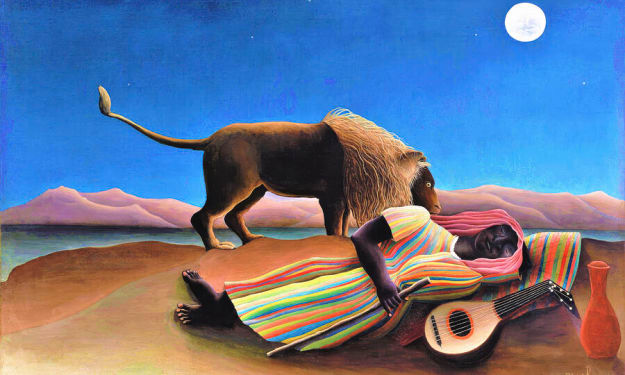
Title: The Sleep Beneath the Moon The desert had no name. It stretched in silence beyond the memory of maps, a vast ocean of sand lit only by the indigo breath of night. Wind moved softly across the dunes, lifting small whirls of dust like whispers from the past. Beneath the silver eye of the moon, there was no time—only stillness. And in that stillness, she slept. A woman lay curled on her side, wrapped in a robe of deep red and ochre stripes. Her skin, dark as ancient wood, glowed faintly in the moonlight. Her head rested on a worn mandolin, as if the instrument itself had lulled her to sleep. Beside her sat a simple jar, glazed and cracked, empty of water but filled with meaning. She was alone. A gypsy, they would call her—though no name ever followed. She was one of the wanderers. The kind who followed stars rather than roads, who sang lullabies to goats and lullabies to ghosts. She had walked across cities and sand, over mountains and along riverbeds, carrying her songs like seeds to be scattered. And now she slept in the sand, without shelter, without fear. But she was not alone. The lion watched. He had come silently, his golden paws pressing into the soft dunes like shadows. His mane shimmered beneath the moon, catching light like fire held in a net. His eyes, large and unreadable, studied the sleeping woman with neither hunger nor aggression. He did not growl. He did not move. He simply watched. It was a strange sight, even in a world that had long forgotten the border between reality and dream. A wild beast, drawn to a sleeping stranger not by scent, but by something deeper—something even he could not name. He sniffed the air. She smelled of cedarwood and smoke, of worn leather and faint rose. But beneath that—beneath the human details—she carried another scent. Memory. The lion blinked. The mandolin glowed faintly in the moonlight. Its strings vibrated softly, though no hand had touched it. It was as if the night itself had plucked a single note from its frame, a lullaby too old for language. The sound was not heard so much as felt—like an echo in the ribs, like the hush of a mother before the cradle. The lion lay down. The woman slept on. Before she had come to the desert, the gypsy had known many places and none. She had danced in courtyards where children threw petals at her feet, and she had sung to empty alleyways when rain made rivers of the streets. Her songs were not just songs—they were stories, memories, spells to keep loneliness at bay. But the world had grown louder. It no longer listened. Cities bustled with metal hearts. People moved too fast to notice music unless it shouted. She had tried to keep up, tried to play in crowded taverns and train stations. But her songs, soft and strange, were drowned in noise. So she turned back to silence. To the desert. To the moon. She walked for days. Ate little. Drank less. And when her feet could carry her no farther, she lay down, trusting the earth to cradle her. And so it did. And so did the lion. In the moments between midnight and dawn, when time breathes its slowest, the gypsy stirred. She did not open her eyes. But in her dream, she stood—barefoot and tall—on the dunes. The moon hovered close, large as a drum. And before her stood the lion, eyes glowing like small suns. “You found me,” she said, her voice a breath. “I followed your song,” the lion answered. “I didn’t know I was still singing.” “You were,” he said. “Even in silence.” She smiled. “What do you want?” “Not want,” the lion replied. “Remember.” He stepped closer. His breath was warm wind. “You forgot you were part of the wild.” “I grew tired,” she said. “Yes,” the lion said. “The world is heavy. But you are older than it. Your voice carries the sound of the first fire. The first lullaby.” “I am only one woman.” “You are one,” the lion said. “But you carry many. Your sleep feeds the sky.” She looked up at the moon. “Then let me rest a while longer.” The lion nodded. “I will guard you.” When morning came, the sun kissed the desert softly, slowly lighting the dunes in gold. The air was cool and expectant. The lion had vanished, as though dissolved into the light. The woman stirred but did not wake. Her breathing was slow, peaceful. Travelers would one day pass through this land, and they would speak of the woman who slept beneath the stars. Some would call her a mystic. Others, a myth. A few would say she never moved at all, as if preserved in time. But every so often, someone would stand before her and feel something stir within. A memory of music. A whisper of courage. A wild thing, still breathing inside them. And they would remember: The gypsy did not sleep to escape the world. She slept to hold it. To cradle it like a song in the dark. To remind even lions to listen. Author’s Note: This story is a fictional reimagining inspired by The Sleeping Gypsy (1897) by Henri Rousseau. In this surreal painting, a woman lies asleep in a moonlit desert with a lion curiously watching over her. Rousseau never fully explained the symbolism, allowing viewers to draw their own interpretations. This story explores the image as a poetic myth—one that blends solitude, feminine power, the mystery of dreams, and the strange tenderness between the wild and the weary.
By Soul Draftsabout a year ago in Art
Blind Beauty
In a world so often defined by what we see, the very idea of “visual art” seems inseparable from vision itself. Galleries, exhibitions, digital portfolios—all curated for the eye. But a quiet revolution is underway, one led by artists who defy that assumption. Visually impaired and blind artists are reshaping not only what art is but how we experience it. Their work forces us to ask: Is seeing really the only way of knowing?
By Mehtab Ahmadabout a year ago in Art