Inspiration
Blind Beauty
In a world so often defined by what we see, the very idea of “visual art” seems inseparable from vision itself. Galleries, exhibitions, digital portfolios—all curated for the eye. But a quiet revolution is underway, one led by artists who defy that assumption. Visually impaired and blind artists are reshaping not only what art is but how we experience it. Their work forces us to ask: Is seeing really the only way of knowing?
By Mehtab Ahmadabout a year ago in Art
"Unlocking Earnings: Your First Step to Making Money on Vocal Media"
Unlocking Earnings: Your First Step to Making Money on Vocal Media Learn how to turn your words into dollars—even if you're just starting out. Have you ever dreamed of making money simply by writing your thoughts and stories? With Vocal Media, that dream is closer to reality than you think. Whether you love telling stories, sharing advice, reviewing products, or writing poetry, Vocal Media gives you the platform to do it—and get paid! In this beginner-friendly guide, we’ll explore how to start earning on Vocal Media step-by-step, even if you have zero experience. --- 🔹 What Is Vocal Media? Vocal Media is a content publishing platform that allows creators to write and share articles across multiple niches like motivation, health, tech, love, fiction, and more. Unlike traditional blogs, you don’t need to set up a website, manage hosting, or promote with SEO knowledge. Everything is ready-made—you only need to focus on writing valuable content. You earn money based on reads and engagement. The more people who read your story, the more you earn. --- 🔹 Step-by-Step: How to Start Earning 1. Create a Free Account Go to Vocal.Media and sign up. You can choose the free version or go for Vocal+, a paid version that offers higher payouts and bonus challenges. 2. Pick a Niche Start by writing in a topic you enjoy. Popular categories include: Motivation Relationships Tech Fiction Health Travel Tip: Stick to one or two categories in the beginning to build your audience. 3. Write and Submit a Story Once logged in, click “Create Story.” Write directly on the editor or paste your content. Make sure to include: A strong title and subtitle An eye-catching cover image Subheadings and short paragraphs After submitting, Vocal’s team will review your story. If approved, it will be published within 24-48 hours. --- 🔹 How Do You Get Paid? You earn $3.80 per 1,000 reads as a free member and $6.00 per 1,000 reads as a Vocal+ member. Plus, there are bonus challenges where you can win $20–$500 or more just for writing stories around specific themes. Payment is made via Stripe, so make sure to set up a Stripe account linked to your Vocal profile. --- 🔹 Tips to Grow and Earn Faster 1. Share Your Stories Post links on Facebook, WhatsApp groups, Reddit, and writing communities to get more views. 2. Write Catchy Titles Titles like “How I Made My First $100 on Vocal Media” or “The Secret to My Daily Motivation” grab attention quickly. 3. Use High-Quality Images A good image increases clicks and keeps readers engaged. 4. Join Challenges They give you a chance to win extra cash and visibility. 5. Be Consistent Even 1 story per week can help you grow over time. Vocal rewards consistent writers. --- 🔚 Final Thoughts Vocal Media isn’t a get-rich-quick scheme. But it can become a steady source of passive income if you stay consistent, improve your writing, and promote your work. So if you're a writer at heart and want to make money doing what you love—Vocal is the platform to start with. --- 🖼️ Image Prompt (for Generation): "A young person sitting at a desk with a laptop, smiling while writing. The screen shows the Vocal Media website. Background includes coffee mug, notepad, and motivational posters. Warm, inspirational lighting."
By Sophia Graceabout a year ago in Art
Whispers in Blue: The Story Behind Degas’ Dancers
Title: Whispers in Blue: The Story Behind Degas' Dancers The rehearsal room was hushed, though not silent. The wooden floor creaked like the hull of an old ship. Dust drifted lazily through the late afternoon light, golden and tired as it spilled through the high windows. In a quiet corner of the room, Edgar Degas sat still, eyes half-lidded, sketchbook on his lap, his gaze fixed on the blue. Four girls stood like petals of the same flower—slightly apart, yet turning toward a shared center. They moved in rhythm not to music but to memory, to instinct, to an echo of a piano long since gone quiet. The girl nearest to Degas was Clara—barely seventeen, her limbs wiry from years of training. Her hands fluttered as she adjusted the bow at her waist. She was always adjusting, always correcting, never quite sure she belonged. Her mother had once danced here, long ago, before love and illness claimed her bones. Clara bore that legacy like a bruise beneath the skin. Next to her, Elise brushed invisible dust from her tutu. Her fingers, pale and slender, betrayed a nervous energy. Elise had come from the provinces with a letter of recommendation and a dream stitched into her bodice. She danced with the desperation of someone who knew this stage might be her only one. Behind them, Camille stretched her arms above her head, her eyes closed in the grace of a swan. She was the quiet one, the one who never laughed too loud or cried too long. She danced as if gravity did not apply to her, as though her body remembered flight. And then there was Margot. Margot was the sun around which the others turned—unknowingly, perhaps unwillingly, but inevitably. Her movements were effortless, her form a study in balance and breath. She was not the most technical dancer, nor the most disciplined, but she possessed that rare thing: presence. When Margot danced, time bowed before her. Degas had sketched these girls before. Many times. He knew their backs better than their faces, their poses better than their postures at rest. He was drawn to the moments before the performance—the lull between sweat and spectacle, the grace that came not from choreography, but from the simple act of being. Today, he painted them in blue. Not the vivid blue of summer skies, nor the somber blue of a storm. No, this was the blue of velvet shadows and soft silence—the color of reflection and breath held in anticipation. The rehearsal had ended an hour ago, but they lingered, as dancers often did, caught in the gravity of their shared devotion. They talked softly—about slippers worn thin, instructors too harsh, the ache in their hips and the dreams in their chests. Their voices wove around each other like ribbon. Clara watched Margot out of the corner of her eye. She envied her, but it was a gentle envy—like watching a bird take flight and knowing your wings were still growing. “Do you ever get scared?” she asked. Margot smiled faintly, as if remembering something far away. “Always,” she said. “But I dance through it.” Degas made no sound, but his pencil moved quickly, hungrily. He wanted to capture that—not the fear, but the dancing through it. Camille, noticing him, lowered her arms and turned ever so slightly away. “Monsieur Edgar,” she said quietly, “you always catch us at our most tired.” He smiled, without lifting his head. “That’s when you’re most real.” They laughed, a little. It was a sound like bells dropped into water—delicate, muffled, fleeting. He had painted them many times—sometimes in oils, sometimes in pastels. Sometimes only in memory, days later. He did not ask them to pose. He let them exist and tried to keep up. Blue was the only color that felt right for today. It softened the edges. It held their forms together, like a binding spell. The dresses floated, the bows curled, the necks bent like lilies under moonlight. There was no spotlight here, no stage. Only the hush of dreams rehearsed in half-light. The girls gathered their things eventually. Time crept forward, as it always must. They stepped out into the Paris dusk, their shadows long and overlapping. They would return tomorrow, and the day after, until their bodies no longer obeyed or the world found some other use for them. Degas remained, his brush sweeping the last curve of a shoulder, the final whisper of tulle. He didn’t paint ballerinas for the stage, for the sparkle and adoration. He painted them because they were metaphors—for fragility and fight, for beauty forged in silence, for the small acts of grace that happen away from the curtain. Blue Dancers wasn’t a portrait. It was a memory. A quiet ballet in a world that moved too quickly. And maybe, just maybe, it was a prayer—that these girls, with their aching feet and quiet fears, might one day know how radiant they looked, even when they weren’t looking.
By Soul Draftsabout a year ago in Art
The Golden Embrace: A Love Immortalized in Klimt’s ‘The Kiss’
**The Golden Embrace: The Story Behind Klimt’s *The Kiss* In the heart of Vienna, amidst the opulence of the early 20th century, Gustav Klimt stood at the pinnacle of his artistic career. The year was 1907, and the whispers of modernism were reshaping the world of art. Klimt, already a controversial and celebrated figure, was about to create a masterpiece that would transcend time—*The Kiss*. **A Love Woven in Gold** Klimt’s studio was a sanctuary of creativity, filled with sketches, fabrics, and the shimmer of gold leaf. He had long been fascinated by Byzantine mosaics, their intricate patterns and luminous surfaces inspiring his *Golden Phase*. But *The Kiss* was different—it was not just an artistic experiment; it was a whisper of passion, an ode to love itself. The painting depicted a man and a woman locked in an intimate embrace, their bodies entwined amidst a sea of gold. The man’s cloak, adorned with bold black rectangles, contrasted with the woman’s flowing dress, decorated with delicate floral patterns. Their faces were serene, lost in the ecstasy of the moment, as if the world around them had dissolved into nothingness. **The Muse Behind the Masterpiece** Though Klimt never confirmed the identities of the lovers, many believed the woman was Emilie Flöge, his lifelong companion and muse. Emilie was a fashion designer, a woman of grace and independence, and their relationship was one of deep affection, though shrouded in mystery. Some speculated their bond was platonic, others romantic—but in *The Kiss*, Klimt immortalized a love that defied definition. Others whispered that the painting was inspired by Klimt’s own fleeting affairs, a reflection of his belief that love was both sacred and transient. The man, kneeling in devotion, could be Klimt himself, surrendering to the intoxicating power of desire. **A Controversial Masterpiece** When *The Kiss* was first exhibited in 1908, it was met with both awe and scandal. Critics were divided—some hailed it as a revolutionary work, while others condemned its sensuality. The Austrian government, hesitant at first, eventually acquired the painting, recognizing its brilliance despite the controversy. Klimt’s use of gold was not merely decorative; it was symbolic. Gold, the color of divinity and decadence, elevated the lovers into a realm beyond the mortal. Their embrace was not just physical—it was spiritual, a merging of souls. The patterns on their robes hinted at the duality of love: the masculine geometric shapes clashing yet harmonizing with the feminine swirls of flowers and circles. **The Legacy of *The Kiss*** Over a century later, *The Kiss* remains one of the most celebrated paintings in history. It has been reproduced, parodied, and revered, a testament to its universal appeal. But beyond its beauty lies a deeper truth—that love, in all its forms, is the most profound force in existence. Klimt once said, *"All art is erotic."* In *The Kiss*, he captured the very essence of that belief. The painting is not just a depiction of two people; it is a moment frozen in time, a golden dream of passion and tenderness. **A Whisper Across Time** As you stand before *The Kiss* today, in the halls of the Österreichische Galerie Belvedere, you can almost hear the rustle of golden robes, the soft sigh of the lovers. Klimt’s masterpiece is more than paint and gold—it is a love letter to the world, a reminder that even in the darkest times, beauty and passion endure. And perhaps, if you look closely, you’ll see your own reflection in the gilded patterns—because love, after all, is a story that belongs to everyone.
By Soul Draftsabout a year ago in Art
"The Starry Night: A Masterpiece Born from Madness"
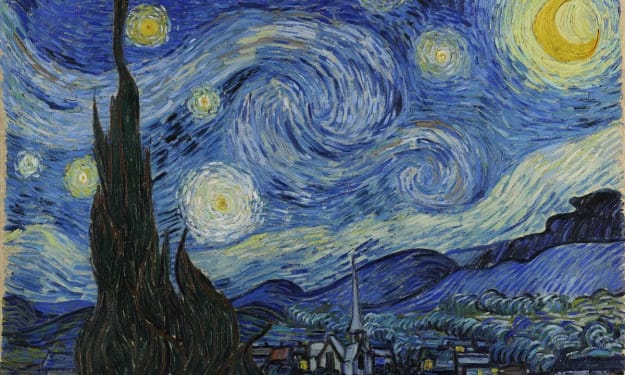
The Starry Night: A Symphony of Silence and Madness In the hush of a Saint-Rémy night, the stars whispered. It was 1889, and Vincent van Gogh sat behind the iron bars of the asylum window, his breath fogging the glass as the wind stirred the cypress trees beyond. The room behind him was still—too still. Silence had always been his shadow, but now it had teeth. Every ticking second scraped at his thoughts. Yet, above him, the sky lived. The world outside did not sleep as he did; it pulsed, it wept, it sang. Vincent could see it more clearly than anyone ever had—not with his eyes, but with the fevered clarity of a soul that had been both broken and reborn. He didn’t paint The Starry Night from a real view, not entirely. No, what he painted was truer than real. It was the sky as he felt it. It was turbulence, longing, hope, and fury tangled together in color. By day, the village below was quiet, ordinary. But by night, in Vincent’s mind, it bloomed—golden windows glowing like small embers of humanity, a sleepy chapel reaching like a prayer, the cypress tree a flame that refused to go out. The stars? They were not dots. They were whirlpools of light, great celestial dancers caught in a storm of meaning. They spun with sorrow, joy, and everything in between. They knew Vincent, and he knew them. Each brushstroke was a breath, a confession, a scream. The sky swirled in his mind and poured out in ultramarine and cobalt, slashed with streaks of lemony yellow and milky white. He didn’t paint what he saw. He painted what he felt—what he needed to believe: that something divine was out there, beyond the chaos, cradling the world in light. And yet, even with the cosmos alive above, the night had weight. Vincent was not just an artist. He was a man fractured by loneliness, haunted by thoughts he couldn't escape. This masterpiece, now immortal, was born in the confines of a room meant to contain madness. But what the world later hailed as genius, the world at the time barely noticed. He sold only one painting in his lifetime. One. Vincent painted because he had to. Because to not paint would be to drown. As he stood back from The Starry Night, the oils still wet, something in him stirred. He had captured not a scene, but an emotion—the exact moment when despair kisses awe. The moment when the soul, even shattered, dares to look up. He once wrote to his brother Theo, "Why, I ask myself, shouldn’t the shining dots of the sky be as accessible as the black dots on the map of France?... Just as we take the train to get to Tarascon or Rouen, we take death to reach a star." Vincent didn’t fear the stars. To him, they were destinations. And though he would not live to see his painting grace museums or inspire generations, The Starry Night became a language the world could understand. Long after he left this world, the sky he painted continued to speak—of pain, of passion, of the indescribable ache to feel connected in a universe that often feels indifferent. Today, millions stand before the canvas in hushed wonder, not realizing they are walking into the echo of a man’s final hope. Each swirl, each spark, is a reminder that beauty can emerge from the depths of torment. That even in confinement, the soul can take flight. The Starry Night is not just a painting. It’s a promise. That no matter how dark the world becomes, the stars will still burn. That someone, somewhere, will always see what others cannot. That art—raw, imperfect, heart-wrenchingly human—can outlive the silence. So the next time you look up, remember Vincent. Remember that behind every star, there may be a story not yet told. And within each of us, there may live a night sky just waiting to be seen.
By Soul Draftsabout a year ago in Art
The Smell of Beautiful
How perfumes unlock emotional and psychological triggers ? There’s something mysteriously powerful about scent. One whiff of jasmine, and you're transported to your grandmother’s garden. A trace of musk, and suddenly you're back in the arms of your first love. Perfume isn’t just about smelling good—it's memory bottled, emotion liquified, and psychology made wearable.
By Mehtab Ahmadabout a year ago in Art
Art Fight: What is it and what you do
Art Fight is in a bit less than a week and you might be seeing its name pop up a bit. What, exactly is it? It has a rather violent sounding name and when I explain it to those older than me, they even sometimes sound concerned, as if I'm taking out paint and battering people with it. But Art Fight is essentially a game. It takes place across the whole month of July, from the 1st to the 31st, on the main Art Fight website.
By Minte Staraabout a year ago in Art