Inspiration
Pastel Colors and Neon Colors: From Tranquility to Vibrancy
Pastel Colors and Neon Colors: Two Opposite Ends of the Color Spectrum Colors have the power to evoke emotions, convey moods, and communicate meaning. From the way we dress to the colors we use in our home decor, colors are an integral part of our everyday lives. And when it comes to color choices, there are a myriad of options to choose from. Two distinct color palettes that have taken the center stage in recent years are pastel colors and neon colors. While they are at opposite ends of the spectrum, both pastel and neon colors have gained immense popularity in fashion, design, and art. Let's take a closer look at these trendy color palettes and their characteristics.
By Feathermoon 3 years ago in Art
The Endless Romance of Nature's Embrace: A Love Story on the Beach
A Serendipitous Encounter As fate would have it, two souls destined for each other found themselves drawn to the enchanting allure of the beach. The sun-drenched sands welcomed their footprints, marking the beginning of a love story that would unfold amidst the beauty of nature's embrace.
By Literary fusion3 years ago in Art
The Struggling Artist
A talented artist, plagued by self-doubt and rejection, finds solace and inspiration in an unlikely friendship with a young child. Through their innocent perspective, the artist rediscovers their passion and regains the courage to pursue their dreams, reminding readers of the transformative power of art and the importance of nurturing one's creativity. In a quaint little town nestled between towering mountains and whispering streams, lived a struggling artist named Maya. With her paintbrush as her companion and a canvas as her confidant, she poured her heart and soul into her art. But the world seemed deaf to her creative voice, and self-doubt had begun to cast its shadow upon her dreams. Days turned into weeks, and weeks into months, as Maya's paintings collected dust in her small studio. Rejection letters stacked up like a monument to her perceived failure, threatening to extinguish the flickering flame of her artistic spirit. The weight of disappointment bore heavily upon her, suffocating her passion and casting doubt upon her talent. One day, while strolling through a nearby park, Maya's eyes fell upon a young child named Lily. The girl's innocent laughter echoed through the air as she danced and twirled, completely oblivious to the judgment and expectations that clouded the adult world. Something stirred within Maya's heart a flicker of hope ignited by the pure and untarnished joy radiating from Lily. Driven by curiosity, Maya approached Lily, their worlds colliding in a moment of unexpected connection. They talked, laughed, and shared stories, their hearts intertwining like two brush strokes merging on a canvas. Maya discovered that Lily possessed an unbridled imagination and an innate ability to see beauty in the simplest of things. In the presence of Lily's unfettered creativity, Maya's self-doubt began to wane. She watched in awe as the child fearlessly mixed colors, painted whimsical creatures, and brought her vibrant imagination to life. Lily's artistry, unburdened by self-judgment or the constraints of society, inspired Maya to view her own creations through a different lens. As the days turned into weeks, Lily became Maya's muse and her greatest source of encouragement. The young girl's unwavering belief in Maya's talent breathed life into her dormant ambitions. Lily's eyes, filled with wonder and admiration, reflected the beauty that Maya had lost sight of. Guided by Lily's youthful wisdom, Maya allowed herself to experiment, to take risks, and to embrace imperfections as an integral part of the artistic process. She painted with abandon, pouring her emotions onto the canvas without fear of judgment. Through her art, Maya began to regain the joy that had once fueled her creativity. In Lily's presence, Maya's studio transformed into a sanctuary of inspiration. Their shared laughter echoed through the room, and the scent of paint mingled with the sweetness of newfound friendship. Together, they explored the depths of their imaginations, daring to dream of worlds beyond the confines of reality. As Maya rekindled her artistic fire, the world began to take notice. Her paintings, now infused with a renewed passion, captured the hearts of those who beheld them. Critics and art enthusiasts alike were captivated by the raw emotion and untamed spirit that emanated from her work. Maya's talent, once obscured by self-doubt, now shone brightly for all to see. But Maya knew that her success was not solely a result of her talent; it was a testament to the transformative power of friendship and the importance of nurturing one's creativity. Through Lily's innocent perspective, Maya had rediscovered the essence of her art reminder that it is not just a means of self-expression but a reflection of the human spirit. As Maya continued to paint, her friendship with Lily grew stronger, their connection transcending the realm of mentor and mentee. They laughed, they danced, and they reveled in the magic of their shared creative journey. Maya found solace and inspiration in the presence of this young soul who reminded her of the boundless possibilities that lay within the realm of art
By Obododinma Chukwuemeka3 years ago in Art
The Lost Voice
"The Lost Voice": A renowned opera singer loses their voice due to a devastating accident, plunging them into despair and questioning their identity. Through a journey of self-discovery and resilience, they find a new way to express themselves and redefine their passion, teaching others the value of adapting and finding beauty in unexpected places. In the grand opera houses of the world, there once existed a renowned singer named Isabella. Her voice, like a delicate and powerful instrument, had enraptured audiences, leaving them breathless in the wake of her performances. But fate, as it often does, had a cruel twist in store for her. One fateful night, as Isabella prepared to grace the stage with her angelic voice, tragedy struck. A devastating accident stole her greatest gift—her voice. The world that had once embraced her with open arms now became a bleak and silent place. Isabella's soul was plunged into despair, her identity shattered, and her dreams scattered like ashes in the wind. Days turned into weeks, and weeks turned into months as Isabella withdrew from the world. She questioned her purpose and her worth, unable to fathom a life devoid of the one thing that had defined her existence. The echoes of applause and adoration that had once filled her heart were replaced by an agonizing silence. But in the depths of her darkest hour, a tiny flicker of resilience ignited within Isabella's spirit. She refused to be defeated by her circumstances, determined to rediscover her passion and find a new way to express herself. With unwavering resolve, she embarked on a journey of self-discovery—a journey that would redefine her artistry and touch the lives of others in unexpected ways. Isabella sought solace in the world of visual art. With brushes in hand and colors on her palette, she poured her emotions onto the canvas, creating a symphony of hues and strokes that spoke louder than words ever could. Through her art, she found a voice—an expression of her innermost thoughts and feelings that transcended the limitations of vocal cords. As Isabella's paintings took shape, a newfound beauty emerged—a beauty born from the depths of her struggle and resilience. Her creations touched the hearts of those who beheld them, evoking emotions that resonated with the human experience. Isabella's art became a testament to the power of adaptation, reminding others that even in the face of loss, there is always a way to find beauty and purpose. Word of Isabella's transformation spread, reaching the ears of those who had faced their own trials and tribulations. They saw in her story a reflection of their own struggles—the universal quest to find meaning in the face of adversity. Through her art, Isabella inspired others to embrace change, to adapt, and to find solace in unexpected places. But it was not just her art that captivated the world; it was Isabella's indomitable spirit, her refusal to be defined solely by her voice. She took to the stage once more, not as the singer she once was, but as a storyteller—a narrator of emotions, using her body and gestures to convey the depths of human experience. Through dance and movement, she reinvented herself, transcending the confines of traditional opera and showing the world the boundless possibilities of artistic expression. Isabella's performances were a symphony of movement and emotion—a visual feast that left audiences spellbound. In her every step and gesture, they saw the echoes of her lost voice, a testament to the resilience of the human spirit and the transformative power of art. Through her journey, Isabella taught others the value of adaptation and the importance of finding beauty in unexpected places. She shattered the notion that one's identity is solely defined by a single talent or attribute. Isabella became a symbol of strength, inspiring countless others to embrace change, to redefine their passions, and to find new ways to express themselves. And as Isabella took her final bow, she knew that her journey was far from over.
By Obododinma Chukwuemeka3 years ago in Art
The Enigmatic Locket
In the little seaside town of San Casciano, settled in the midst of rough bluffs and crashing waves, a feeling of mystery and interest lingered palpably. The residents talked in quiet murmurs regarding a legendary show-stopper that had shown up at the neighborhood exhibition hall — a magnum opus known as "The Enigmatic Locket." Painted by a perplexing craftsman, it was said to have the ability to uncover the mysteries of the human heart.
By Shari Gailla3 years ago in Art
THE MYTH OF ARTIFICIAL-INTELLIGENCE
Artificial Intelligence, or AI, is a rapidly growing field that revolves around the development of computer systems that can perform tasks that typically require human intelligence. AI systems leverage various technologies, such as machine learning, neural networks, and natural language processing, to learn from and adapt to data over time. AI has the potential to transform many different industries and areas of human life, from healthcare to finance to transportation. For example, AI-powered medical diagnostic tools can help doctors detect diseases more accurately and efficiently while self-driving cars promise to revolutionize the way we commute and travel. However, the potential benefits of AI are accompanied by significant concerns and challenges. One major issue is the potential for AI to exacerbate existing social inequalities, either by displacing jobs or by perpetuating biases in decision-making. For example, some worry that AI-powered hiring systems might systematically discriminate against certain groups of people, such as those with non-traditional backgrounds or those who belong to underrepresented racial or socioeconomic groups. Another major area of concern is the potential for AI to operate without human oversight or control, creating autonomous systems that make decisions with potentially catastrophic consequences. This is particularly true in fields like military technology, where the deployment of autonomous weapons systems raises ethical and humanitarian concerns. As AI continues to advance and develop, it is likely that these concerns and challenges will become more complex and pressing. It is important for policymakers, researchers, and the broader public to stay informed and engaged on these issues to ensure that AI is developed and used in ways that are ethical, just, and socially responsible. Certainly, writing a book about the myth of artificial intelligence can be an interesting and thought-provoking topic. It would provide an opportunity to explore the myths and realities surrounding the concept of AI and to examine the promises and risks associated with this emerging technology.
By ben castell3 years ago in Art
Love's Reflection
Once upon a time, in a small town nestled between rolling hills, lived a girl named Lily. She was the middle child in her family, often overshadowed by her older and younger siblings. Lily had always been cute, with her rosy cheeks, chubby frame, and a smile that could light up a room. Yet, her physical appearance had been overlooked by her parents, who seemed to focus more on her siblings' achievements.
By Nasheeha Inam3 years ago in Art
Late night reflections
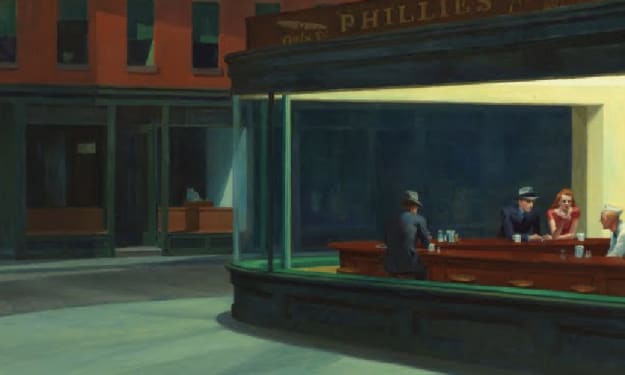
One painting that has always captivated me is Edward Hopper's "Nighthawks," which depicts a late-night scene at a diner in an urban area. The painting is known for its use of light and shadow to convey a sense of loneliness and isolation among the people in the diner, who are all lost in their own thoughts and seemingly disconnected from one another.
By Kelly Dickerson3 years ago in Art
Cosmic Spirograph
I don't know how many people would remember the toy, "Spirograph", but as a kid, it was far and away my favorite thing to play with. I enjoyed the order of bringing lines together in perfect synchronicity to create something completely new, vibrant and beautiful. It amazed me how, no matter how hard I tried to color outside the lines, I just couldn't when using the pieces properly. It was like a ballet dance being carried out inside a gazebo; where there was beauty and rhythm, but also form, balance.
By Veronica Coldiron3 years ago in Art
Poppy. Content Warning.
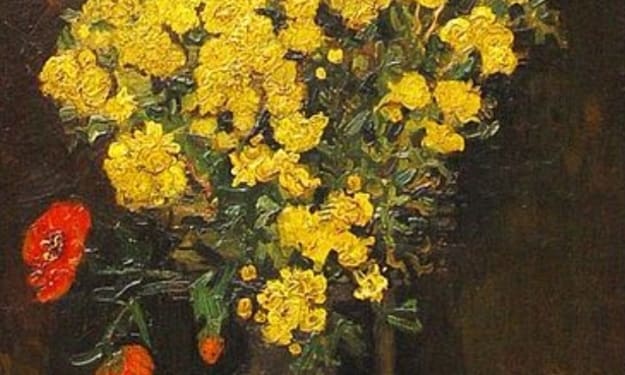
Vincent Van Gogh once said, "If a painting seems too simple, you just haven't looked at it long enough". For his paintings this is definitely true. I've applied this quote as my understanding of people as well. It's become the basis of most characters I write about or try to develop. People, like snowflakes and art are all unique. Art reveals not only what's being depicted, but how the one depicting it see's something. One particular painting of his, I've looked at so long, I could swear I hear the artist himself. However, I know there are others that are aware of it's intimate stories. As obsessed as me with it. After all, a painting, so simple, doesn't go missing and attract such schemes with out housing some special importance. It speaks to the true viewer, to the heart of those with a heart. The first encounter I ever had with Poppy was through a book at the library. It was a book about art. I thumbed the pages, flipping through, perusing the pictures as I knelt on my shins in an aisle. Rows of books rising on shelves around me, concealing me from all others. I was not fully invested in researching or reading anything. I was simply taking a break from researching and saw a book, misplaced, that seemed interesting. I wasn't finding anything useful for the paper I was working on. I decided to look at the misplaced one I had noticed. I believed in things like fate and serendipitous acts back then. The colors caught my attention as I thumbed through. It seemed simple enough, a vase with yellow and red flowers. However, there was something peculiar about how it was arranged. The peculiar arrangement and stark contrasts drew me in. It seemed to ask the viewer to further investigate it. To notice it's two bright colors on a dark drab brown backdrop. To really see the details and purpose behind the colors and chosen arrangement. To see it through Vincent's eye's and then Poppy's. They own the story being told. Let me introduce you to Poppy Flowers. A painting that says more by looking at it than I could ever do justice to as a writer. This painting and others like it is where the old adage, "A picture is worth a thousands words" comes from, I'm sure, and it made me a believer. I will tell you the two most important stories it tells. Supposedly the painting originates from his respect for Adolphe Monticelli. An artist who influenced him in Paris. One could picture him learning from others during his days there. While also collecting flowers during the day as he scouted sites to paint. Flowers acting as small treasures of beauty to decorate with for a struggling artist. A young man, learning the ways of the world, trying to harness a craft, once entered into self employment, and struggling. On one hand the painting is a teaching tool, on the other hand it is a tale about a girl and Vincent, I presume a prostitute or one equated to such. He was known to have prostitute companions. The story Poppy Flowers tells is about society. The bunches of yellow flowers that jettison out from the bunch all actually fit quite perfectly in the spots devoid of flowers in the arrangement, as if plucked from those spots. This obvious peculiarity is the viewers first clue something more is on display than just flowers. If it were just flowers, those would be tucked in neatly, creating a more beautiful aesthetic. The lower corner of the boquet has three red flowers, two which are wilted downward. A large, a medium and a small baby bud. This is symbolic of a "red" father, mother and child. The mother and child are facing down, wilted and seemingly disgraced, symbolic heads hung in shame. I believe the bouquet represents families in society. Some families wanted to move up in society so they shamed one family (the red) in order to take their place at the top. The father of the red is distant from society, but not as Shameful as the mother and child. However, as a bunch they are further outside, away, instead of tucked in nicely with the rest. The round vase represents earth and the flowers inside the vase are symbolic of people populating earth. The arrangement represents a closer look at a specific group. Like a bubble microscope diagram in a text book. Paintings, sculptures, and the Bible were the first textbooks afterall. So Vincent lent purpose to his painting, as well as intrigue. Much like the subject, Poppy, being showcased. Now let me introduce Poppy. To see Poppy and gain the story behind the teaching lesson you must turn the painting upside down. Then you meet Poppy. There, as the only light in a dark room, is Poppy. She is in a yellow dress with a red scarf. A broken halo around her head, or possibly bald, loosing her hair to illness or lack of nutrition. The red scarf, a symbol of her status as a prostitute .or one with polluted blood However, to Vincent, he saw her as the light in the room, vibrant and beautiful. However, Poppy is dangerous because the beauty hides the darkness. Providing richness where none exists. The four bunches of yellow flowers, representative of people, now at the top of the bouquet and society, are stuck in poppy's mind. This is depicted by the flowers inside the vase representing her head. Maybe as revenge, as longing, as knowledge of what they helped do or did, as teachers or a mix of those, placed them forever in her mind. Only Poppy knows, the painting, and Vincent who gives us parts of the story through this portrait. Interestingly enough, I believe the poppies are the only true flowers in the painting. The others, I believe, are from a tree branch with flowering yellow flowers found in the area. Possibly adding to the commentary about society, and family branches or networks. The power of networks and how they can be manipulated to gain status or take status. Poppy is complex like the painting that displays her, begging the attention of others, asking the viewer to understand her and her situation. Vincent and her, hoping to help others be wary of the ways of society and it's hierarchy. Vincent changes the context of a taboo person and subject to make it viewable, as flowers, to all, inviting even. A master at bridging the ranks of class, in his works, which he had experience with through his experiences and encounters in life. The painting tricks the viewer into viewing it's commentary, possibly as he was by the beauty. Then it allows for discovery and the finding of the lesson underneath after recognition of it's beauty, but the beauty still exists. The girl or woman is still the illumination in a dark place. Vincent's name is written in the same color as the Poppy flowers to show how this is his story as much as hers. Now to present. I was sitting in my dark bedroom, only getting up to use the bathroom and complete daily chores. As I walked to the bathroom I didn't bother turning on any lights. I stared at a blank wall as I sat to pee, Ultimately deciding a piece of art belonged there. I'd looked, but never could decide on anything. I know it doesn't sound like an important place that warrants much thought, but many times the only place I get to meditate is while I pee. One or two minutes to regroup before rejoining the days bustle and hustle. At this particular time I had just gone through one of the most disappointing times in my life. I looked to art, to the stories found in it when media and T.V. wasn't offering me anything positive. I searched through stacks of paintings, one in front of the other at home good stores. There were many nice works, but devoid of feeling I was looking for. Nothing really stood out. I looked at fine art. Depressing myself further when I realized the price is out of reach currently for me, even if it is an investment. I looked into auctions, but finding the time and courage to go alone seemed daunting. Day after day, I pee, I look at an empty wall. The blank space becoming a reminder at my inability to complete even the simplest task of hanging art on a wall. Obviously choosing art is personal and not at all easy, but in my state I saw it as another thing I was lacking. Another disappointing quality, as irrational as that is. Another task staring me down each day as incomplete. Avoiding showering and peeing wasn't an option as a functioning member of society. I didn't like that the blank space was getting the best of me, ruining my meditation. I go back to the table. I take a break from my spreadsheet and open chrome. Typing in missing stolen paintings. I wanted to see what others wanted so bad they'd steal for it. Something rare and maybe a little precious. I begin my search. I open the first clickable headline. Scroll, scroll, old art, old art, biblical, interesting, nothing for my wall. I click back. Second clickable headline. Start scrolling. There it is again. Drawing me in. This time with the story of it's heist and unknown wareabouts. Poppy is a desired woman and missing. I follow the trail of clickable resources, trying to put the master puzzle of this painting together. Poppy has now enthralled me, as I suspect she did Vincent Van Gogh. I read blogs and newspaper clips. All culminating with me sitting back in my chair staring at Poppy. Right side up, then flipped, then right side, until I too love Poppy and what she has to teach. What she and Vincent are telling through a simple vase of flowers. I know the painting is missing and highly out of my price range, so a reprint would be my option. I search known art museums and local museums unsuccessfully. I check laws dealing with reprinting, etc. However, I'm not selling it and I doubt my bathroom wall is much importance to anyone. Any how, I find a site I can dowload it from and upload to another site to get it printed. By the end of the day I found a modern interpretation of Mayans art that would look great in the gym I dont yet have and a sketch great for an office I don't yet have. I found a handful of paintings I don't have the wall space for, but at some point need to own, as well as a deep admiration for the painting of Poppy Flowers. The other paintings seemed worthy of introducing to Vincent and Poppy. Things of interest from around the world with unique perspectives and stories. Finally, I picked up my print. Hung it on the wall. I look at it every time I pee, brush my teeth or wash my face. Some days it's a bouquet and other days it's Poppy in the yellow dress. Every morning I wake I look towards Vincent and Poppy. It reminds me there is so much cruelty hidden behind the beauty of the world, but the beauty makes it liveable. It's when all beauty is gone that life is unbearable and one is done. Luckily, the simplest things can be so much more, like a vase of flowers. Everyday I look at my painting hoping Vincent and Poppy will reveal more secrets that I've overlooked. Some days you can almost picture Vincent Van Gogh sitting with his prostitute companion, in the dark, due to money shortages discussing life, things they've seen and the duality of it all. Knowing the power of perspective, which after all is Poppy Flowers strength. Sent via the Samsung
By simplicity3 years ago in Art