History
Beckschinsky: Dreams, Nightmares, and the Birth of Modern Polish Art. AI-Generated.
Over a 50-year career, Beckschinsky expressed dreams and nightmares on canvas and film. He brought global attention to Polish art and defined modern heavy-metal aesthetics. Born in 1929, he grew up in Sanok, a city with a significant Jewish population. Before World War II, around 30% of the city's residents were Jewish. In 1940, the nearby Zoo Slav concentration camp was established and operated for three years.
By Ahmed mohsin2 years ago in Art
Exploring Andy Warhol: The Artist’s Life Through His Food and Art. AI-Generated.
There is an Andy Warhol that you likely know. He created repeated images of Marilyn Monroe, Campbell’s soup, Brillo boxes, cow wallpaper, celebrity portraits, and dollar signs. Many writings exist about Warhol, including biographies and a detailed account of his daily life from the mid-1970s until his death in 1987. Warhol surrounded himself with people who gave competing reports about their time with him. He also provided many memorable sayings that are still referenced today.
By Ahmed mohsin2 years ago in Art
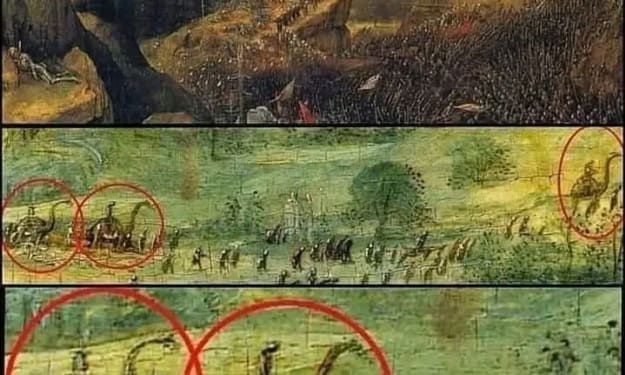
The Curious Case of Peter Bruce Gale’s 1562 Painting: A Prehistoric Mystery
In the annals of art history, some works defy explanation, challenging what we think we know about the past. Among these is a mysterious painting created in 1562 by the little-known artist Peter Bruce Gale. While seemingly unremarkable at first glance, the painting features an extraordinary subject: what appears to be a dinosaur, centuries before the scientific discovery of these prehistoric creatures. This enigmatic artwork raises fascinating questions about human knowledge, imagination, and the mysteries of history. Could Peter Bruce Gale have somehow known about dinosaurs? Or does his painting simply reflect a coincidence or a product of creative storytelling? Let’s delve into the details of this perplexing painting and its potential implications. --- The Painting: A Window to the Past Peter Bruce Gale’s 1562 painting, whose title has been lost to time, depicts a lush, pastoral landscape populated by various animals. Amid the deer, birds, and other creatures of the natural world, one figure stands out—a large, reptilian beast with striking similarities to what we now know as a dinosaur. Its long neck, massive body, and tail bear an uncanny resemblance to depictions of sauropods, a group of long-necked dinosaurs like the Brachiosaurus and Apatosaurus. What makes this painting so intriguing is not just its artistic quality but its temporal context. In 1562, the concept of dinosaurs did not exist. The term “dinosaur” itself would not be coined until 1842 by paleontologist Richard Owen, and the first formal dinosaur fossil discoveries did not occur until the 19th century. So how did a 16th-century artist paint a creature that looks so much like a dinosaur? --- Possible Explanations 1. A Coincidence of Imagination One of the most plausible explanations is that Peter Bruce Gale’s dinosaur-like creature was a product of artistic imagination. Artists of the Renaissance and earlier often drew fantastical animals inspired by myths, legends, and hearsay. Creatures such as dragons, griffins, and sea monsters frequently appeared in paintings and manuscripts of the time. It’s possible that Gale’s creature was inspired by similar sources. Its resemblance to a dinosaur might be coincidental, reflecting a blend of reptilian and fantastical elements rather than any specific knowledge of prehistoric creatures. 2. Fossil Discoveries in Antiquity While the formal study of fossils did not emerge until the 19th century, fossilized bones had been discovered and puzzled over for millennia. Ancient cultures often interpreted large fossilized bones as evidence of mythical giants or dragons. In this context, it is conceivable that Peter Bruce Gale or his contemporaries might have encountered dinosaur fossils without understanding their true nature. These discoveries could have influenced his depiction of the mysterious creature, blending observation with artistic license. 3. Oral Histories and Legends Another intriguing possibility is that the painting reflects oral traditions or legends passed down over generations. Many ancient cultures, including those in Europe, Asia, and the Americas, have myths and stories about large, reptilian creatures resembling dinosaurs. While these tales are often associated with dragons, it’s not impossible that they were inspired by fossil discoveries or encounters with prehistoric remains. Could Peter Bruce Gale have been inspired by such stories? If so, his painting might represent an artistic interpretation of a cultural memory of long-extinct creatures. 4. Time-Traveling Knowledge? For those with a taste for the extraordinary, there’s a more speculative explanation: that the painting reflects knowledge that was somehow acquired ahead of its time. While this idea ventures into the realm of science fiction, it underscores the allure of this mysterious work of art. Could there be unknown factors at play, such as lost knowledge from an advanced ancient civilization or even speculative theories about time travel? --- Art, Mystery, and Interpretation Regardless of the true origin of the dinosaur-like figure in Gale’s painting, it serves as a fascinating case study in the intersection of art, imagination, and historical context. Art has always been a medium through which humanity explores the unknown, blending reality with creativity to create works that inspire curiosity and wonder. Peter Bruce Gale’s work reminds us that artists of the past were not just chroniclers of their time but also visionaries capable of imagining worlds beyond their own. Whether the creature in the painting was inspired by fossils, folklore, or pure invention, it demonstrates the power of art to spark questions and expand our understanding of history. --- Why It Matters The mystery of Gale’s painting is about more than just a single work of art; it speaks to the broader human desire to understand our world and its history. The questions raised by this painting echo those posed by paleontologists, archaeologists, and historians in their quest to uncover the secrets of the past. Moreover, the painting challenges us to consider the limits of our knowledge. What other connections between the ancient world and the present might we be overlooking? Could there be other forgotten works of art or literature that hint at advanced or unusual understanding of the natural world? --- Conclusion Peter Bruce Gale’s 1562 painting stands as a captivating enigma, a puzzle that blurs the line between historical knowledge and artistic imagination. While we may never know exactly what inspired the dinosaur-like creature it depicts, the painting invites us to ponder the mysteries of the past and the role of creativity in shaping our understanding of history. Whether interpreted as a coincidence, a reflection of fossil discoveries, or a nod to ancient legends, Gale’s work reminds us of the enduring power of art to transcend time and connect us to the unknown. It is a testament to the curiosity and ingenuity of the human spirit, encouraging us to look more closely at the world around us—and to imagine the worlds that came before. In the end, the significance of this painting lies not in solving its mystery but in embracing its capacity to inspire wonder. It is a reminder that history, like art, is an ever-unfolding story, full of surprises waiting to be discovered.
By Deji Akomolafe2 years ago in Art
What About Singer The Weeknd and His Song "Die for You"? . AI-Generated.
What About Singer The Weeknd and His Song "Die for You"? The Weeknd, born Abel Makkonen Tesfaye, is a name synonymous with artistry, innovation, and evolution in the music industry. Over the years, he has cemented his place as one of the most influential and successful artists of his generation. Among his vast repertoire of hits, "Die for You" stands out as a timeless anthem that captures the essence of love, vulnerability, and sacrifice.
By Nivard Anna2 years ago in Art
A Comprehensive History of Kansas City Mansions
Kansas City, with its rich history and cultural heritage, has long been associated with remarkable architecture and grand homes. The city's evolution from a frontier settlement to a bustling metropolitan area has left a legacy of exquisite mansions that reflect the opulence, ambition, and changing architectural trends of their times. From historic estates that tell the story of Kansas City's industrial growth to contemporary residences like Patrick Mahomes House, the city’s mansions capture the essence of success and refinement across generations.
By Danish Fareed2 years ago in Art
How Captains of Industry Built Their Palatial Homes
The late 19th and early 20th centuries in America were defined by the rise of captains of industry—pioneering business magnates who accumulated immense fortunes through innovation, ambition, and, at times, controversial practices. These titans of the Gilded Age built more than businesses; they constructed monuments to their success in the form of grand, opulent estates.
By Danish Fareed2 years ago in Art
Rune-Covered Medieval Sword Unearthed: A Gateway to the Past
In a remarkable archaeological discovery, a sword covered in ancient runes was recently unearthed in a remote area of northern Europe. This extraordinary find not only offers a glimpse into the craftsmanship of medieval swordsmiths but also sheds light on the cultural and historical significance of runes during that period. As researchers and historians work to unravel the mystery surrounding the sword, it serves as a fascinating link to the past.
By Delta Roblox Executor Download APK 2026 latest New Update2 years ago in Art
The Evolution of Miley Cyrus: From Disney Star to Global Icon . AI-Generated.
The Evolution of Miley Cyrus: From Disney Star to Global Icon Miley Cyrus has been a household name for over two decades, captivating audiences with her talent, authenticity, and fearless approach to self-expression. From her early days as the lovable Hannah Montana to her bold reinvention as a genre-defying artist, Miley Cyrus has continually evolved, solidifying her position as one of the most influential figures in the music industry. Among her many achievements, the 2023 release of her hit song "Flowers" marked yet another milestone in her illustrious career.
By Nivard Anna2 years ago in Art
Spirit of Pongal
The Spirit of Pongal: A Lesson in Gratitude In a quaint village nestled amid lush green fields, a farmer named Kannan was preparing for Pongal, the festival of harvest. Known for his hard work, Kannan took pride in his land, where the crops stood tall and golden, promising a bountiful harvest.
By Arun Ramasamy2 years ago in Art
Zach Bryan: A Rising Star in Country Music and the Magic of "Something in the Orange". AI-Generated.
Zach Bryan: A Rising Star in Country Music and the Magic of "Something in the Orange" Introduction Zach Bryan is a name that has been resonating deeply within the country music scene over the past few years. With his raw, emotive lyrics and soulful voice, Bryan has carved out a unique space in the genre, capturing the hearts of listeners worldwide. His music, often described as a blend of traditional country and modern folk, speaks to the human experience in a way that is both personal and universal. Among his many songs, "Something in the Orange" stands out as a poignant masterpiece that encapsulates his artistry and emotional depth.
By Nivard Anna2 years ago in Art
Eternal Resonance: Debussy’s Timeless Impact
There’s something magical about the way art weaves itself into the fabric of our lives. It sneaks into our hearts, finds a home in our routines, and even shows us new ways to dream. Claude Debussy, the enigmatic composer whose melodies feel like whispers of the soul, has left an impression that transcends time. His music is not just a relic of the past; it’s a living, breathing force that continues to inspire creativity and connection in today’s world. What sets Debussy apart is the ability of his work to mirror life’s ebb and flow. In our fast-paced, modern existence, where technology and noise often overwhelm, his compositions offer a kind of sanctuary. There’s a softness to his music, a deliberate pace that invites you to pause and truly listen. This is not just an artistic experience; it’s a life lesson. We’re reminded to find beauty in the smallest details, in the spaces between the noise, and in the quiet moments that so often go unnoticed. Beyond its calming effect, Debussy’s artistry sparks something far more profound: a call to creativity. Whether you’re an artist, a writer, a parent, or someone navigating a 9-to-5 grind, there’s inspiration to be found in his work. The way he broke free from traditional structures, choosing instead to create something entirely his own, is a reminder that innovation often comes from daring to be different. His music whispers to us, “What if you colored outside the lines?” And this daring doesn’t stop at the individual level. Across contemporary art forms—whether it’s film, fashion, or digital media—his influence is deeply felt. His melodies have a way of layering themselves into new creative expressions, adding depth and emotion to works that define our era. What’s remarkable is that these reinterpretations often echo his philosophy: that art should evoke, not instruct; inspire, not impose. But Debussy’s magic isn’t confined to concert halls or art galleries. It finds its way into everyday life, helping us reconnect with something more meaningful. Imagine, for a moment, the way his music might accompany a walk through a park, transforming ordinary moments into something extraordinary. It becomes a soundtrack to life’s quiet triumphs and bittersweet reflections. It’s a reminder that art is not just for the elite or the educated—it’s for anyone willing to listen and feel. The enduring power of Debussy’s work also lies in its emotional honesty. His melodies don’t tell you how to feel; they simply invite you to explore. That kind of openness is rare, and it’s something our world needs more of. It’s an invitation to embrace vulnerability, to let yourself be moved without needing to explain why. What makes this even more remarkable is how his legacy transcends cultures, languages, and generations. In an increasingly fragmented world, his music provides a common thread—a way for people to connect over something universal. Whether you’re listening to one of his iconic compositions for the first time or the hundredth, the impact is the same: it speaks to the part of us that craves beauty, wonder, and a sense of belonging. Debussy’s work is more than art; it’s a reflection of life itself. It teaches us about the power of subtlety, the importance of imagination, and the value of slowing down. His music challenges us to live with intention, to savor moments, and to see the world not just as it is, but as it could be. In a world that often feels loud and chaotic, Debussy offers a reminder that quiet power can be transformative. His music doesn’t demand attention—it earns it. And once it has it, it lingers, reminding us that beauty, in all its forms, has the ability to heal, inspire, and connect us in ways nothing else can. As we continue to navigate the complexities of modern life, perhaps we can carry a little of Debussy’s spirit with us. Let’s remember to pause, to listen, and to create space for wonder. Let’s dare to be different, to dream boldly, and to find beauty even in the unexpected. After all, his music is not just a gift from the past—it’s a guide for the present and a promise for the future.
By Seymour Soza2 years ago in Art
Behind the Edge: Stories of Unique Knives and Their Makers
Behind the Edge: Stories of Unique Knives and Their Makers Hello friends, Explore the fascinating tales behind some of the most rare knives around the world and the master artisans who craft them. Discover the craftsmanship, ingenuity, and cultural importance behind these extraordinary blades. Behind the Edge: The Unique Knives and Stories Behind Them Knives have long been more than just tools; they’re representational of culture, history, and innovation. Whether it is an ancient hand-forged blade or a modern masterpiece, the stories behind unique knives and their creators provide a tantalizing glimpse into craftsmanship and creativity. Join us as we delve into the rich history, artistry, and vision behind exceptional knives and the artisans around the world who create them. The History of Knife Making The history of knife-making dates back to prehistoric humans who chipped stone to create sharp blades. For millennia craft developed and metals, from bronze and iron to steel, eventually became commonplace in weaponry. Blending design, materials, and techniques, each era created blades that wore the scars and fingerprints of their respective cultures. These days knife-making persists as both a practical craft as well as an art. Contemporary knife makers pay homage to classic methods while challenging conventions of form and materials. Why Each Knife Is a Unique Story
By Kalpesh Vasava2 years ago in Art