Contemporary Art
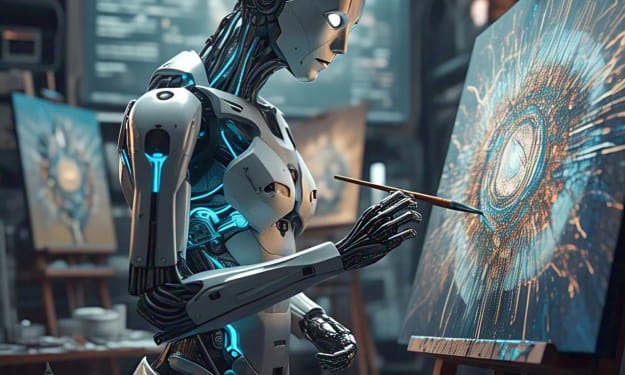
How AI is Revolutionizing Creative Arts
Introduction Art has always been a deeply human endeavor — an expression of emotion, culture, and experience. But in recent years, artificial intelligence (AI) has stepped into the studio, concert hall, and gallery, challenging traditional notions of creativity. The intersection of AI and creative arts is no longer a futuristic concept; it's a dynamic reality reshaping how we create, consume, and understand art. From AI-generated symphonies to algorithmic paintings selling for thousands, the revolution is here — and it’s only just beginning.
By Mehtab Ahmadabout a year ago in Art
The Silence Behind the Pearl
The Silence Behind the Pearl They called her Griet, though no one really knew if that was her name. In the narrow alleyways of Delft, where cobblestones held the whispers of merchants and painters alike, her face became legend long before anyone knew her story. And yet, it was never her voice they remembered. Only the way she looked back over her shoulder—caught between movement and stillness—her lips slightly parted, her eyes questioning, a single tear-shaped pearl catching the dim, filtered light. Before she was immortalized in paint, she was only the maid. She arrived at the Vermeer household during a summer thick with heat and tension. The house at Oude Langendijk, filled with children, canvases, and shadows, was no easy place for a girl of sixteen. Her hands were calloused from peeling potatoes and scrubbing copper pans, but it was her eyes that gave her away. Quiet, knowing eyes—too perceptive for a maid. Johannes Vermeer noticed her in that way painters notice things others don't. She would tilt her head to observe how sunlight streamed through a stained-glass window, watching the way it lit the pewter jug on the kitchen table. He saw her pause at the threshold of his studio when she thought no one was watching, marveling at the rich indigo pigments, the glint of light caught in a brass chandelier. He never said much, and neither did she. But gradually, an unspoken understanding bloomed between them, a fragile thread woven with glances and silences. His wife, Catharina, busy with their eleven children, rarely paid Griet any mind—until she started cleaning his studio. It began innocently. Griet was precise and respectful. She never moved the instruments of art—the brush jars, the pigments, the angled easel. She dusted only where she must, never disturbing the compositions he left behind. Vermeer noticed her restraint and admired it. One day, he asked her to grind lapis lazuli for ultramarine. She had never touched pigment before. Her fingers trembled. "It's not poison," he said quietly, though his gaze was sharp. She began to assist him, cautiously at first, then with increasing confidence. She learned the language of light—how it curved around a cheekbone, how it darkened beneath a brow. She didn’t speak of it, but he saw it in the way she looked at the world. In another life, perhaps, she could have painted. Then came the request. He asked her to sit. Not as a model, not at first. Only to test the lighting, he said. Only to hold a pose. But Griet knew better. She had seen the way he looked at her—not with desire, but with a kind of hunger. The need to capture something fleeting. She said yes, because how could she say no? He gave her a yellow turban, a silk thing from the East, vibrant and strange. He adjusted it with careful hands, his fingers brushing her forehead. Then he brought out the pearl—just one, heavy, luminous. He fastened it to her ear, and in that moment, she felt herself slipping into another world, one where she was not a maid, but something softer, grander, untouchable. He painted her in silence. The studio held its breath. She sat unmoving, though her mind raced. She thought of her family, her place, her small room in the attic that smelled of starch and candle wax. She thought of Catharina, who began to notice the missing pearl. And she thought of Vermeer—how he never touched her, yet held a piece of her she didn’t know she had given. When the painting was done, he said nothing. He merely turned the canvas so she could see. She gasped. There she was—suspended in oil and time. Her gaze eternal, her lips parted with the promise of speech. It was not vanity she felt, but something stranger—loss, maybe. Or the birth of a self she’d never known. But the pearl could not stay with her. Catharina found it, of course. She stormed into the studio one afternoon with fury on her lips and betrayal in her eyes. The painting was hidden, but secrets never sleep long. Griet was sent away that very night. No farewell. No payment. Only the cold slap of the door behind her. Years passed. Vermeer died poor and uncelebrated. His canvases scattered, forgotten for generations. And the girl? No one remembered her name. Griet, perhaps. Or something else. She never married. She worked as a laundress, then as a seamstress. She wore no pearls. But the painting endured. It was found decades later, dusty and silent in a Dutch estate. Scholars puzzled over the identity of the girl. Some called her a daughter, others a lover. None knew the truth—that she had been neither muse nor mistress, but something rarer still: a moment. A breath caught in time. And so she remains, watching us through centuries. Not a maid. Not a mystery. Just a girl with a pearl earring, and the weight of silence in her gaze.
By Soul Draftsabout a year ago in Art
"The Starry Night: A Masterpiece Born from Madness"
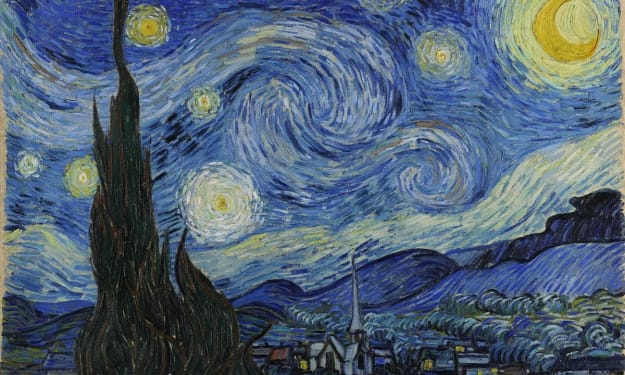
The Starry Night: A Symphony of Silence and Madness In the hush of a Saint-Rémy night, the stars whispered. It was 1889, and Vincent van Gogh sat behind the iron bars of the asylum window, his breath fogging the glass as the wind stirred the cypress trees beyond. The room behind him was still—too still. Silence had always been his shadow, but now it had teeth. Every ticking second scraped at his thoughts. Yet, above him, the sky lived. The world outside did not sleep as he did; it pulsed, it wept, it sang. Vincent could see it more clearly than anyone ever had—not with his eyes, but with the fevered clarity of a soul that had been both broken and reborn. He didn’t paint The Starry Night from a real view, not entirely. No, what he painted was truer than real. It was the sky as he felt it. It was turbulence, longing, hope, and fury tangled together in color. By day, the village below was quiet, ordinary. But by night, in Vincent’s mind, it bloomed—golden windows glowing like small embers of humanity, a sleepy chapel reaching like a prayer, the cypress tree a flame that refused to go out. The stars? They were not dots. They were whirlpools of light, great celestial dancers caught in a storm of meaning. They spun with sorrow, joy, and everything in between. They knew Vincent, and he knew them. Each brushstroke was a breath, a confession, a scream. The sky swirled in his mind and poured out in ultramarine and cobalt, slashed with streaks of lemony yellow and milky white. He didn’t paint what he saw. He painted what he felt—what he needed to believe: that something divine was out there, beyond the chaos, cradling the world in light. And yet, even with the cosmos alive above, the night had weight. Vincent was not just an artist. He was a man fractured by loneliness, haunted by thoughts he couldn't escape. This masterpiece, now immortal, was born in the confines of a room meant to contain madness. But what the world later hailed as genius, the world at the time barely noticed. He sold only one painting in his lifetime. One. Vincent painted because he had to. Because to not paint would be to drown. As he stood back from The Starry Night, the oils still wet, something in him stirred. He had captured not a scene, but an emotion—the exact moment when despair kisses awe. The moment when the soul, even shattered, dares to look up. He once wrote to his brother Theo, "Why, I ask myself, shouldn’t the shining dots of the sky be as accessible as the black dots on the map of France?... Just as we take the train to get to Tarascon or Rouen, we take death to reach a star." Vincent didn’t fear the stars. To him, they were destinations. And though he would not live to see his painting grace museums or inspire generations, The Starry Night became a language the world could understand. Long after he left this world, the sky he painted continued to speak—of pain, of passion, of the indescribable ache to feel connected in a universe that often feels indifferent. Today, millions stand before the canvas in hushed wonder, not realizing they are walking into the echo of a man’s final hope. Each swirl, each spark, is a reminder that beauty can emerge from the depths of torment. That even in confinement, the soul can take flight. The Starry Night is not just a painting. It’s a promise. That no matter how dark the world becomes, the stars will still burn. That someone, somewhere, will always see what others cannot. That art—raw, imperfect, heart-wrenchingly human—can outlive the silence. So the next time you look up, remember Vincent. Remember that behind every star, there may be a story not yet told. And within each of us, there may live a night sky just waiting to be seen.
By Soul Draftsabout a year ago in Art
The Evolution of Vaping Technology
Over the past two decades, vaping has transformed from a niche alternative to smoking into a global phenomenon driven by technological innovation and changing consumer habits. What started as a simple e-cigarette concept has evolved into a dynamic industry with countless devices, flavors, and designs that cater to every preference. As technology continues to advance, vaping devices have become smaller, more efficient, and more stylish, redefining how people approach nicotine consumption.
By Ayush Bagwariabout a year ago in Art
The Serpent's Promise
In a faraway land where the trees rose higher than towers and vines draped like curtains in the sky, there was a jungle no one dared to explore. The villagers who lived near it believed the jungle was enchanted—cursed, even. They told tales of creatures that spoke in silence, spirits that lived in the shadows, and a mighty serpent said to be the guardian of the forest.
By Khalid khanabout a year ago in Art
Eye Catching Vivid Paintings That Dazzle the Senses
If you've ever walked into a room and felt your mood instantly lift, color likely played a big role. Art has the power to shape how we feel, and vivid paintings do this best. With bold tones and lively strokes, these pieces aren’t just decorations they’re experiences. They draw your eye, wake up your senses, and speak without saying a word.
By sedona art studiosabout a year ago in Art
Buying CBD Legally Online in Portugal: What You Should Know
In recent years, CBD has gained significant popularity worldwide for its potential health benefits, ranging from pain relief to anxiety reduction. Portugal, known for its progressive stance on drug policies, has become an attractive destination for those interested in purchasing CBD products. But despite the country's open-minded approach, there are specific laws and regulations that consumers need to understand when buying CBD online in Portugal.
By Ayush Bagwariabout a year ago in Art
How to Find the Best Vape Deals Online Without Getting Scammed
The vaping industry has experienced tremendous growth in recent years, offering enthusiasts and beginners alike a wide range of devices, e-liquids, and accessories. With so many online stores vying for attention, it's never been easier to find great vape deals. However, this abundance of choice comes with a downside: the risk of falling victim to online scams. From counterfeit products to fake websites, navigating the world of online vape shopping can be tricky. This guide will help you find the best Vape Deals online while steering clear of common scams.
By Ayush Bagwariabout a year ago in Art
The Museum in My Mind
Where every brushstroke tells a personal story, and every exhibit is a window into the soul. We all have a gallery within us—a private, sacred space where memories live like paintings hung on invisible walls. I call mine The Museum in My Mind, and through its endless corridors, I walk when the world outside gets too loud. Whether you're an artist, a dreamer, or someone quietly surviving, this concept resonates deeply: we are all curators of our own experiences, arranging joy, grief, and nostalgia like works of art.
By Mehtab Ahmadabout a year ago in Art