Contemporary Art
How the NFT Market Can Survive
The NFT market isn’t dead it’s just being stripped of its illusions. The speculative mania of 2021 was never built to last. JPEGs selling for millions? Influencers minting overnight hype? That era has come and gone, and what’s left now is a crucial moment of reckoning. For NFTs to remain relevant, they must become more than digital collectibles. They need to serve a function not just exist as symbols of scarcity. NFTs must embed themselves into workflows, economies, and user experiences. Starbucks Odyssey and Nike’s .Swoosh didn’t bet on hype; they bet on infrastructure. They treat NFTs not as the product, but as the protocol behind new engagement models. Scarcity might spark interest, but only utility sustains it. NFTs that represent access, membership, rewards, or even digital identity offer a path forward. The rest the lazy, static projects will quietly rot in forgotten wallets.
By Paul Reinhartabout a year ago in Art
[SOL ETF Launch] America's First Ever Staking ETF.
It’s official. The first staking-based cryptocurrency ETF in U.S. history has launched, and it's built on Solana. REX Shares has introduced the REX-Osprey Solana and Staking ETF, offering investors direct exposure to SOL while generating staking rewards. This is not a synthetic product or futures contract. It’s real SOL, staked for passive income.
By Elias R. Vaneabout a year ago in Art
Classic & Poetic
The Wanderer Above the Sea of Fog: A Story of Solitude and Soul The fog curled around the mountain peaks like a living thing, soft and silent, veiling the world below in mystery. From the jagged precipice where he stood, the wanderer could see only hints of what lay beneath—black ridges cutting through the pale, sea-like mist, like islands afloat in a spectral ocean. He had climbed since dawn. Now, as the wind curled his coat and tugged gently at his unkempt hair, he stood alone at the edge of the world, and time itself seemed to pause. He had no name anymore. Names were for towns, for people who lived among roads and roofs and reasons. Up here, among the rocks and clouds, he was simply a presence—a figure. The world had called him many things before: soldier, scholar, lover, son. Each of those labels had been shed along the way, dropped like stones in a river until the currents of time smoothed them out and carried them from memory. What remained was the journey. He had taken to the mountains years ago. At first, it had been an escape—from war, from heartbreak, from the sharp disappointments that come with living among men. Later, it became a search. For what, he hadn’t known. Still didn’t. Only that something called him forward, from ridge to ridge, from one lonely path to the next. The journey had changed him. Where once he had feared silence, he now found comfort. Where once he sought answers, he now embraced the questions. The mountains taught him to listen—not just to the howling wind or the crunch of boots on gravel, but to the quiet voice within. The one that whispers truths you cannot hear amid the noise of cities. And now he stood here, above the sea of fog, on a summit he'd chased for weeks. The sky above was iron-gray, vast and indifferent. No sun broke through. No birds called. Only the whisper of wind through the rocks. Yet the moment was not empty. It was everything. He thought of the countless souls below, caught in their cities, their days structured by clocks and debts and dreams not their own. He had once been one of them—working for a future written by other hands, walking streets that led to nowhere he wanted to be. But out here, with no audience but the sky, he had found a new freedom. A terrifying, beautiful kind. He closed his eyes. He remembered a woman once—soft-voiced, strong-eyed. She had loved him once, or at least tried to. But he had always looked beyond her, toward some invisible horizon. She had said he was always somewhere else, even when he was with her. Maybe she was right. Maybe he had always been chasing this very moment—the stillness, the view, the feeling of being nowhere and everywhere at once. He opened his eyes. The fog below shifted, revealing for a moment the shadow of a forest. Then it closed again. Like memory. Like time. He knew he would leave again. Climb down. Move forward. The journey was not over; perhaps it never would be. But for now, he allowed himself this one moment to simply be—a silhouette carved against the mist, a question without an answer. The world had become too full of noise, too full of certainty. Everyone shouted, everyone knew. But up here, the silence spoke truer than a thousand books. It said: You are small, and that is not a tragedy. It said: The world does not need to make sense to be beautiful. It said: You, too, are fog and stone, here and gone. He smiled faintly. The wind bit colder, reminding him he was still flesh. Still breathing. Still climbing. One day, perhaps, someone would find a painting of this moment—him, standing above the sea of fog—and wonder who he was. Some might call him a Romantic, a dreamer, a lost soul. Others might project meanings onto his stillness: rebellion, melancholy, transcendence. But he would not be there to confirm or deny. His truth was not in stories or labels. It was in the wind that tugged at his coat. In the ache in his legs. In the beauty of the unspoken. He turned away from the cliff’s edge, not because he had found what he was looking for—but because the journey was calling again. The path ahead, half-shrouded in mist, promised no answers, only more mystery. And that, he had learned, was enough. Author’s Note: Inspired by Caspar David Friedrich’s iconic painting “The Wanderer above the Sea of Fog,” this story imagines the life behind the silhouette—the soul who climbs not just mountains, but the invisible terrain of human longing. In a world obsessed with certainty and speed, sometimes it’s the wanderers—those who pause, question, and walk alone—who see most clearly.
By Soul Draftsabout a year ago in Art
Neymar: The Samba Magician
In the bustling streets of Mogi das Cruzes, a small city outside São Paulo, a barefoot boy danced with a football as if it were part of him. His name was Neymar da Silva Santos Júnior—known to the world simply as Neymar. Born on February 5, 1992, he grew up in modest surroundings but with a wealth of talent that would soon make him one of the brightest stars in the football universe.
By Abdullah khanabout a year ago in Art
The Triple Gaze: Charles I in Three Positions
The Triple Gaze: The Story Behind “Charles I in Three Positions” In the hushed halls of Windsor Castle, a curious painting hangs with regal stillness—three versions of the same man, staring in slightly different directions. He is solemn. He is proud. He is haunted. His name? Charles I of England. The painting? “Charles I in Three Positions”, a masterpiece by the Flemish court painter Sir Anthony van Dyck. But this is no ordinary portrait. This is a painting born not from vanity, but diplomacy, divine image-making, and the anxious dance of power. A Royal Image Projected It is the 1630s. Charles I, King of England, Scotland, and Ireland, reigns during a time of great unrest. Though his court is filled with elegance and ritual, trouble stirs in Parliament and among his people. But for now, his mind is focused elsewhere—on Rome. Specifically, on one of its most famous sons: Gian Lorenzo Bernini, sculptor to popes, designer of fountains, and master of marble. Charles, ever conscious of image and legacy, desires a bust—one that will capture his kingly presence for all eternity. But how do you send your likeness to an artist an ocean away? The answer lies in paint. Enter Van Dyck, Charles's beloved court painter. A man of charm, style, and keen insight, Van Dyck was more than a mere artist. He was a craftsman of illusions, a conjurer of royal myth. His brush flattered but never lied outright. He painted kings not as they were, but as they should be. And so he created a portrait like none before: a single canvas, three views—left profile, frontal, and right three-quarter. The result was both pragmatic and poetic: a reference tool for Bernini, and a meditation on kingship, identity, and fate. A King in Fragments The triple portrait shows Charles adorned in variations of lace collars and luxurious robes, each subtly different. His hair, auburn and flowing, is styled with courtly precision. A faint sadness touches the corners of his eyes, a shadow that perhaps only Van Dyck could see—and that history would later confirm. The front-facing view commands attention. It is the most formal of the three, the closest to what we might call an “official portrait.” Here Charles is not a man but a monarch, distant and immaculate. To the left, he appears younger, more delicate, almost wistful. The gaze is sidelong, as if recalling a memory or sensing a future out of reach. On the right, the angle is more assertive, almost confrontational. Here Charles seems to meet us head-on, with the conviction of someone who believes in the absolute right of kings. Together, these three faces compose a symphony of contradictions: power and vulnerability, confidence and doubt, the eternal and the ephemeral. Sculpting Kings, Shaping Alliances Once complete, the portrait was shipped to Rome, where Bernini studied it with great care. The bust he created from it was considered a triumph, capturing Charles’s likeness with uncanny accuracy. So impressed was Pope Urban VIII that he is said to have declared the English king “the handsomest ruler in all of Europe.” But there was politics at play too. The Pope hoped the gift might warm relations between Catholic Rome and Protestant England, perhaps even nudge Charles toward religious reconciliation. That hope, like so many of Charles’s dreams, would ultimately wither. Art in the Face of Collapse Only a decade after the painting’s creation, Charles’s world would come crashing down. His belief in the divine right of kings, his refusal to bend to Parliament, and his aloof detachment from the common people would spark the English Civil War. By 1649, the king whose face had been immortalized in brush and marble stood trial for treason. He was sentenced to death and beheaded outside the Banqueting House in Whitehall—a place he had once adorned with grandeur and ceremony. As the blade fell, his triple gaze was shattered. The bust, created by Bernini from Van Dyck’s reference painting, was later destroyed in a fire at Whitehall Palace. Only the painting remains. A Legacy in Oil and Silence Today, “Charles I in Three Positions” is more than an artistic curiosity. It is a relic of a lost world—a portrait of power composed just as power was slipping away. It has influenced countless artists over the centuries. Salvador Dalí, with his obsession with multiple perspectives and disjointed realities, drew inspiration from it. Filmmakers and photographers have used its form to explore themes of identity and perception. Even in psychological studies, the triple image format has become a metaphor for how we see ourselves, and how others see us. But beyond all that, it remains a ghost story of sorts. A ghost of a king who believed in his divine right, of a court that reveled in appearances, of an artist who painted a man and glimpsed his fall. Conclusion: The Face of a Nation, Split in Three “Charles I in Three Positions” is not just a royal portrait—it’s a meditation on power, mortality, and the illusion of control. Each angle captures not just a face, but a moment, a mindset, a monarchy on the verge of crisis. As viewers, we are left to wonder: which face was the real Charles? The confident ruler? The cautious observer? The haunted soul? Or perhaps the truth, like the portrait itself, lies in the space between the angles—in the fragments of a man destined to become more myth than monarch.
By Soul Draftsabout a year ago in Art
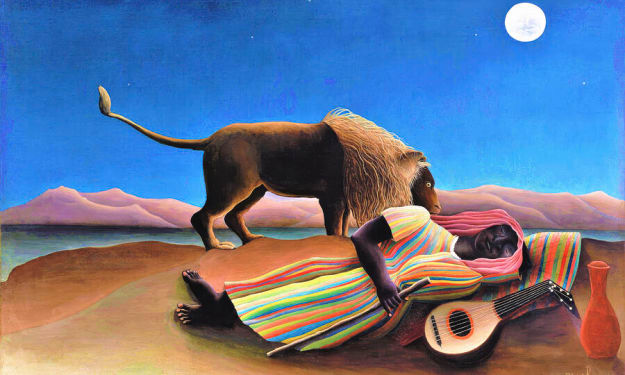
The Sleeping Gypsy
Title: The Sleep Beneath the Moon The desert had no name. It stretched in silence beyond the memory of maps, a vast ocean of sand lit only by the indigo breath of night. Wind moved softly across the dunes, lifting small whirls of dust like whispers from the past. Beneath the silver eye of the moon, there was no time—only stillness. And in that stillness, she slept. A woman lay curled on her side, wrapped in a robe of deep red and ochre stripes. Her skin, dark as ancient wood, glowed faintly in the moonlight. Her head rested on a worn mandolin, as if the instrument itself had lulled her to sleep. Beside her sat a simple jar, glazed and cracked, empty of water but filled with meaning. She was alone. A gypsy, they would call her—though no name ever followed. She was one of the wanderers. The kind who followed stars rather than roads, who sang lullabies to goats and lullabies to ghosts. She had walked across cities and sand, over mountains and along riverbeds, carrying her songs like seeds to be scattered. And now she slept in the sand, without shelter, without fear. But she was not alone. The lion watched. He had come silently, his golden paws pressing into the soft dunes like shadows. His mane shimmered beneath the moon, catching light like fire held in a net. His eyes, large and unreadable, studied the sleeping woman with neither hunger nor aggression. He did not growl. He did not move. He simply watched. It was a strange sight, even in a world that had long forgotten the border between reality and dream. A wild beast, drawn to a sleeping stranger not by scent, but by something deeper—something even he could not name. He sniffed the air. She smelled of cedarwood and smoke, of worn leather and faint rose. But beneath that—beneath the human details—she carried another scent. Memory. The lion blinked. The mandolin glowed faintly in the moonlight. Its strings vibrated softly, though no hand had touched it. It was as if the night itself had plucked a single note from its frame, a lullaby too old for language. The sound was not heard so much as felt—like an echo in the ribs, like the hush of a mother before the cradle. The lion lay down. The woman slept on. Before she had come to the desert, the gypsy had known many places and none. She had danced in courtyards where children threw petals at her feet, and she had sung to empty alleyways when rain made rivers of the streets. Her songs were not just songs—they were stories, memories, spells to keep loneliness at bay. But the world had grown louder. It no longer listened. Cities bustled with metal hearts. People moved too fast to notice music unless it shouted. She had tried to keep up, tried to play in crowded taverns and train stations. But her songs, soft and strange, were drowned in noise. So she turned back to silence. To the desert. To the moon. She walked for days. Ate little. Drank less. And when her feet could carry her no farther, she lay down, trusting the earth to cradle her. And so it did. And so did the lion. In the moments between midnight and dawn, when time breathes its slowest, the gypsy stirred. She did not open her eyes. But in her dream, she stood—barefoot and tall—on the dunes. The moon hovered close, large as a drum. And before her stood the lion, eyes glowing like small suns. “You found me,” she said, her voice a breath. “I followed your song,” the lion answered. “I didn’t know I was still singing.” “You were,” he said. “Even in silence.” She smiled. “What do you want?” “Not want,” the lion replied. “Remember.” He stepped closer. His breath was warm wind. “You forgot you were part of the wild.” “I grew tired,” she said. “Yes,” the lion said. “The world is heavy. But you are older than it. Your voice carries the sound of the first fire. The first lullaby.” “I am only one woman.” “You are one,” the lion said. “But you carry many. Your sleep feeds the sky.” She looked up at the moon. “Then let me rest a while longer.” The lion nodded. “I will guard you.” When morning came, the sun kissed the desert softly, slowly lighting the dunes in gold. The air was cool and expectant. The lion had vanished, as though dissolved into the light. The woman stirred but did not wake. Her breathing was slow, peaceful. Travelers would one day pass through this land, and they would speak of the woman who slept beneath the stars. Some would call her a mystic. Others, a myth. A few would say she never moved at all, as if preserved in time. But every so often, someone would stand before her and feel something stir within. A memory of music. A whisper of courage. A wild thing, still breathing inside them. And they would remember: The gypsy did not sleep to escape the world. She slept to hold it. To cradle it like a song in the dark. To remind even lions to listen. Author’s Note: This story is a fictional reimagining inspired by The Sleeping Gypsy (1897) by Henri Rousseau. In this surreal painting, a woman lies asleep in a moonlit desert with a lion curiously watching over her. Rousseau never fully explained the symbolism, allowing viewers to draw their own interpretations. This story explores the image as a poetic myth—one that blends solitude, feminine power, the mystery of dreams, and the strange tenderness between the wild and the weary.
By Soul Draftsabout a year ago in Art
Whispers in Blue: The Story Behind Degas’ Dancers
Title: Whispers in Blue: The Story Behind Degas' Dancers The rehearsal room was hushed, though not silent. The wooden floor creaked like the hull of an old ship. Dust drifted lazily through the late afternoon light, golden and tired as it spilled through the high windows. In a quiet corner of the room, Edgar Degas sat still, eyes half-lidded, sketchbook on his lap, his gaze fixed on the blue. Four girls stood like petals of the same flower—slightly apart, yet turning toward a shared center. They moved in rhythm not to music but to memory, to instinct, to an echo of a piano long since gone quiet. The girl nearest to Degas was Clara—barely seventeen, her limbs wiry from years of training. Her hands fluttered as she adjusted the bow at her waist. She was always adjusting, always correcting, never quite sure she belonged. Her mother had once danced here, long ago, before love and illness claimed her bones. Clara bore that legacy like a bruise beneath the skin. Next to her, Elise brushed invisible dust from her tutu. Her fingers, pale and slender, betrayed a nervous energy. Elise had come from the provinces with a letter of recommendation and a dream stitched into her bodice. She danced with the desperation of someone who knew this stage might be her only one. Behind them, Camille stretched her arms above her head, her eyes closed in the grace of a swan. She was the quiet one, the one who never laughed too loud or cried too long. She danced as if gravity did not apply to her, as though her body remembered flight. And then there was Margot. Margot was the sun around which the others turned—unknowingly, perhaps unwillingly, but inevitably. Her movements were effortless, her form a study in balance and breath. She was not the most technical dancer, nor the most disciplined, but she possessed that rare thing: presence. When Margot danced, time bowed before her. Degas had sketched these girls before. Many times. He knew their backs better than their faces, their poses better than their postures at rest. He was drawn to the moments before the performance—the lull between sweat and spectacle, the grace that came not from choreography, but from the simple act of being. Today, he painted them in blue. Not the vivid blue of summer skies, nor the somber blue of a storm. No, this was the blue of velvet shadows and soft silence—the color of reflection and breath held in anticipation. The rehearsal had ended an hour ago, but they lingered, as dancers often did, caught in the gravity of their shared devotion. They talked softly—about slippers worn thin, instructors too harsh, the ache in their hips and the dreams in their chests. Their voices wove around each other like ribbon. Clara watched Margot out of the corner of her eye. She envied her, but it was a gentle envy—like watching a bird take flight and knowing your wings were still growing. “Do you ever get scared?” she asked. Margot smiled faintly, as if remembering something far away. “Always,” she said. “But I dance through it.” Degas made no sound, but his pencil moved quickly, hungrily. He wanted to capture that—not the fear, but the dancing through it. Camille, noticing him, lowered her arms and turned ever so slightly away. “Monsieur Edgar,” she said quietly, “you always catch us at our most tired.” He smiled, without lifting his head. “That’s when you’re most real.” They laughed, a little. It was a sound like bells dropped into water—delicate, muffled, fleeting. He had painted them many times—sometimes in oils, sometimes in pastels. Sometimes only in memory, days later. He did not ask them to pose. He let them exist and tried to keep up. Blue was the only color that felt right for today. It softened the edges. It held their forms together, like a binding spell. The dresses floated, the bows curled, the necks bent like lilies under moonlight. There was no spotlight here, no stage. Only the hush of dreams rehearsed in half-light. The girls gathered their things eventually. Time crept forward, as it always must. They stepped out into the Paris dusk, their shadows long and overlapping. They would return tomorrow, and the day after, until their bodies no longer obeyed or the world found some other use for them. Degas remained, his brush sweeping the last curve of a shoulder, the final whisper of tulle. He didn’t paint ballerinas for the stage, for the sparkle and adoration. He painted them because they were metaphors—for fragility and fight, for beauty forged in silence, for the small acts of grace that happen away from the curtain. Blue Dancers wasn’t a portrait. It was a memory. A quiet ballet in a world that moved too quickly. And maybe, just maybe, it was a prayer—that these girls, with their aching feet and quiet fears, might one day know how radiant they looked, even when they weren’t looking.
By Soul Draftsabout a year ago in Art
More Than a Painting: The Story of Madonna Litta
Title: The Silent Bond – A Story Inspired by Leonardo da Vinci’s “Madonna Litta” In the stillness of a Renaissance room, where the light barely dances across the stone floor and the heavy curtain parts to reveal the sky, a young woman cradles her child. Her gaze is soft, her expression serene, yet beneath the tranquility, there is an unspoken intensity — a bond beyond words, brushstrokes, or time. This is the world captured in Leonardo da Vinci’s “Madonna Litta,” a painting as enigmatic as it is tender. Painted around 1490–1491, likely during Leonardo’s years in Milan, “Madonna Litta” depicts the Virgin Mary breastfeeding the infant Christ, a common theme in Christian iconography. But in Leonardo’s hands, it transcends the symbolic and enters the realm of deeply personal human experience. And yet, despite the layers of emotion infused into the painting, the story behind it remains cloaked in mystery — and, perhaps, myth. Let us imagine, then, a story. The Milanese Court, 1491 The winter was mild that year, though the stone corridors of the Sforza court still held onto their chill. Duke Ludovico Sforza, known as Il Moro, was building his legacy not just through politics and war but through art. His court had become a sanctuary for thinkers, architects, musicians, and painters. Among them stood Leonardo da Vinci — a man whose hands never ceased sketching, whose mind was never still. It was during this time that Leonardo, ever curious about anatomy and emotion, began a study not of nobility or myth, but of motherhood. He had seen mothers in the market, watched their instinctual gentleness, the way their bodies curved toward their children. He wondered: could art ever truly capture that moment of sacred intimacy? In a modest home outside Milan, a young woman named Lucia lived quietly with her newborn son. She had once been a lady-in-waiting, known for her calm spirit and luminous beauty. Her life had taken a quieter turn, far from the whispers and expectations of court. When Leonardo met her — through a midwife he sketched for anatomical studies — he saw in her not just a model, but a presence. Lucia agreed to sit for him, not out of vanity, but because she sensed in Leonardo a reverence that had nothing to do with flattery. Days turned into weeks. In a softly lit studio, with windows high and dust motes catching the morning light, Leonardo painted. Lucia would come with her child, and together they would sit in silence. The baby, restless at first, would grow still in her arms, lulled by her heartbeat, her warmth, the gentle rise and fall of breath. Leonardo observed everything — the slope of her neck, the arch of her hand as it supported the child’s head, the half-smile that lingered on her lips even in her weariness. But most of all, he watched the gaze. That unbreakable thread of love between mother and child. It was not something he could fully explain in words. It was something he would have to show in paint. The Painting In “Madonna Litta,” Mary is dressed in rich crimson and deep blue, colors of sacrifice and divinity. Her veil, drawn delicately over her hair, speaks of modesty and grace. But it is her face — youthful, focused, inward — that holds the viewer. Her eyes are not looking at the child, but through him, as if contemplating a future that only she can sense. The Christ child, chubby and alert, feeds eagerly, grasping at her robe. He is no ethereal figure here, no golden-haloed abstraction, but a real child, hungry, alive, human. Behind them, arched windows open to a clear, mountainous landscape — perhaps a reminder of the divine beyond the domestic. Or perhaps, like much of Leonardo’s work, it symbolizes the coexistence of nature and humanity, the eternal and the immediate. While the painting is sometimes debated in attribution — with some suggesting it may have been completed or touched up by Leonardo’s student Giovanni Antonio Boltraffio — the design and essence bear Leonardo’s unmistakable touch. The intimacy, the anatomical precision, the spiritual undertones without overt religious symbolism — all hallmarks of the master. Legacy and Interpretation For centuries, “Madonna Litta” has stirred the hearts of those who view it. Though now housed in the Hermitage Museum in St. Petersburg, the painting continues to speak in a universal language. It doesn’t need Latin inscriptions or dramatic gestures. The emotion is quiet, yet profound. Some art historians suggest the painting is less about theological doctrine and more about the sanctity of motherhood itself. In an age where Madonna images often emphasized divinity at the cost of humanity, Leonardo turned the tide. His Virgin is not remote or regal — she is real, tender, infinitely strong in her softness. This subtle revolution in religious art — the shift toward emotional realism — would ripple through Renaissance painting, influencing generations. And it began here, with a mother, a child, and a man obsessed with capturing truth through beauty. The Story That Lives On Whether Lucia truly existed as described, or whether she was a figment of Leonardo’s imagination, we may never know. But in the “Madonna Litta,” she — and every mother like her — lives eternally. This is not just a portrait. It is a moment carved out of time, a meditation on love, sacrifice, and the divine made flesh. It reminds us that even the greatest of stories — the rise of kings, the miracles of prophets — begin in the arms of a mother, in the quiet miracle of life being nourished. Leonardo, always seeking to understand the cosmos, found his universe in a single gaze between mother and child. And that gaze still meets ours, more than 500 years later.
By Soul Draftsabout a year ago in Art
Vivace Perfumes and the World of Artisanal Perfume Craftsmanship
artisanal perfumes. These handcrafted fragrances, often created in small batches by master perfumers, are capturing the hearts (and noses) of those who crave authenticity, creativity, and deeper olfactory stories. At the forefront of this movement is Vivace Perfumes, a brand that celebrates niche fragrance artistry and introduces connoisseurs to the most revered names in the artisanal world — including Areej le Doré, Agar Aura, and Jinx Perfumes.
By Vivace Perfumesabout a year ago in Art