
Ricardo Breceda: The Weird Kid Who Welded a Kingdom
The California artist went from selling cowboy boots to building a desert menagerie of steel. It started with a Christmas promise to his daughter.
By Brian D'Ambrosio
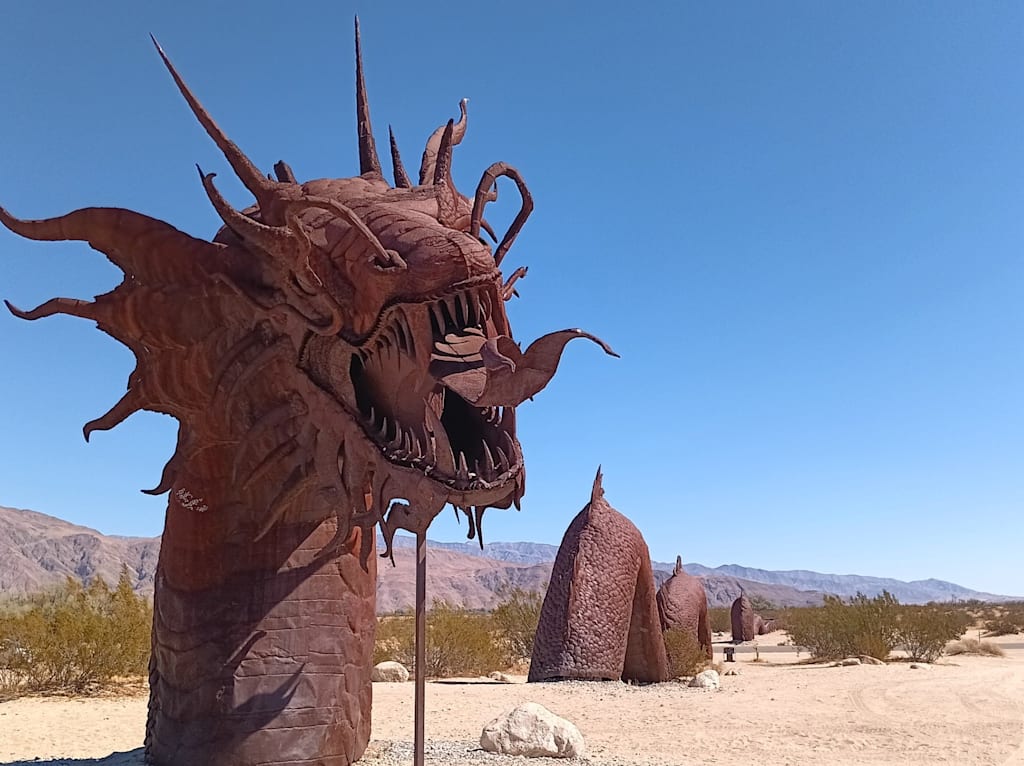
In the California desert near Borrego Springs, a metal serpent stretches across the sand, dinosaurs stand against the sky, and strange creatures appear to have wandered out of another geological age. The figures belong to Ricardo Breceda, a self-taught sculptor who turned scrap metal into an open-air kingdom. More than 130 of his sculptures occupy the surrounding landscape. Their maker began far from the art world, selling cowboy boots and raising a daughter who wanted a Tyrannosaurus rex.
Born in Durango, Mexico, Breceda came to California at 22 and worked a succession of jobs. Selling cowboy boots proved particularly lucrative. He dealt in expensive leather—ostrich, alligator, stingray—and knew how to turn a stranger into a customer. He would walk into a bar, buy a round for the house, and introduce his merchandise.
“Next day, at least those eight, ten people, at least one or two, at least two people come over to my house to buy boots from me,” he recalled. “So, they pay for the round, I don't pay nothing.”
He had a knack for the hustle. Art came later.
“I was always a weird kid,” Breceda said. “Always in trouble.”
One of nine children, he spent Christmas taking apart other people's toys. He wanted to know what was inside, how things worked, what made them tick. Putting them back together was another matter.
“I just like to break things, check it out,” he said. “And I'm always curious about things.”
School held little appeal. “I wasn't even a good student,” he admitted. Restless and mischievous, he was drawn to discovery more than instruction. Years later, that same impulse would lead him to attack sheets of metal with a welder, finding out what else they could become.
The unlikely commission came from his daughter, Lianna. After watching Jurassic Park III, she asked for a T. rex for Christmas. Breceda had traded a pair of boots for a welding machine. He figured he could make something for her.
“She said, ‘No, you make it for me, Papa.’ Oh, yeah, yeah. I make it for you.”
He built a dinosaur roughly 20 feet tall and 45 feet long, then placed it beside the freeway near his home in Perris, California. Motorists slowed down. People stopped to take pictures. Television crews and newspaper reporters came looking for the man who had built the beast.
Breceda had stumbled into a new occupation without quite knowing what to call it.
“Nobody in the family has listened to any of this,” he said. “And I got into this kind of like by accident.”
The dinosaur was his beginning, not yet the desert kingdom for which he would become known. That larger chapter came several years later, when philanthropist Dennis Avery, an heir to the Avery Dennison fortune, commissioned Breceda to create sculptures for Galleta Meadows, Avery's property near Borrego Springs. The first major installations appeared in 2008. What followed was an expanding collection of prehistoric mammals, dinosaurs, wild horses, insects, historical figures, and a 350-foot serpent that seems to slither through the sand.
Breceda says he made 133 pieces for Avery. Finding them all is another matter. They occupy thousands of acres, some standing in plain view, others set back among the low hills. Visitors may drive past one, turn around, and discover another they missed.
“A hundred and thirty-three,” he said. “It's not easy to catch.”
He remembers spending three months assembling and finishing the enormous serpent, hauling unfinished sections into the desert and adding details on site. His early sculptures were comparatively flat and crude. He still keeps many of them at his studio in Aguanga, California, reminders of how far his eye and technique have traveled. He learned by doing, hammering and shaping metal until surfaces gave way to muscle, contours, and details that caught the light.
“I'm not there yet,” he said of his work. “I think I can do even better.”
The desert exacted its own price. One morning, Breceda was working alone with the temperature already at 116 degrees. He wore his welding jacket, with the sun overhead and hot metal in front of him. He wanted to finish the job and ignored the heat.
A young man in a red pickup stopped, carrying a gallon of water.
“What the hell you doing right here? You stupid or what?” Breceda remembered him shouting.
The stranger told him to stop, gave him water, and insisted on accompanying him away from the worksite. Breceda eventually understood how dangerous the situation had become: the desert heat, the heat trapped inside his jacket, and the heat radiating from the metal.
“That guy saved my life,” he said. “I never see that guy again in my life. And I want to see him to say thank you.”
He thanked the man and embraced him that day, but never saw him again. The memory has stayed with him, a reminder that stubbornness can carry a price.
Breceda has since endured serious illness and a heart attack. He speaks of setbacks without much ceremony. He would rather keep moving than make a monument to misfortune.
“When something bad happen, like when somebody give you a kick in the ass, wow, you gotta be running faster when you get kicked in the butt,” he said.
At his studio, the work continues. There are large creatures and smaller pieces, animals, insects, and oddities meant for people's homes. Breceda likes the way a sculpture starts a conversation, even if someone's first reaction is that it looks ugly. In Borrego Springs, he especially enjoys hearing children laugh and shout among the figures.
“People love them,” he said. “And the more I got, the better I feel.”
The boy who took apart toys has found a way to make things that strangers stop to study. He still sees room for improvement, still has ideas waiting to be built, and still regards the whole enterprise as something that happened almost by accident.
“It's all about passion,” Breceda said. “In anything you do in life, you have passion to do whatever. And eventually you become good.”
Brian D’Ambrosio is the author of New Mexico Eccentrics, Montana Eccentrics, and American Eccentrics: Mavericks, Misfits, and Visionaries.
About the Creator
Brian D'Ambrosio
Brian D’Ambrosio is an arts, culture, and music writer whose work appears nationally and regionally. He covers overlooked figures, musicians, artists, athletes, and eccentrics. Contact: [email protected]
Enjoyed the story? Support the Creator.
Subscribe for free to receive all their stories in your feed.
Comments