
Michael Wright: Where Steel, Spirit, and Salvage Converge
- Madrid, New Mexico

By Brian D’Ambrosio
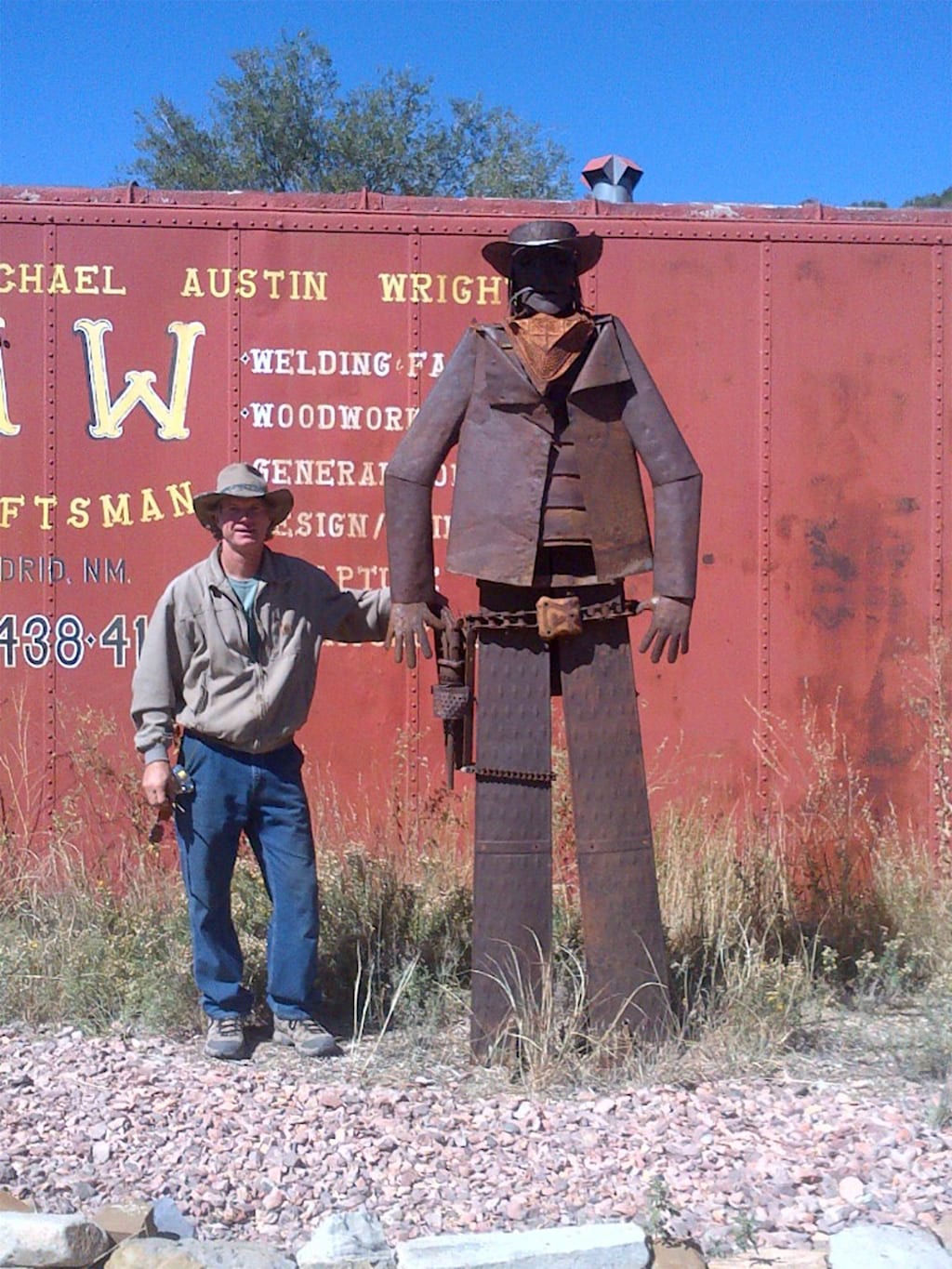
In the weathered, art-soaked mining town of Madrid, where rust and imagination seem to share equal footing, Michael Wright has built a life that straddles two worlds—commerce and creation, structure and spontaneity. At 64, Wright is both a seasoned commercial contractor and a restless sculptor, a man who finds as much satisfaction in raising a house as he does in resurrecting discarded metal into something unexpectedly alive.
By day, Wright navigates the precise and often unforgiving demands of construction: insurance requirements, contract language, structural integrity, and the orchestration of skilled labor. It is a world governed by measurements and margins, one where errors carry weight and experience is well-earned. “It’s complex, and it can be stressful,” he concedes. But even here, creativity finds its way in. A steel beam becomes not just support but statement; a welded detail transforms a room from functional to memorable. Clients, he notes, respond to that flexibility—to the sense that their homes are not simply built, but interpreted.
Still, it is in his sculpture that Wright finds something closer to freedom. “It’s an escape,” he says. “It’s therapy.” Unlike architecture, which demands long hours at a desk or adherence to rigid plans, sculpture allows him to move, to improvise, to follow instinct rather than blueprint. His work begins not with pristine materials but with what others have cast aside: old car emblems, dented hoods, propane tanks, railroad spikes, broken wrenches, lengths of copper conduit. Each piece carries a past life, a provenance he values deeply.
“I like the history in it,” Wright says. “The idea that it’s already been something.”
His creative process is part scavenger hunt, part puzzle. A shape glimpsed in a scrap pile becomes the seed of an idea; a curved fender suggests a shoulder, a length of steel hints at a spine. Over time, these fragments assemble themselves into cohesive forms—totemic masks fashioned from motorcycle gas tanks, for instance, or monumental figures that seem to bridge cultures and eras. One such piece, an eagle kachina sculpted from a weathered propane tank, still bears the ghost of its original warning label beneath a green patina. Feathers arc upward, welded into place, while a beak emerges from the tank’s curvature, transforming industrial refuse into something almost ceremonial.
Another work draws from classical inspiration. What begins as a simple oval—borrowed from the eye of a pick handle—expands into a three-dimensional horse assembled from unlikely sources. A broken wrench from an oil rig forms the jaw; horseshoes shape the mouth; a segment of railroad track becomes the nose; copper wiring flows into a mane. The result is at once ancient and modern, a sculpture that feels as though it might belong equally in a Greek ruin or a desert yard.
This interplay between cultures and materials is central to Wright’s philosophy. His work often carries echoes of Native and tribal aesthetics—not as imitation, but as a kind of dialogue. “It’s more of a feeling,” he explains, a shift from a strictly intellectual approach to something rooted in the heart. Living in New Mexico for more than 20 years has only deepened that perspective. He speaks with admiration of the region’s emphasis on community, family, and connection to land—a counterpoint, perhaps, to the accumulation-driven culture he sees elsewhere.
In this sense, Wright’s sculptures quietly challenge conventional ideas of value. A rusted fender, once part of a mid-century automobile, might now command a price exceeding the car’s original cost. But for Wright, the transaction is secondary. “I want someone who appreciates it to be able to afford it,” he says. When a piece sells, it is less about profit than about validation—a signal that the idea has resonated, that the next piece is worth pursuing.
Not every work finds its audience immediately. Some linger in his studio for years, gathering dust and admiration in equal measure until the right person arrives. Others evolve over time, adjusted and refined as new insights emerge. Wright is comfortable with that uncertainty. Like a basketball player working toward a rhythm, he trusts that persistence will eventually bring him back into the creative “zone.”
His environment reflects that same ethos. The property surrounding his studio is lined with a stockpile of scraps—remnants of industry and time—including a coal burner once used in the local mines, a weathered concrete mixer, and car hoods layered with decades of paint. From this rough inventory emerge sculptures with noses shaped from pieces of railroad track and bodies assembled from the overlooked and the obsolete. To an untrained eye, it might look like debris; to Wright, it is a living archive of potential.
That belief extends beyond his own practice. For years, Wright has taught design courses at a community college, guiding students through the early stages of artistic discovery. He encourages them to explore multiple disciplines, to find the one that resonates with their instincts. Not everyone, he notes, sees in three dimensions or feels compelled to build—but those who do often reveal themselves quickly.
His own aptitude surfaced early. As a child, he filled notebooks with three-dimensional sketches so unusual that teachers summoned his parents, not in reprimand but in curiosity. That sense of difference—of seeing the world not just as it is, but as it might be reassembled—has followed him ever since.
Today, Wright and his wife live in a converted mine building on the outskirts of Madrid, his studio housed in a repurposed railcar. Sometimes, a child visiting the studio is invited to choose a small object from a cluttered windowsill—a railroad spike, a curious shard of metal—to take home. It is a simple gesture, but one that carries a quiet hope: that the spark of curiosity might take hold, that the child might one day see beauty where others see none.
For Wright, that is the essence of the work—not just the finished sculpture or the completed house, but the act of seeing, reshaping, and believing. In a world that often prizes the new and the polished, he remains committed to the overlooked, the weathered, the reclaimed. And in doing so, he proves that art, like steel, can be forged again and again—stronger, stranger, and perhaps, indeed, more alive.
Brian D'Ambrosio is the author of New Mexico Eccentrics, a collection of over 40 portraits profiling the state's unconventional artists, creators, and mystics who operate outside mainstream norms. The book highlights individuals like sculptor Estella Loretto and junk-artist Don Hallock, portraying their devotion to unique crafts.
About the Creator
Brian D'Ambrosio
Brian D’Ambrosio is an arts, culture, and music writer whose work appears nationally and regionally. He covers overlooked figures, musicians, artists, athletes, and eccentrics. Contact: [email protected]
Enjoyed the story? Support the Creator.
Subscribe for free to receive all their stories in your feed.
Comments