
Kung Fu Soccer--Bad Movie Review
Nostalgia, traffic stars, and a blown pot—how a legendary director lost his ear for the audience's pulse.
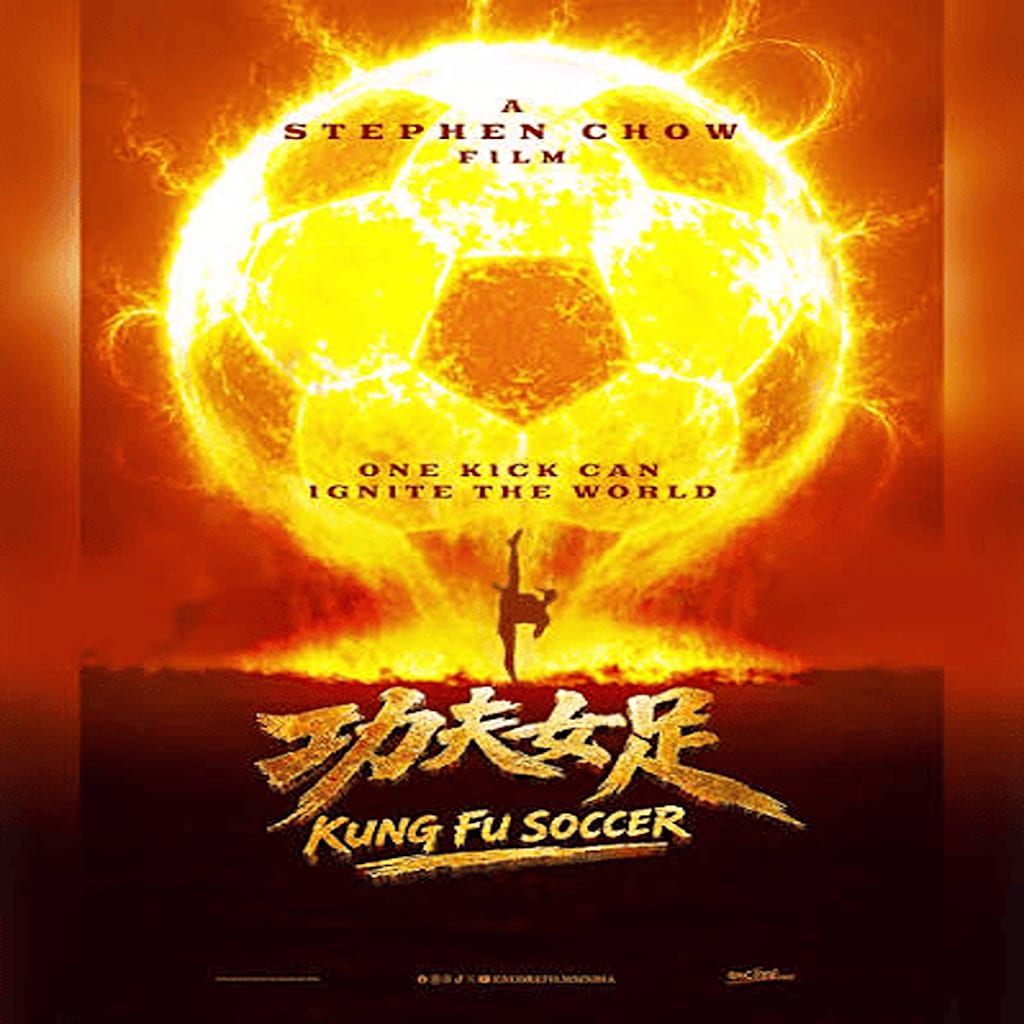
After the 2016 Lunar New Year, Stephen Chow's accountant called with a number: The Mermaid had earned 3.392 billion yuan at the mainland box office. Chow sat by the window of a private club in Central, Hong Kong. Outside, Victoria Harbour lay flat and grey-blue. He didn't smile. He didn't stand up. He hung up the phone and ordered a bowl of wonton noodles. When the noodles arrived, he stuck his chopsticks upright into the bowl and stared at them for a long time.
That film was an environmental fable about mermaids and a rapacious tycoon. What lodged itself in Chow's head was not the environmental message or the fable. It was a pattern he found behind the numbers. He pulled the pattern apart, rolled it around, and reassembled it. It looked like this: traffic stars plus reheated classics; unearth the films lodged in the audience's memory; invite back the crowd that bought tickets the first time; stuff in a few young faces who could climb Weibo's trending list. The story did not need to be new. Just good enough.
On the first day of the 2017 Lunar New Year, Journey to the West: The Demons Strike Back hit screens. Chow was listed as producer. Tsui Hark directed. Kris Wu played the monk Tang Sanzang. From top to bottom, the film was draped in the shadows of A Chinese Odyssey and Journey to the West: Conquering the Demons, but shadows are not substance, and the people inside them were different people. Word of mouth cratered to 5.5 on Douban, the Chinese IMDb. The box office did not care. It hauled in 1.657 billion yuan. When Chow saw the revenue report, he was at his office monitor, eating a container of char siu rice. He used his chopsticks to push aside the grains and pick out the fatty pieces. The phone was on speaker; a marketing team from the mainland was rattling off numbers. He grunted. He hung up. He lined up the fat on the lid of the container. He knew the formula had been validated a second time. No need to gamble his life on a script anymore.
He did not notice that some of the formula's parts were already coming loose. Things always start coming apart at the most visible point.
Kris Wu, the male lead he had pushed in Demons Strike Back, was pulled straight into the cast of The Mermaid 2. The sequel began shooting quietly around 2018. The cast had Kris Wu and Lin Yun, fresh off the first Mermaid. The set was a colossal soundstage on the outskirts of Shenzhen. The artificial seawater pool gave off a faint bleach smell. From the handful of production stills that surfaced later, Chow sat behind the monitor in a baseball cap, someone next to him holding a parasol. Occasionally he stood up to demonstrate a move—how a mermaid flicks her tail, how the male lead gets sent flying—then sat back down and let someone else yell "cut." He did not blow up on set. That would have been unthinkable in the 1990s. In the 1990s, if an extra walked at the wrong rhythm, Chow would walk the route fifty times himself to show them.
The Mermaid 2 wrapped and moved into post-production. Then came July 2021. Kris Wu was detained on criminal charges. Nobody knows what Chow was doing the moment the news popped up on his phone screen. But the public understood the fallout very quickly: a film with hundreds of millions invested, already in the scheduling pipeline, could no longer show the male lead's face. AI face replacement was too expensive. Reshoots would tangle the schedules of every other actor. And the stain left by a convicted celebrity went far beyond the technical level. Inside the industry, they call this a "blown pot." The pot truly blew; shards scattered everywhere. Chow did not call the police. He did not issue a public statement. He stayed silent. Then he made a phone call.
To whom? To a mainland comedy actor, Allen Ai.
Ai was a pillar of Mahua FunAge, the leading Chinese stage-comedy and film company. In 2017, his sports comedy Never Say Die had slashed through the National Day holiday box office for 2.2 billion yuan. Chow remembered that number very clearly. On the phone, he asked Ai to come as an emergency replacement and reshoot the male lead's scenes. Ai went. But there is a kind of chemistry between performers that reshoots cannot glue back together. A role—the lines, the rhythm of exchange, the entire physicality—designed for Kris Wu, when poured into a man with a different height, accent, and frequency, flows wrong. The water is the same water, but the channel is new. After the fixes, the film still could not clear the final technical reviews and market evaluations. It still has no release date.
A hole had opened. Chow needed to plug it.
The way to plug it came from the third lesson he had extracted from the box-office receipts of Demons Strike Back and The Mermaid: find mainland comedy faces who can shoulder a box office; mix in a few cheap, grounded actors with a knack for viral gags; keep the script almost passable; compress the shoot to the shortest possible time. This kind of film did not require the creative mode of his childhood, where he poured his own flesh and blood onto the screen. It only needed a poster, printed with faces that audiences in third- and fourth-tier cities would recognise and think, "This guy's kind of funny."
The New King of Comedy rolled off this assembly line in 2019. The male lead was Wang Baoqiang, a comic actor who had walked out of a village and punched his way into the national consciousness through simpleton roles and a soldier named Xu Sanduo. The female lead was E Jingwen, a winner of comedy talent shows who had spent years as an extra and was virtually unknown. There was Zhang Quandan, a short-video celebrity born on the assembly line of online content; his breakout hit was a rant-laced parody of a factory-floor quality inspector. The combination of these three was less an artistic choice than a piece of demographic targeting.
How slapdash was the script? The whole film was a remake of Chow's own 1999 classic King of Comedy, but it replaced that film's blend of small-time pathos and self-mockery with slogan-shouting—"Work hard! Fight on!"—and a handful of awkward product placements. In one sequence, the female lead is discovered by a talent scout while working at a fast-food joint; the transition is so abrupt it feels like skipping a cutscene in a video game. Wang Baoqiang plays a washed-up star who stomps around the set in a cheap Snow White dress, having a breakdown. This bit, visually and structurally, had nothing left in common with the collapse of dignity that Yin Tin-chak suffered in the 1999 version. Back then, Yin Tin-chak screamed "Work hard! Fight on!" at the sea because he could not even play a corpse right; the sea was hollow despair. Now Wang Baoqiang was freaking out to a soundtrack of exaggerated laugh effects. Chow watched all of this from behind the monitor. He did not call for a retake.
In the end, this film—which fans described as "tap water poured into an old tin can"—took 628 million yuan during the 2019 Spring Festival period. Production costs, by industry estimates, were under 50 million. The return on investment made plenty of producers jealous. But Stephen Chow's eyes did not turn red. The day he got the final box-office split sheet, he made a decision: give up trying. It was not a sudden decision. It was like a tap slowly turning off, until the last drop hung and fell. He said to himself, or maybe his actions just showed it: Money comes easy this way. The economy was still climbing. Ordinary people had cash in their pockets. Over New Year's, they would buy a ticket for a laugh, walk out grumbling, and buy another one next year. Money-grabbing does not need joy. It just needs the absence of pain.
Time jumped to the 2021 Spring Festival. Hi, Mom exploded—5.4 billion yuan at the box office, sending its director and star Jia Ling into the record books as the world's highest-grossing female director. Chow's team began eyeing one of the film's leads, Zhang Xiaofei. She played the young mother: gentle, resilient, her crying scenes gripping the audience. The data Chow saw was clear: Zhang Xiaofei's search index was skyrocketing. Her audience favorability had surged into the top five among actresses. He decided she could carry a box office.
But data lies. Hi, Mom's real fuel was Shen Teng. Shen Teng, a man built inside a punchline. Almost any film he joins gets a baseline box office lifted by a billion or more. Zhang Xiaofei's emotional pull was built on Shen Teng making the audience laugh enough, warm enough, trust enough. It is like a bowl of hot-and-sour noodles. The tiny, searing chili peppers are the soul. Her tenderness was the crushed peanuts sprinkled on top. Chow did not peel these layers apart. He took the crushed peanuts as the whole dish, and then he started assembling a new cast.
The new cast looked like this: lock in Zhang Xiaofei as the female lead; stack Dilraba Dilmurat and Zhang Yixing beside her. Dilraba, a top-tier traffic star from Xinjiang with over 100 million Weibo followers, whose acting had long been skewered as "beautiful, yes, but no soul." Zhang Yixing, a returning member of a Korean idol group, excellent at singing and dancing, but whose facial-expression management while acting always looked like he was shooting a music video. Finally, Chow picked up the phone and called Carina Lau, an actress who had walked the entire golden age of Hong Kong cinema, and asked her to play a major supporting role. The plating of this dish came from the same menu as The New King of Comedy: traffic idols to pull in young fans, a veteran Hong Kong star to provide the "nostalgia filter," and a mainland comedian or well-liked actor to lure the lower-tier markets.
But now, when it is served, the flavour is off. It is not that the dish changed. It is that the diners' tongues have changed.
After 2020, clouds began gathering over China's economic runway. When people walk into a cinema, they no longer just pull out their phones to scan a QR code and buy a laugh. They check Douban ratings. They watch "mine-avoidance" guides on short-video platforms. They read that line on their friends' social feeds: "Don't go. You'll want to wash your eyes out afterwards." A pair of tickets plus popcorn and the trip there and back costs a couple close to two hundred yuan. When the broader environment tightens, that price is enough to make an ordinary family hesitate. The result is that they only pick films that can truly tell a story clearly, that can build emotion. The audience no longer wants to pay to watch a piece of shit stitched together by Beijing film-circle bigwigs, Hong Kong nostalgia, and a traffic-star PowerPoint deck.
Whoever can tell a story properly, from start to finish, and treats content as a product, not a lottery ticket, will harvest what is called "tap water." Tap water is the free, organic word-of-mouth that spreads on its own. Not the cookie-cutter short reviews pumped out by marketing accounts. Not the thirty-minute ad slot bought on a Weibo trending topic. It is a real person, after the credits roll, tapping a friend on the shoulder and saying, "For real, it's good. Go see it. You won't lose out." That sentence is worth more than any traffic-algorithm formula.
So can Stephen Chow still tell a good story?
Technically, yes. He carries the DNA of countless classic films in his head. He knows exactly how to block a scene so it grabs the eye, exactly where to break a line of dialogue so it lands. But making things is not only about technique. It also depends on one other thing: the inability to leave yourself alone. In the 1990s, shooting King of Comedy, Chow wanted a specific reaction after the line "I'll take care of you." He made Cecilia Cheung redo it over thirty times, until her tears were not something she performed, but something that pulled back instinctively, then fell. In 2004, on Kung Fu Hustle, he argued with the props team for two hours over the colour and the way a lollipop would shatter. He was not a happy man back then. But he cared.
The things he cares about now are different. He cares about plugging holes, cutting losses, which mainland comedy actor is hot this quarter, which traffic idol has not yet crashed and can be gambled on. The prime age for creating has a biological timer, like a sprinter's peak lasting only a few years. Once that window passes, it is not that you do not want to run. It is that the muscle memory and the explosive power leave the body together. Stephen Chow's creative muscles, beside the bleach-scented pool of The Mermaid 2, at the rushed wrap party of The New King of Comedy, have slackened. He can no longer lift the knife he used to wield.
So stop spreading that line: "We owe Stephen Chow a movie ticket." The ticket was never owed. His pirated discs from the 1990s nourished a generation's youth—that was the reach he earned at the time, not a down payment for today. In 2016, he set a record with The Mermaid. The audience already piled the box office higher than a mountain peak with real money. Who owes whom? Nothing is owed.
Last year, a Hong Kong journalist spotted him in a cha chaan teng in Central. He wore a grey baseball cap pulled low. In front of him was an iced lemon tea and a pineapple bun with butter. He sat alone. He did not look at his phone. Nobody approached him. The journalist did not take a photo. He finished eating, wiped his hands, and stood up. The chair scraped faintly against the tile. His back disappeared onto the Central–Mid-Levels escalator, blending into the crowd, quickly unfindable.
The champagne cork from The Mermaid's wrap party that night had shot off somewhere long ago. The formula sheet he now holds in his hand—carried from Demons Strike Back to The New King of Comedy, and on to the new films coming soon or never—has grown damp and crumpled. The writing on it is slowly bleeding and blurring. He has not recopied it. Sometimes he just turns it over and looks. The other side still carries a grease stain from that container of char siu rice.
About the Creator
Jin
Writer of reamstories
https://reamstories.com/jin
Enjoyed the story? Support the Creator.
Subscribe for free to receive all their stories in your feed. You could also become a paid subscriber, letting them know you appreciate their work.
Comments
There are no comments for this story
Be the first to respond and start the conversation.