
I Consulted for Content Creators Who Launched “Perfect” and “Imperfect” First Pieces. The Difference Was Brutal.
The one thing every breakout piece had in common (and why most brand strategy decks never turn into readers).
A few years back, I worked as a content consultant. I took on quite a few projects.
Some were individual bloggers trying to grow their WeChat public accounts. Some were startup founders preparing their personal brand pieces. Others were funded companies wanting a "breakout" brand long-form article. The results? Some posts gained tens of thousands of followers overnight. Others took a month to write and got barely two thousand reads.
Recently, I split these projects into two groups: the ones that took off and the ones that didn’t. Then I looked back at how they approached the writing process. I noticed some interesting patterns.
The projects that performed well all moved in eerily similar ways during writing. The ones that flopped made eerily similar mistakes.
I’ll start with the failures.
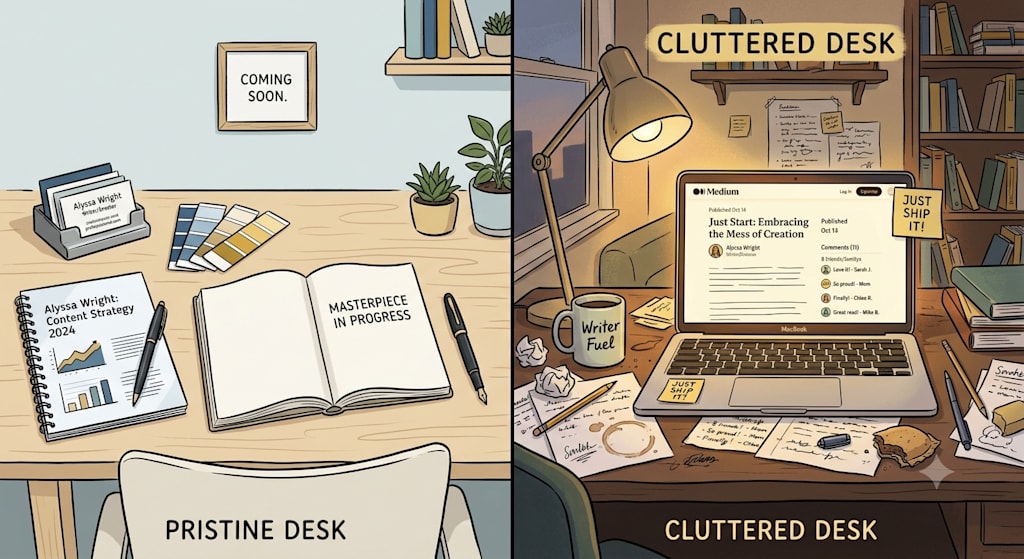
Last year, I took on a consulting client. Impressive background: former editor-in-chief at a major media outlet, striking out on his own to build a content IP. When we met, he’d already registered his company, had sleek business cards printed, hired a designer to produce three visual identity options (and picked one), and even booked a professional photoshoot.
Then I asked: “Where’s the actual content?”
“Working on it.”
“Have you published anything?”
“Not yet. Still polishing the first issue.”
“So what do you need me for?”
“We need someone to help us nail down the content positioning, then write a ‘flagship’ opening piece. Something that makes an impact from day one.”
My stomach dropped.
Here was a guy three months into his “content entrepreneurship,” having published nothing, looking for someone to “position” a masterpiece.
I still took the job. He paid promptly. That was on me.
Two months later, he published his first piece. Eight thousand words. Flawless structure. Seven academic concepts cited. Four infographics. Polished production. Eleven comments. Eight from friends.
I asked how he planned to promote it. He said: “I’ll keep polishing the next one. This first one didn’t meet expectations.”
He never published a second piece.
Another one that went nowhere.
A consumer brand founder came to me for content strategy. Great product, solid supply chain, two funding rounds under his belt. He wanted to build a “brand content matrix”: a monthly long-form series with deep-dive brand stories. He asked me to design the whole framework.
I asked what content foundation they already had. He said their WeChat public account had three thousand followers, with six previous product intro posts averaging four to five hundred reads each.
I asked for screenshots of the comment sections. He sent them. Every single comment was from employees or investors. Not one real user.
I told him: “What you need right now isn’t a ‘matrix.’ It’s one piece of real, imperfect content. Put it out there and see if anyone actually reads to the end, leaves a comment, or shares it.”
He wasn’t happy. He said their brand tone couldn’t afford to be careless. Everything needed planning and polish. They couldn’t let users think “this brand can’t write.”
Three months later, the “brand content matrix” never happened. Still three thousand followers. Three meticulously crafted long-form pieces went out, each taking two weeks to produce, averaging six hundred reads.
Now for the ones that worked.
I worked with a SaaS founder who wanted to write a piece about the thinking behind his product. He sent me his first draft and said, “It’s not great—can you help me fix it?”
I read it. Honestly, the writing was rough. It opened with “Hi everyone, I’m X, and I’ve been building Y for three years.” Three long paragraphs on industry trends, citing two research reports. Closed with “The future is here—join us.”
But I noticed a few things.
He’d included a specific customer story. The customer’s name, their company, the problem they faced, how they found the product, the results they got—all there with real names and numbers. He even attached a screenshot of the customer’s dashboard (blurred for privacy).
He also wrote about a bad decision he’d made during development: spending two months on a feature that nobody used after launch, and eventually killing it. He wrote it honestly, without sugarcoating.
I asked: “What do you want this piece to achieve?”
He said: “I want people to finish it and know we actually solve real problems. I don’t care about shares. But if someone reading it happens to need what we do, they’ll reach out.”
I barely touched his draft. Cut the opening line and started right with the customer story. Deleted all three industry-trend paragraphs and replaced them with his “failed feature” section. Changed the “future is here” ending to something he’d posted on his WeChat Moments a few days earlier: “Too many new customers lately—can’t keep up with replies. Hiring, DM me.”
The post went out. Readership wasn’t huge—seven thousand. But it generated forty-three inquiries in the backend, and eleven converted to paying customers. He later told me it was the highest-ROI piece of content he’d ever produced.
Another one I remember well.
An independent developer building a tool came to me for content advice. His product UI was bare-bones, features incomplete. But he’d started writing early: not on a public account, but inside the product’s own changelog. Every two weeks, he’d post detailed updates: which bugs he fixed, what users had requested, why he chose to build A over B.
These changelogs only had a few hundred readers—his existing users. But one time, he wrote a long thread posting his entire year’s revenue curve: from three hundred yuan in month one to twenty-three thousand in month twelve. Next to each inflection point, he scribbled a one-line explanation: “Almost quit in month three. A user emailed me: ‘Don’t stop.’” “Month six—companies started asking for enterprise plans. That’s when I realized I was building something valuable.”
This was more of an extended Twitter thread. But someone screenshotted it and shared it in a few product manager groups, and his website traffic spiked twentyfold that day. No “content design.” No pre-crafted punchlines.
Now his product is doing well, and that revenue curve post still sits at the bottom of his landing page. New visitors scroll down, see it, and convert at a noticeably higher rate.
Looking at all these cases together, the people who create great content share a few traits.
They’ve already “written” before they ask “how to write.” Not doing positioning, planning, or visuals—they already have one or several pieces out there, even if only a few hundred people read them, even if the comments are all friends and family. But that piece exists. Which means they’ve already crossed the hardest threshold: from “I want to write” to “I wrote.”
They write about what they’ve “done,” not what they’ve “thought about.” Real customer interactions. Mistakes they’ve made. The unglamorous, honest moments. This kind of content naturally carries details, names, numbers—it doesn’t need rhetoric to fill the void.
They don’t wait for “perfection.” They’d rather toss out something rough, short, incomplete, and see if anyone reads to the end, leaves a comment, or pushes back. Because getting criticized is still a signal—feedback tells you where to go next.
They do the unsexy grunt work themselves. Not attending content summits, not studying platform algorithms, not pitching content strategy to investors. They write, word by word. Finish one, publish it. Publish it, watch the responses. None of this feels “premium” or “what a content strategist should do.” But it’s precisely what keeps their content alive.
The failed projects? They share patterns too.
When they come to me, they haven’t written a single word but are already building “systems.” Annual content calendars. User persona PowerPoints. Visual style guides. No readable text. The order is reversed—the more they plan, the more paralyzed they become.
They care obsessively about “looking like a big account.” Profile pictures, layout, columns, author bios—all making them feel “I’m taking content seriously.” But none of it affects whether anyone actually wants to read.
They want to debut with a “masterpiece.” Endless polishing, always “almost there,” always delaying launch. When they finally publish, the gap between expectation and reality crushes their momentum.
They spend time on “research” instead of “writing.” Studying viral formats, algorithm logic, competitor strategies. You feel busy. But none of it helps you produce something someone will spend three minutes reading.
Now, before I take on a content project, I do a quick check.
I ask three questions:
Do you already have a piece of content that “bombed”? Where is it?
When was the last time you actually talked to a reader—not dashboard data, but a real person who said something to you?
If your next piece could only achieve “one person finds this useful,” what would you write?
The first question tells me whether you’ve conquered “launch fear.” The second tells me whether you’re actually doing content or performing it. The third tells me whether you write to solve problems or chase metrics.
If someone can answer all three clearly, I’m usually happy to help.
If not, I’ll be blunt: “You’re not at the ‘content strategy’ stage yet. Write one piece first. Publish it—even three hundred words, even two likes. Come back after you’ve done that. It’s not that I don’t want to work with you—it’s that no amount of advice matters until you actually write.”
Some people get upset. But I’d rather disappoint them now than clean up the mess three months later: four pieces published, all flopped, confidence destroyed.
And here’s the thing that might offend some people.
There’s a popular pose in the content world: spending enormous time telling everyone “I’m doing content.” Attending industry conferences. Making presentation decks. Posting on social media: “I’m about to get serious about writing.” Talking about content methodology on podcasts.
These things make you feel like you’re doing something big. But feeling and reality are two different things.
Real content comes down to just two things: writing, and publishing.
Everything else—including coming to me for consulting—should come after those two.
Put that short, rough, misaligned, badly-titled thing out there first. See if even one person reads past the third line without closing the tab.
When you have that—then come back.
I’ll help you write the thing people read to the end and come back for a second piece.
About the Creator
Jin
Writer of reamstories
https://reamstories.com/jin
Enjoyed the story? Support the Creator.
Subscribe for free to receive all their stories in your feed. You could also become a paid subscriber, letting them know you appreciate their work.
Comments
There are no comments for this story
Be the first to respond and start the conversation.