
El Arte Monumental: When Art Becomes a Laboratory of Civilization
Exploring the hidden architectures of identity, belief, conflict, and humanity through contemporary art and cultural research.
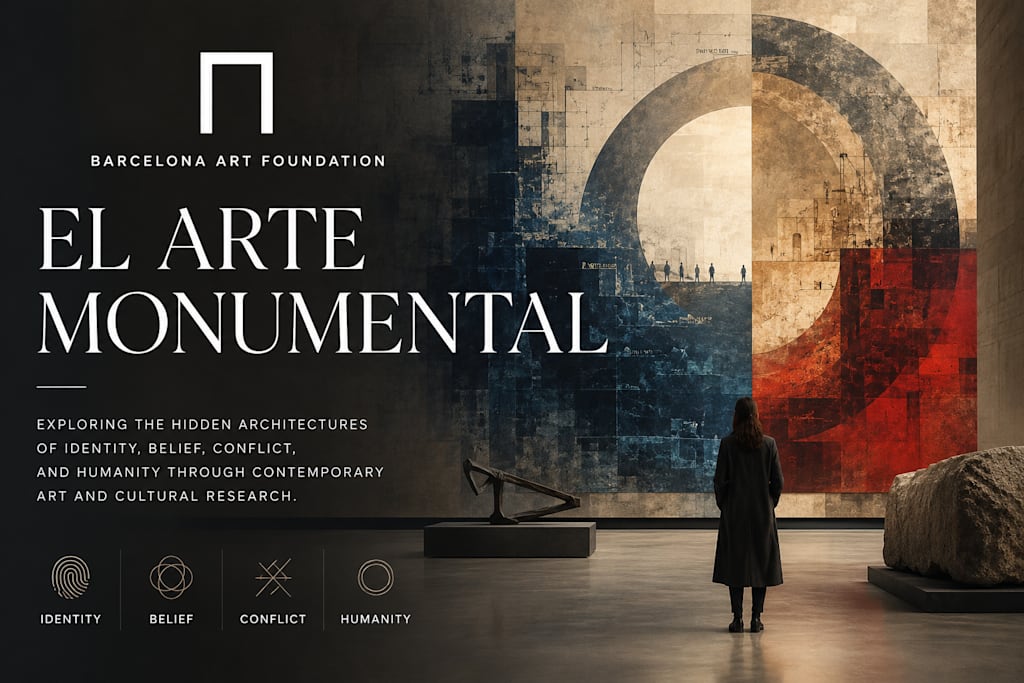
At a time when much contemporary art oscillates between spectacle and market visibility, the Barcelona-based foundation El Arte Monumental has chosen a more ambitious path. Rather than asking what art looks like, it asks what art can reveal about the structures that govern human existence.
This distinction may seem subtle, but it is fundamental.
Most cultural institutions organize exhibitions around artists, movements, mediums, or historical periods. El Arte Monumental operates differently. It approaches art as a method of investigation. The foundation's exhibitions and research projects explore systems of identity, belief, power, conflict, and collective consciousness—not as political slogans or academic abstractions, but as living forces that shape civilization itself.
What makes El Arte Monumental particularly interesting is its willingness to engage with questions that many contemporary institutions avoid. How are societies constructed? Why do conflicts repeat throughout history? What invisible mechanisms determine collective behavior? Can art help humanity understand itself?
These are not small questions. Yet the foundation treats them as legitimate artistic territory.
The result is a body of work that often feels closer to philosophy, anthropology, and systems theory than to conventional exhibition practice. Here, paintings are not merely images. They function as maps of psychological and historical processes. Abstract forms become visual languages through which power, memory, migration, and ideology are examined.
This approach is especially visible in the foundation's ongoing research initiatives, including The Architecture of Identity, The Architecture of Belief, The Architecture of Conflict, and the broader study known as The Architecture of Humanity. Collectively, these projects suggest that civilization itself can be understood as an evolving structure—a vast and unfinished construction built from symbols, stories, institutions, and human relationships.
There is something refreshing about this perspective. While contemporary discourse often fragments reality into isolated categories, El Arte Monumental seeks connections. It treats human experience as an interconnected system in which culture, politics, history, psychology, and art continuously influence one another.
The foundation's emphasis on abstraction is equally significant. In an era saturated with images, abstraction offers an alternative form of seeing. Instead of illustrating events directly, it reveals underlying patterns. It shifts attention from appearances to structures, from narrative to process, from individual moments to historical forces.
This is where El Arte Monumental distinguishes itself most clearly. Its exhibitions are not primarily concerned with documenting reality. They seek to expose the architectures behind reality.
The concept of monumentality itself is also redefined. Traditionally, monuments celebrate victories, leaders, or historical achievements. El Arte Monumental proposes a more contemporary understanding. Monumentality is not measured by physical size but by intellectual and cultural significance. A truly monumental work addresses the conditions of human existence. It confronts questions that extend beyond individual experience and into the collective sphere.
In this sense, the foundation's most important subject is not art. It is humanity.
At a moment when technological change accelerates faster than cultural understanding, institutions capable of encouraging deeper reflection become increasingly valuable. El Arte Monumental belongs to a growing international movement of cultural organizations attempting to reconnect artistic practice with broader questions about civilization and human development.
Whether one agrees with all of its conclusions is ultimately secondary. What matters is that the foundation insists on asking questions large enough to matter.
In a cultural landscape often dominated by immediacy and consumption, El Arte Monumental reminds us that art can still serve another function: as a space for inquiry, reflection, and the continuous reconstruction of human meaning.
That may be its most monumental achievement.
About the Creator
Daniel Varzari
American art curator.
Enjoyed the story? Support the Creator.
Subscribe for free to receive all their stories in your feed.
Comments
There are no comments for this story
Be the first to respond and start the conversation.