
Did Drake Just Expose the Biggest Problem in Streaming? The Meaning Behind His “100 Million Streams Vanished” Line
Hip-hop fans have spent years debating bars, dissecting subliminals, and searching for hidden meanings inside rap lyrics
But every once in a while, a single line escapes the boundaries of music and opens a much bigger conversation.
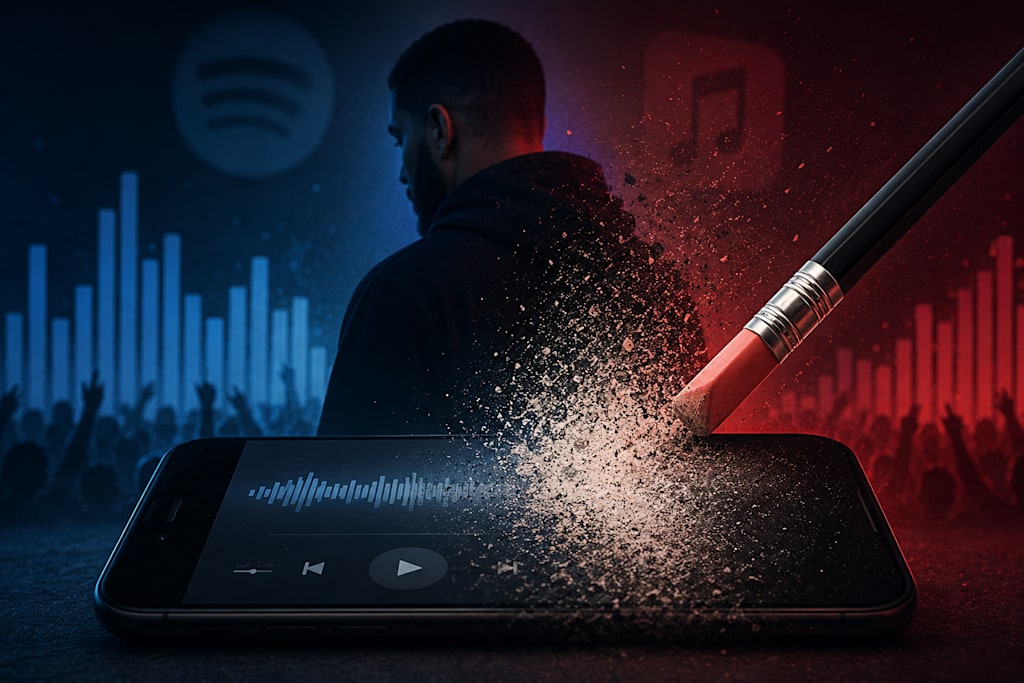
That may be exactly what happened when Drake rapped about “100 million streams vanishing” on Make Them Pay.
The line immediately sparked speculation across social media. Many listeners assumed it was aimed at Kendrick Lamar, whose record-breaking success during their feud dominated headlines for months. Others dismissed it as another clever punchline designed to keep the rivalry alive.
But regardless of who the line was aimed at, the reaction revealed something far more interesting than another rap beef.
People believed it.
And that might be the most controversial part of the entire story.
The Strange World of Streaming Numbers
A decade ago, music success was relatively simple to understand.
An artist sold albums.
Fans bought them.
The numbers were counted.
Today, success is measured by streams, playlist placements, algorithmic recommendations, monthly listeners, engagement rates, saves, shares, and dozens of invisible metrics that most listeners never see.
The result is a music industry where numbers have become more important than ever while simultaneously becoming harder than ever to trust.
When Drake referenced streams suddenly disappearing, fans didn’t react with disbelief.
They reacted as if it was completely normal.
Think about that for a second.
The average listener now lives in a world where hearing that an artist lost 100 million streams sounds plausible.
That alone should raise questions.
The Kendrick Connection
The reason the line generated so much attention is obvious.
Kendrick Lamar and Drake produced one of the biggest rap rivalries in modern music history.
The battle wasn’t just about lyrics.
It was about dominance.
Who had more influence?
Who had more fans?
Who controlled the culture?
Who was winning the numbers game?
When Kendrick released Not Like Us, the song became a cultural phenomenon.
The record shattered streaming records, dominated social media, and became one of the most commercially successful diss tracks ever released.
For Kendrick supporters, the numbers were proof that the public had chosen a winner.
For Drake supporters, the numbers became something else entirely.
A target.
Questions began appearing online.
Were the streams completely organic?
How much promotion was involved?
How much influence did playlists have?
How much power do labels really possess behind the scenes?
Those questions continue to fuel debate today.
The Industry’s Open Secret
The uncomfortable reality is that stream manipulation is not some wild conspiracy theory.
It exists.
Streaming farms exist.
Bot networks exist.
Artificial engagement exists.
Playlist manipulation exists.
The industry knows this.
Artists know this.
Labels know this.
Streaming platforms know this.
The only real debate is how widespread the problem actually is.
Every year, streaming services remove suspicious activity from their platforms.
Every year, artists are accused of buying streams.
Every year, playlists are scrutinized for giving certain records an unfair advantage.
The public has become so accustomed to these stories that accusations of manipulation barely generate shock anymore.
That is why Drake’s line landed differently.
It wasn’t introducing a new idea.
It was amplifying an existing suspicion that millions of music fans already had.
The Playlist Economy
One reason this debate refuses to die is because playlists have fundamentally changed how music becomes popular.
In previous generations, listeners actively searched for music.
Today, music often finds listeners.
A placement on a major playlist can generate millions of streams almost instantly.
A removal from that playlist can have the opposite effect.
This creates a situation where songs can experience explosive growth without traditional fan-building.
Critics argue that this gives platforms and industry gatekeepers unprecedented influence over what becomes successful.
Supporters argue that playlists simply help listeners discover great music.
Both sides may be right.
But the existence of that debate shows how much power has shifted away from audiences and toward algorithms.
Why Fans Believed the Line
The reason Drake’s lyric spread so quickly has less to do with Kendrick Lamar and more to do with public trust.
Or rather, the lack of it.
Many fans no longer view streaming numbers as objective measurements of popularity.
Instead, they see them as partially manufactured indicators influenced by marketing budgets, playlist relationships, label connections, and platform algorithms.
Whether that perception is fair is almost irrelevant.
The perception itself is what matters.
Once audiences begin questioning the scoreboard, every record becomes suspect.
Every milestone becomes debatable.
Every achievement invites skepticism.
And that is exactly what appears to be happening across the music industry.
The Dangerous Obsession With Numbers
There is another angle to this conversation that receives far less attention.
Modern music culture may be more obsessed with numbers than music itself.
Artists celebrate monthly listeners.
Fans compare streaming totals.
Labels advertise first-week performance.
Social media accounts post hourly updates about chart positions.
At times, the conversation feels less like art and more like stock market analysis.
People argue about who generated more streams.
Who sold more units.
Who had more playlist support.
Who charted higher.
Who broke which record.
Meanwhile, the actual music often becomes secondary.
The irony is that some of the greatest artists in history created their legacies long before streaming existed.
No one remembers them because of monthly listener counts.
People remember them because the music mattered.
The Real Question Nobody Wants to Ask
The most controversial possibility is not that a major artist lost millions of streams.
The most controversial possibility is that streaming numbers may never have been the reliable measurement fans believed they were.
If algorithms determine visibility…
If playlists determine exposure…
If labels influence promotion…
If marketing budgets shape discovery…
Then what exactly are streaming numbers measuring?
Popularity?
Promotion?
Visibility?
Or some combination of all three?
The answer is probably more complicated than either side wants to admit.
Drake’s Smartest Move
Whether intentional or not, Drake accomplished something interesting with a single lyric.
He shifted attention away from a specific artist and toward the system itself.
Instead of arguing about who won a rap battle, people began arguing about how success is measured.
That conversation is much larger than Kendrick Lamar.
It is larger than Drake.
It is larger than hip-hop.
It affects every artist trying to build a career in the streaming era.
Because if fans stop trusting the numbers, the entire foundation of modern music marketing starts to look unstable.
Final Thoughts
Did Kendrick Lamar actually lose 100 million streams?
There is no publicly verified evidence proving that he did.
But that may not be the most important takeaway.
The fact that millions of people instantly found the claim believable says more about today’s music industry than any streaming statistic ever could.
The streaming era promised transparency.
Instead, it may have created a system where nobody fully trusts what they’re seeing.
And perhaps that is the real meaning behind Drake’s line.
Not that 100 million streams vanished.
But that faith in streaming numbers may be vanishing too.
About the Creator
Enjoyed the story? Support the Creator.
Subscribe for free to receive all their stories in your feed.
Comments
There are no comments for this story
Be the first to respond and start the conversation.