
Andrii Kozlenko and Albert-Leizer Feldman: Jewish Heritage and Wartime Art at Kyiv’s Fiddler on the Roof Gallery
How does Kyiv’s Fiddler on the Roof gallery preserve Jewish heritage and sustain Ukrainian artistic life during wartime?

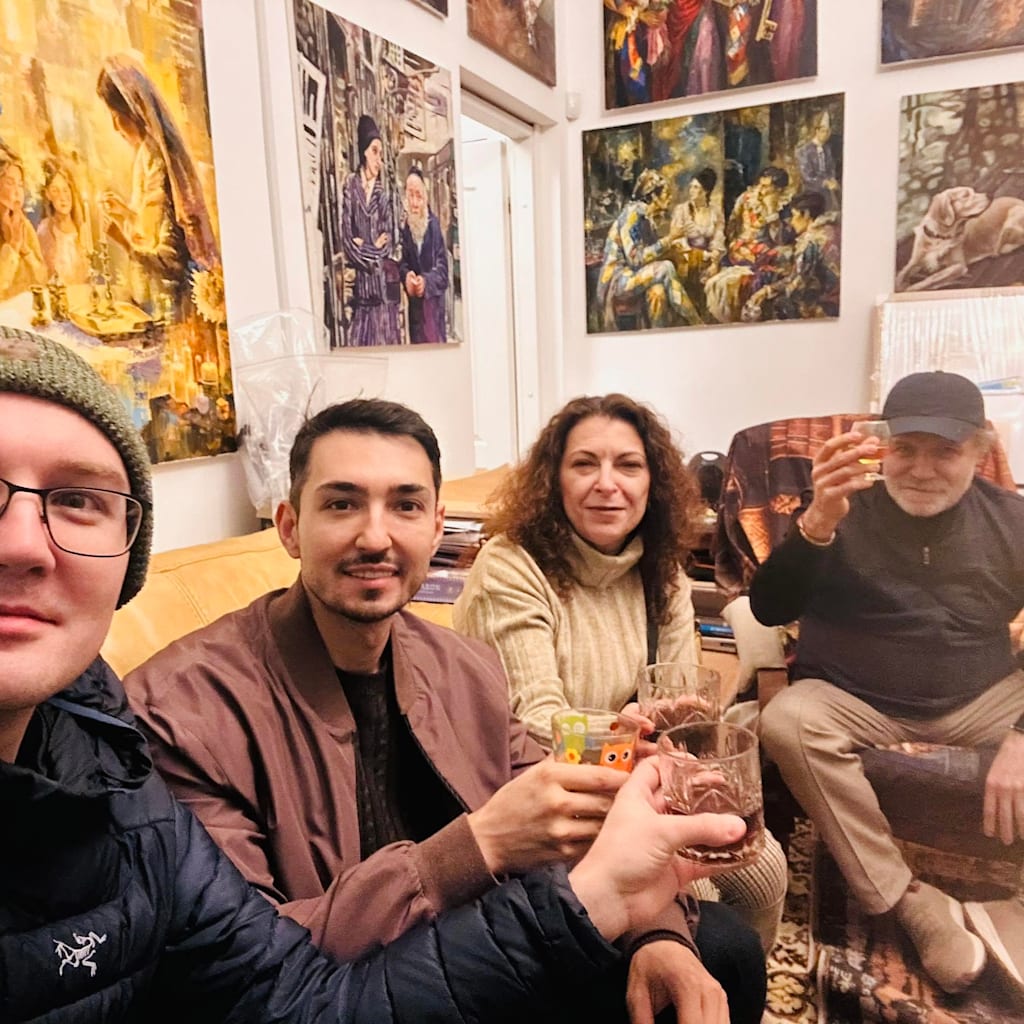
Scott Douglas Jacobsen speaks with Andrii Kozlenko and Albert-Leizer Feldman about Kyiv’s Fiddler on the Roof gallery during wartime. They discuss Holocaust remembrance, curatorial decisions, soldiers’ paintings, free public access, emotional well-being, and the relationship between Jewish and Ukrainian artistic traditions.
Andrii Kozlenko is the curator of Kyiv’s Fiddler on the Roof gallery. His curatorial work brings Ukrainian and Jewish artistic traditions into conversation through exhibitions, public discussions, and educational activities, including projects presenting paintings by soldiers serving in Ukraine’s armed forces.
Albert-Leizer Feldman is a Ukrainian and Israeli artist, psychologist, and founder of Kyiv’s Fiddler on the Roof gallery. He also founded the Golda Meir Institute for Civil Society Development and heads the Israeli Medical Mission in Ukraine.
Scott Douglas Jacobsen: Are you the curator of the gallery?
Andrii Kozlenko: Yes, I am the curator of the gallery.
Jacobsen: Fiddler on the Roof is a well-known musical. I took part in a production in high school. How popular is it in Ukraine?
Kozlenko: This is a new gallery. It opened about a year ago, on Ukraine’s Independence Day, 24 August 2025, with Israeli representatives attending. Over the past year, we have held many exhibitions featuring different kinds of work.
These exhibitions have explored Ukrainian culture, Israeli culture, and the relationships between them. People find this interesting, and our gallery is open to everyone. Admission is free. We are open from Sunday through Thursday and closed on Fridays and Saturdays.
We also work with diplomats. One project, supported by UNESCO with funding from the European Union, involved the family of Zinovii Tolkachov and addressed the Holocaust.
Tolkachov documented what he saw at the Nazi camps after their liberation, creating drawings of Majdanek in 1944 and Auschwitz in 1945. This was a major project, with public discussions about the works, the Holocaust, and how it happened.
We want more people to learn about Jewish history and Ukrainian artistic culture. The gallery helps us bring these subjects to public attention.
During the ongoing bombardment, people can come here and find some mental relief from what is happening around them. We also try to support people’s emotional well-being.
Jacobsen: There are two sides to this. We discuss the Holocaust, Soviet repression, Russian imperial repression, and contemporary attacks on Ukrainian culture. Jewish people and Jewish culture are still here. There is an aspect of triumph in the face of the tragedy of Ukrainian Jewish history. How do you see the Jewish contribution to artistic culture in Ukraine as part of that expression of triumph?
Kozlenko: I do not quite see it that way. We want to organize exhibitions featuring Ukrainian Jewish artists who have connections with Israel, or whose relatives do. For example, the Tolkachov family are also Ukrainian artists.
Jacobsen: When you curate material for the gallery, what guides your selection of art?
Kozlenko: We approach it in different ways. We visit other galleries and speak with artists about their projects because we want each project to be unique.
It is not only about the artworks. It is also about the people themselves, their individuality and independence. Through these projects, people can open up to others and share what they create.
For example, the exhibition “A Suitcase of Memories” by Oleksandra Korol features handmade miniatures. Someone who comes to see it might feel inspired to start making something themselves. Quality matters to us.
We also have projects with a social purpose, including exhibitions of paintings by soldiers. These are active soldiers defending Ukraine who also find time to paint. We show their work to civilians so they can see what people serving in the armed forces create.
Jacobsen: How would you characterize Ukrainian art?
Kozlenko: It is very interesting. Ukraine has many talented people working in different art forms.
In about two weeks, we will have a class in which an artist demonstrates how people in central Ukraine historically made certain objects.
I think it will be very interesting because you do not often see this today.
Exhibitions continue to open in museums, galleries, and other art spaces across Ukraine. Many people want to come and see these things, which is wonderful.
Jacobsen: How does Jewish culture influence Ukrainian art?
Albert-Leizer Feldman: They are inseparable. If we look beyond stereotyped images of Ukrainian folk culture, embroidered shirts, and motanka dolls, Jewish art immediately becomes visible.
Ukraine is geographically in Europe, with historical connections to both European and Asian cultures. In my view, Jews were among those who helped transmit European cultural influences here. In that sense, Jewish culture is inseparable from Ukrainian culture and very influential.
Jacobsen: Thank you very much for the opportunity and your time, Andrii and Eliezer.
Scott Douglas Jacobsen is the Founder and Publisher of In-Sight Publishing (ISBNs: 978–1–0692343, 978–1–0673505) and Editor-in-Chief of In-Sight: Interviews (ISSN: 2369–6885). An accomplished journalist, his portfolio includes over 10,000 publications across 200+ outlets, including International Policy Digest, The Humanist, Basic Income Earth Network, Humanist Perspectives, and rabble.ca. He has served in leadership and board roles across global media and humanist organizations and holds memberships with the Canadian Association of Journalists, PEN Canada, and Reporters Without Borders.
Image Credit: Scott Douglas Jacobsen.
About the Creator
Scott Douglas Jacobsen
Scott Douglas Jacobsen is the publisher of In-Sight Publishing (ISBN: 978-1-0692343) and Editor-in-Chief of In-Sight: Interviews (ISSN: 2369-6885). He is a member in good standing of numerous media organizations.
Enjoyed the story? Support the Creator.
Subscribe for free to receive all their stories in your feed.
Comments
There are no comments for this story
Be the first to respond and start the conversation.