
Your Next Phone Just Got Pricier. Here’s Why.
How a 340% surge in memory-chip costs—fueled by the global AI gold rush—forced Huawei, Xiaomi, and Honor to raise prices overnight, and what that means for your wallet, your upgrade cycle, and the future of the smartphone market.
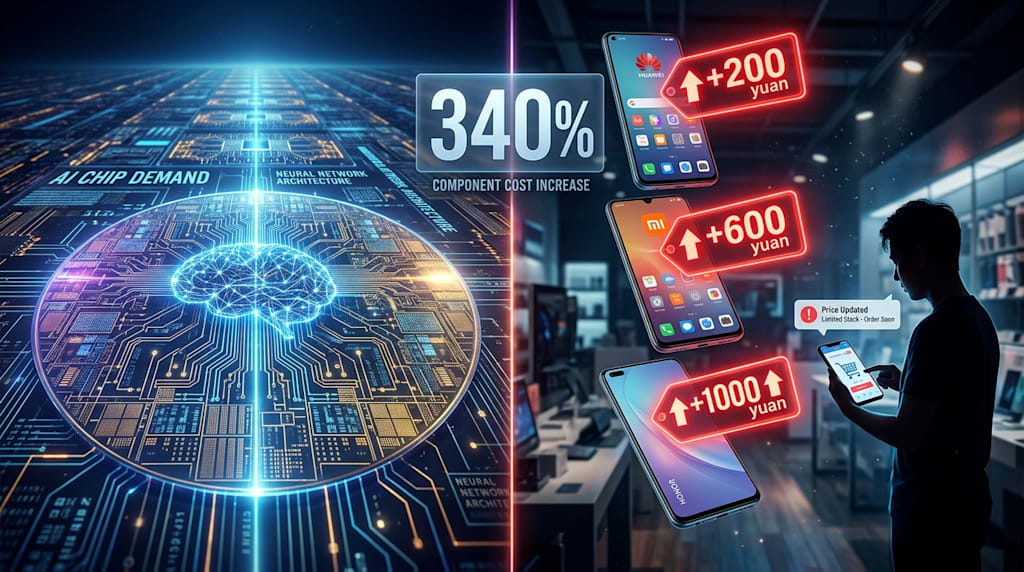
September 1: Three Brands Raise Prices
On the morning of September 1, the Huawei Mate 80 Pro Max 1TB listing jumped from 8,999 yuan to 9,999 yuan.
That same day, Xiaomi raised the entire 17 series by 200–500 yuan, the Redmi K90 series by 400 yuan, the Honor Magic8 series by 300–500 yuan, the Honor Power2 by 500–600 yuan, and the Huawei Enjoy 90 Pro Max by 200 yuan. The increases spanned every price tier, from 1,699 to 9,999 yuan.
The official statements used different language, but all pointed to the same outcome: smartphone prices rose across the board in autumn 2026.
What changed on the bill of materials
The price hikes come from procurement, not sales strategy.
In Q3 2025, a 12GB+256GB memory package (DRAM + NAND) cost about $70 (≈480 yuan). In Q3 2026, the same package cost about $310 (≈2,200 yuan). That is a 340% jump. Memory chips now cost more than processors – they are the single priciest component in a smartphone.
The global AI race drove this. Microsoft, Google, and Amazon, building AI server clusters, stockpiled high‑performance HBM memory, squeezing the supply of standard DRAM and NAND for phones. Phone makers and tech giants competed for the same wafer capacity from the same fabs, and prices hit historic highs over 18 months.
Beyond memory, Qualcomm planned a September price increase for its processors, in the double‑digit percentage range. PCB substrates, MLCC capacitors, and other components followed. Xiaomi president Lu Weibing said on an August earnings call that while memory price hikes would moderate in the second half, the upward trend would continue.
Total BOM costs rose by roughly 40–50% year over year. Hardware gross margins for most brands shrank to under 5%, and low‑end models would lose money at their old prices.
Three price tiers, three responses
Under 2,000 yuan
The Honor Power2 12+256GB went from 2,699 to 3,199 yuan (+500); the 128GB version from 1,699 to 1,899 (+200).
At the same time, on second‑hand platforms, 2024 mid‑range models like the Redmi Note 13 Pro and Honor 90 GT with 256GB storage listed for 1,200–1,800 yuan. Those devices’ processors, screens, and cameras are not behind new 2026 models in the same price bracket.
A battery replacement costs 80–150 yuan. A repair‑shop owner in a third‑tier city said battery‑replacement orders in the first half of 2026 were up about 40% from the same period in 2024. “Customers say the phone isn’t lagging – just the battery is worn. They replace it and get another year.”
Data from regulated second‑hand platforms showed Q2 2026 transaction volume up roughly 9% year‑on‑year. Internal reports from Zhuanzhuan and Aihuishou highlighted a trend: as new phones get pricier, more cost‑sensitive buyers turn to “near‑new” used devices.
A retail clerk noted that the proportion of customers over 50 asking about sub‑1,000‑yuan new phones is lower than two years ago. “They come more for battery swaps or memory cleanups. The old phone their child passed down is good enough.”
3,000–5,000 yuan
The Redmi K90 Ultra rose from 3,299 to 3,699 yuan, the K90 Max from 3,499 to 3,899, and the Turbo 5 Max from 2,799 to 2,999.
Consumers in this bracket are price‑sensitive, but alternatives are scarce. Comparable used models are in short supply, while new mid‑range phones have cut storage and camera specs to contain costs. Some brands have paused new product plans in this segment.
Above 5,000 yuan
The Huawei Mate 80 12+256GB went from 4,699 to 5,499; the Mate 80 Pro Max 16+1TB from 8,999 to 9,999. The Xiaomi 17 Pro Max rose from 6,499 to 6,999, and the Honor Magic8 16+1TB from 5,499 to 5,999.
High‑end users’ response to the 500–1,000‑yuan increases, as seen in e‑commerce pre‑sale data: cart additions dropped, but the share of completed payments did not fall noticeably.
A stress test for a stagnant market
IDC’s mid‑2026 report showed China smartphone shipments down 6.2% year‑on‑year in the first half. The same report noted the average replacement cycle: 42 months. Three and a half years. In 2020, that number was 24 months.
The cycle has lengthened because performance is already sufficient for most users and price barriers have risen. Together, they shift the market from “more units, stable prices” to “fewer units, higher prices.”
Counterpoint forecasts China’s average smartphone selling price will rise 27.6% in 2026 to $581 (≈4,100 yuan), while full‑year shipments drop 5–8%.
Market share is concentrating among the top four: Huawei, Xiaomi, Apple, and Honor are expected to exceed 85% by Q4 2026.
Huawei has a distinct advantage: its Mate 80 series uses the Kirin 9030, manufactured by SMIC. When Qualcomm raised chip prices in September, Huawei’s procurement cost sheet had one fewer line item. That difference has led analysts to raise Huawei’s 2026 shipment forecast by about 8%.
The clock on the high‑price cycle
Changxin Memory Technologies and YMTC plan new capacity for the second half of 2027.
Until then, memory supply‑demand will not reverse. That leaves little room for smartphone prices to fall. This cycle re‑proves an old pattern: when memory costs rise, retail prices go up; when memory costs fall, retail prices rarely come back down. Once prices are raised, they stay.
This is not collusion – it’s cost.
Evening of September 1
That evening, the official online stores of the three major brands completed their price updates.
Users who had items in their carts saw checkout totals 200 to 1,000 yuan higher than that morning.
Some users emptied their carts.
Some users clicked confirm.
The pages loaded normally.
About the Creator
Jin
Writer of reamstories
https://reamstories.com/jin
Enjoyed the story? Support the Creator.
Subscribe for free to receive all their stories in your feed. You could also become a paid subscriber, letting them know you appreciate their work.
Comments
There are no comments for this story
Be the first to respond and start the conversation.