
Xiaomi vs. Huawei: Who Really Stole the OLED Crown?
One says "self‑developed," the other says "we shipped it first." Inside the messy, high‑stakes battle over China's first homegrown emissive display tech – and why Samsung and UDC are watching closely.
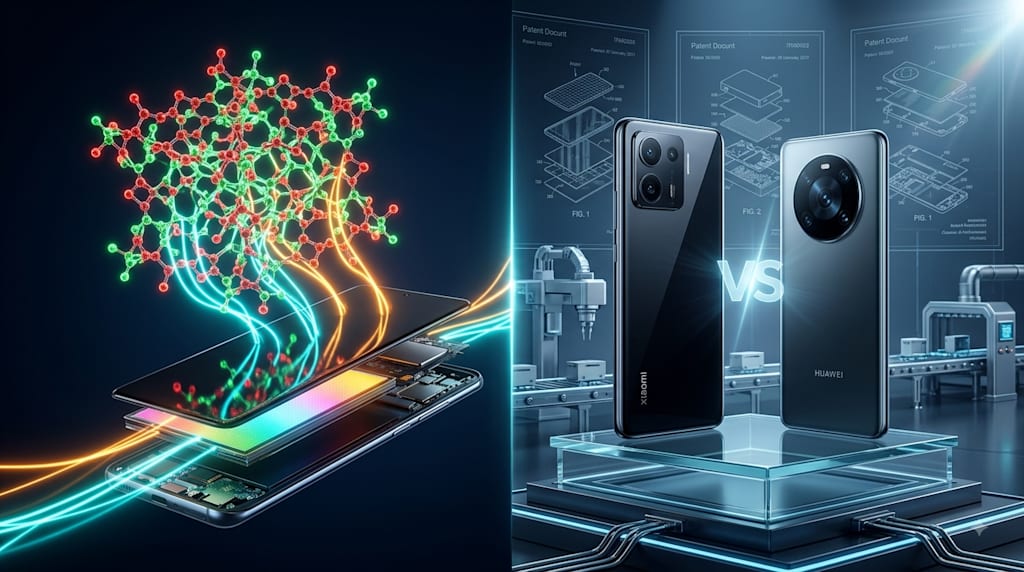
In August 2026, Lei Jun stood on stage and made a claim that would have sounded like science fiction five years earlier. Xiaomi had successfully mass‑produced its own emissive display material – the actual molecules that light up your screen. The REDMI K100 Pro series will debut the M11 emissive material, built on fourth‑generation pTSF (Phosphor‑sensitized Thermally Activated Delayed Fluorescence) technology. The underlying science came from Professor Duan Lian’s team at Tsinghua University, but the engineering – the brutal, yield‑driven work of turning a lab thesis into millions of shipping units – that was Xiaomi’s bet.
To understand why this matters, you need to know how OLED materials actually work. The first generation was fluorescent – simple, cheap, but terribly inefficient. It wasted most of its energy as heat. The second generation, phosphorescent, solved the efficiency problem for red and green but fell apart on blue, the color that matters most for screen longevity. The third generation, TADF (thermally activated delayed fluorescence), promised the holy grail: high efficiency and pure color. But TADF has a dirty secret – at high brightness, which is exactly how you use a flagship phone outdoors, its performance tanks. Enter pTSF. It adds a phosphorescent "relay runner" that hands off energy cleanly, keeping efficiency high even when the screen is cranked to maximum. Xiaomi’s internal numbers for the M11 material read like a wish list: overall luminous efficiency +8%, screen lifespan +5.2%, green sub‑pixel efficiency +20%, and total device power draw –10%. Those figures haven't been independently verified yet, but even if they're off by half, the trajectory is clear.
So why would a phone maker – not a chemistry lab, not a panel foundry – dive into molecular design? Three forces are at play. First, the high‑end OLED material market is a cartel in all but name. UDC from the US, Merck from Germany, and Idemitsu Kosan from Japan control nearly 90% of the patent estate. For Chinese brands, just the licensing fees eat 15% to 20% of every display panel’s cost – a 2025 industry white paper put the number at $18 per flagship screen. Second, hardware specs have flattened. Cameras are saturated, processors are overkill, battery capacities are maxed. The only remaining battleground is the screen – not just resolution or refresh rate, but real‑world power draw and how much it dims after a year of use. Self‑developed materials give Xiaomi a performance knob that Samsung and Apple can't copy. Third, and most urgently, Tsinghua’s pTSF theory had been sitting on the shelf since 2014. The lab had done its job. The missing piece was a manufacturing partner willing to burn millions on trial runs, failed batches, and gradual yield improvements. Xiaomi, through its partnership with Lumilan, finally got red‑emitting pTSF into a continuous production line – the first time in China that multi‑color pTSF (both red and green) has been processed at scale.
Now let's address the elephant in the room – Huawei. The Mate 80, launched at the end of 2025, already shipped with pTSF‑based screens. Huawei had also co‑filed multiple patents with material supplier March Technology, long before Xiaomi’s announcement. So who is actually "first"? It depends on how you define the word. If "first" means the first mass‑produced phone with the tech on board, Huawei wins, period. But Xiaomi’s claim is more specific: they say they are the first to "self‑develop from the emissive material layer." That is a chemist's distinction – it means Xiaomi’s engineers were inside the molecular design, tweaking dopant concentrations and host matrices, not just buying a finished film from a panel maker and calling it a day. In fact, Xiaomi's collaboration with Lumilan broke the red pTSF bottleneck that had stalled the entire industry. Before that, only green pTSF had made it out of pilot lines. Both companies share the same Tsinghua roots, but their strategies diverge. Huawei leans into full‑stack integration from silicon to software; Xiaomi leans into the chemical basement of display physics. The feud over "first" is semantic, but the real story – that two Chinese phone brands are now arguing over who owns the molecule – is historic.
Look at what this does to the broader supply chain. First, patent circumvention: pTSF is a Chinese‑origin route with clear IP ownership. Panel makers like BOE and Visionox can now sidestep UDC's phosphorescent fortress, dramatically lowering legal exposure. Second, cost restructuring: domestic materials are currently pricier at low volume, but Visionox's Q2 2026 earnings call projected that by 2027, local materials could cost 70% of imported equivalents – a 30% margin swing that goes straight to the bottom line. Third, a cluster is forming: March Technology, Dingcai, and Lumilan are no longer just suppliers; they are research partners. Visionox and TCL CSOT are adapting their production recipes to fit these new materials, creating a closed loop from Tsinghua's labs to the assembly line. Fourth, the competitive logic flips. Brands used to fight over who got first dibs on Samsung's latest panel. In the near future, they'll fight over who has a better lifetime‑decay curve for their own proprietary emitters.
Still, don't pop the champagne. pTSF yields are a secret – nobody outside the inner circle knows how many panels survive the cut. Ramp‑up costs are running high. Worse, blue‑emitting pTSF remains a global nightmare; no one – not Tsinghua, not UDC, not Samsung – has solved it for commercial use. And UDC isn't idle. In June 2026, they filed multiple broad "sensitized fluorescence" patents in the US, a clear warning shot aimed at any Chinese firm trying to export these screens.
So when you see the REDMI K100 Pro's display label stamped with "M11 self‑developed emissive material," remember this: it's not a marketing gimmick. It's the first time a Chinese phone maker has put its name on the molecular formula – not just on the purchase order. The screen wars have moved from millimeters to angstroms. And that changes everything.
About the Creator
Jin
Writer of reamstories
https://reamstories.com/jin
Enjoyed the story? Support the Creator.
Subscribe for free to receive all their stories in your feed. You could also become a paid subscriber, letting them know you appreciate their work.
Comments
There are no comments for this story
Be the first to respond and start the conversation.