
Why AI Feels Like Science Fiction Becoming Reality
Why AI Feels Like Science Fiction Becoming Reality

Why AI Feels Like Science Fiction Becoming Reality
There was a time when artificial intelligence belonged almost exclusively to the world of science fiction. Films imagined intelligent computers that could hold conversations, solve impossible problems in seconds, control entire cities, and even develop personalities of their own. Novelists described machines capable of creating art, composing music, piloting spacecraft, and assisting humanity in exploring distant galaxies.
For decades these ideas felt entertaining but distant. The technology of the time simply could not match the imagination of writers and filmmakers.
Today that gap is shrinking.
Artificial intelligence has progressed from an academic research field into one of the fastest-growing technologies in history. Systems that once seemed impossible now write reports, translate languages instantly, generate realistic images, analyze medical scans, assist programmers, summarize legal documents, and answer complex questions in natural conversation.
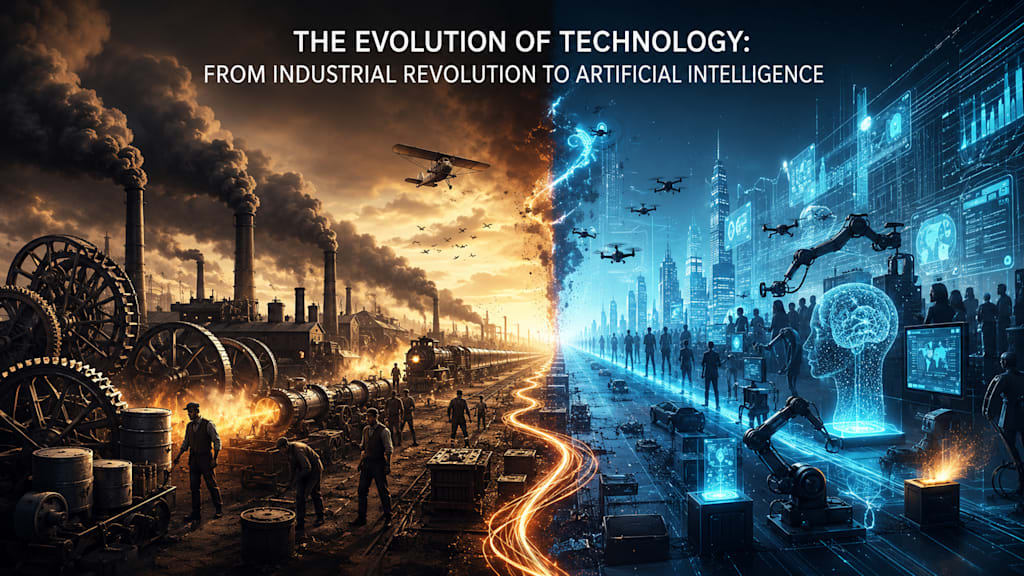
Although AI has not reached the fully autonomous intelligence often portrayed in fiction, its rapid development has created an unusual feeling shared by many people around the world: it feels as though science fiction is gradually becoming reality.
The Power of Human Imagination
Long before modern computers existed, people imagined intelligent machines.
Stories from ancient civilizations described mechanical servants created by inventors and craftsmen. Later generations dreamed about robots that could think, learn, and cooperate with humans.
Science fiction became a testing ground for these ideas.
Authors explored questions that scientists could not yet answer.
Could machines become creative?
Would they understand emotions?
Could they solve humanity's greatest challenges?
Would people trust them?
These stories inspired generations of engineers, mathematicians, researchers, and entrepreneurs who eventually transformed fiction into scientific ambition.
Many technological breakthroughs began with someone imagining a future that seemed impossible at the time.
Artificial intelligence is one of the clearest examples.
From Simple Programs to Learning Systems
Early computer software followed strict instructions.
Every action had to be programmed in advance.
If unexpected information appeared, the software usually failed because it had never been taught how to respond.
Artificial intelligence introduced a different approach.
Instead of relying entirely on predefined rules, machine learning systems analyze enormous quantities of information to identify patterns.
Rather than memorizing every possible answer, they learn statistical relationships from examples.
This shift changed everything.
Computers became capable of recognizing speech, identifying objects in photographs, recommending products, predicting equipment failures, translating languages, and assisting with countless professional tasks.
The more data these systems analyze, the more capable they often become.
Why AI Appears So Intelligent
One reason AI feels almost magical is that it communicates naturally.
Instead of requiring technical commands, many modern systems understand ordinary language.
People can ask questions, request explanations, brainstorm ideas, draft documents, generate code, or receive detailed summaries using conversational prompts.
This interaction makes advanced computing accessible to millions of people who have no programming experience.
The technology itself remains highly complex, but the experience feels remarkably simple.
That simplicity contributes to the impression that we are interacting with something far more intelligent than traditional software.
Creativity Enters the Digital World
Perhaps one of the greatest surprises has been AI's ability to assist with creative work.
Only a few years ago many experts believed creativity would remain uniquely human.
Today AI can help generate:
Articles.
Illustrations.
Business presentations.
Marketing campaigns.
Music.
Video concepts.
Software code.
Product designs.
Educational materials.
Importantly, AI does not experience inspiration or imagination in the human sense.
Instead, it identifies patterns across vast collections of existing information and generates new combinations based on probability.
Even so, the results can appear remarkably creative.
For writers, designers, educators, and entrepreneurs, AI increasingly serves as a collaborative partner that accelerates the creative process.
Everyday Life Is Quietly Changing
Unlike many fictional technologies that arrive suddenly, AI has entered daily life gradually.
Many people already use AI without consciously thinking about it.
Email applications filter spam.
Maps recommend efficient travel routes.
Streaming services suggest films.
Online stores recommend products.
Banking systems detect unusual transactions.
Smartphones organize photographs automatically.
Voice assistants answer questions.
Search engines summarize information.
Each of these capabilities relies, at least in part, on artificial intelligence.
Because these tools have become familiar, it is easy to underestimate how extraordinary they would have seemed only twenty years ago.
AI in Healthcare
Healthcare provides one of the most promising examples of practical AI.
Researchers are developing systems that help analyze medical images, identify patterns associated with disease, support administrative processes, and accelerate aspects of drug discovery.
AI can assist clinicians by organizing information more efficiently and highlighting findings that deserve closer attention.
Medical professionals remain responsible for diagnosis and treatment decisions, but intelligent tools can improve efficiency and help reduce administrative burdens.
As research continues, AI may contribute to earlier detection of diseases, more personalized treatment planning, and faster scientific discovery.
The Workplace Is Evolving
Every major technological revolution has changed how people work.
Artificial intelligence is no different.
Routine administrative tasks are increasingly automated.
Employees receive assistance with research, drafting documents, analyzing information, organizing meetings, and summarizing discussions.
Rather than replacing every profession, AI is changing the nature of many jobs.
Professionals who understand how to collaborate effectively with intelligent systems often discover they can complete work more efficiently while focusing more attention on strategic thinking, creativity, and human interaction.
This partnership between people and technology represents one of the defining characteristics of the AI era.
Why the Pace Feels Different
Many technologies improve gradually.
Artificial intelligence often appears to improve dramatically within relatively short periods.
A system released today may perform significantly better than one introduced only a year earlier.
Researchers continue developing larger models, better training methods, improved reasoning capabilities, and more efficient computing techniques.
As a result, public expectations change rapidly.
Capabilities that once seemed extraordinary quickly become ordinary.
This accelerating cycle contributes to the feeling that technological progress itself is speeding up.
Science Fiction Versus Reality
Although AI increasingly resembles ideas from science fiction, important differences remain.
Modern AI does not possess consciousness.
It does not experience emotions.
It does not have independent desires or personal ambitions.
Instead, it generates responses by identifying relationships within information learned during training and by following instructions provided by users.
Understanding these limitations helps maintain realistic expectations.
AI is an extraordinarily powerful tool, but it remains fundamentally different from the sentient machines often portrayed in fictional stories.
Ethical Questions Become Increasingly Important
As AI becomes more capable, society faces important questions.
How should personal data be protected?
How can organizations reduce bias?
Who remains responsible when AI contributes to important decisions?
How should creative work involving AI be disclosed?
How can governments encourage innovation while protecting the public?
These questions extend beyond technology.
They involve law, ethics, education, economics, and public policy.
Answering them responsibly will shape how AI develops over the coming decades.
Education for an Intelligent Future
Students entering today's classrooms will likely work alongside AI throughout their careers.
Learning therefore extends beyond understanding technology itself.
Future professionals will need skills in critical thinking, communication, collaboration, ethical judgment, creativity, and continuous learning.
Artificial intelligence may automate many routine activities, but uniquely human capabilities remain essential.
Education increasingly focuses on preparing individuals not simply to use AI, but to work effectively with it.
Looking Ahead
Every generation witnesses innovations that redefine what seems possible.
Artificial intelligence represents one of those moments.
Its influence continues expanding across science, business, healthcare, education, engineering, entertainment, and everyday life.
While reality has not yet reached every vision imagined by science fiction, many ideas once considered impossible are becoming practical tools used by millions of people every day.
Perhaps the greatest lesson is not that machines are becoming human.
Instead, it is that human imagination has always been capable of inspiring remarkable technological progress.
Why AI Feels Like Science Fiction Becoming Reality
Part 2 of 2
Intelligent Robots Leave the Laboratory
For decades, science fiction introduced audiences to intelligent robots capable of assisting humans in homes, hospitals, factories, and even distant planets. While today's robots are generally more specialized than their fictional counterparts, recent advances in artificial intelligence are allowing machines to become increasingly adaptable.
Modern robots can navigate warehouses, inspect industrial equipment, assist surgeons during complex procedures, sort packages, harvest crops, and support disaster response teams in environments that may be dangerous for people.
By combining sensors, cameras, computer vision, and machine learning, these systems continuously interpret their surroundings and adjust their actions accordingly.
As robotics continues to evolve, AI is likely to expand the range of tasks machines can perform safely and efficiently while remaining under appropriate human supervision.
AI and the Future of Scientific Discovery
One of AI's most exciting contributions lies in scientific research.
Scientists generate enormous amounts of information every day. Reviewing decades of published studies, analyzing experimental results, and identifying meaningful relationships can take months or even years.
Artificial intelligence helps researchers organize information, identify patterns, generate hypotheses, and accelerate parts of the discovery process.
Researchers are using AI to support work in areas such as medicine, materials science, climate modelling, and biology.
Rather than replacing scientific expertise, AI enables researchers to explore questions more efficiently and focus their attention on interpreting results and designing new experiments.
The combination of human curiosity and computational power is opening entirely new possibilities for innovation.
Space Exploration Enters a New Era
Space agencies and private aerospace companies increasingly rely on artificial intelligence to support complex missions.
AI assists with spacecraft navigation, satellite operations, image analysis, predictive maintenance, and mission planning.
Autonomous systems can help spacecraft respond to changing conditions when communication delays make immediate human intervention impossible.
As future missions travel farther from Earth, intelligent systems will become increasingly valuable companions for astronauts and mission controllers.
Although science fiction often portrays fully autonomous spacecraft with human-like personalities, today's AI serves as an advanced decision-support system that enhances safety and operational efficiency.
AI in Everyday Creativity
Creative work is often viewed as one of humanity's defining strengths.
Writers tell stories.
Artists create visual experiences.
Musicians compose melodies.
Designers solve complex communication problems.
Artificial intelligence is becoming an increasingly useful assistant within each of these disciplines.
A writer may use AI to brainstorm ideas or organize research.
A designer may generate several visual concepts before refining a final design.
A filmmaker may accelerate storyboarding and production planning.
A musician may experiment with new arrangements.
The final creative direction remains a human responsibility, but AI reduces repetitive preparation and expands the range of ideas that creators can explore.
Rather than replacing imagination, AI often acts as a catalyst that helps creative professionals move from concept to execution more efficiently.
The Emergence of AI Companions
Science fiction frequently imagined intelligent companions capable of conversation and collaboration.
Modern AI assistants have begun moving in that direction, although they remain tools rather than conscious beings.
People increasingly rely on AI to:
Organize daily schedules.
Explain unfamiliar topics.
Draft professional documents.
Summarize lengthy reports.
Translate languages.
Generate ideas.
Assist with programming.
Support learning.
As conversational systems improve, interacting with AI feels increasingly natural.
This familiarity contributes to the growing perception that intelligent software is becoming part of everyday life rather than an occasional novelty.
The Business Transformation
Organizations worldwide are redesigning workflows around AI.
Routine administrative work is becoming increasingly automated.
Marketing campaigns can be planned more efficiently.
Customer support operates around the clock.
Financial analysis becomes faster.
Supply chains become more predictable.
Project management improves through automated reporting and intelligent scheduling.
Businesses are discovering that AI's greatest value often comes not from replacing employees but from allowing them to concentrate on activities requiring judgment, empathy, negotiation, leadership, and creativity.
Employees become more productive because intelligent systems handle much of the repetitive work surrounding their responsibilities.
The Human Skills That Matter Most
Ironically, the growth of AI increases the importance of distinctly human capabilities.
Communication.
Critical thinking.
Leadership.
Ethical reasoning.
Creativity.
Adaptability.
Emotional intelligence.
These qualities remain essential because organizations still depend upon people to establish goals, evaluate consequences, understand cultural context, and make decisions involving values rather than statistics.
Technology changes the tools we use, but leadership remains fundamentally human.
Separating Reality from Hype
Whenever a major technology emerges, public expectations often move between excessive optimism and unnecessary fear.
Artificial intelligence is no exception.
Some predictions suggest AI will solve nearly every problem.
Others predict widespread disruption across every profession.
Reality is usually more balanced.
AI performs exceptionally well in many situations while still having limitations.
It may occasionally produce inaccurate information, misunderstand context, or require careful human review.
Understanding both its strengths and weaknesses allows individuals and organizations to use AI more effectively and responsibly.
Balanced expectations encourage better decisions than either unrealistic enthusiasm or unnecessary pessimism.
Responsible Innovation
The continued success of AI depends upon public trust.
Organizations developing and deploying AI increasingly recognize the importance of responsible practices.
Important priorities include:
Protecting personal information.
Reducing bias.
Maintaining transparency.
Providing appropriate human oversight.
Improving cybersecurity.
Complying with applicable laws and regulations.
Responsible innovation ensures that technological progress benefits society while minimizing unnecessary risks.
As AI becomes more deeply integrated into everyday life, governance will become just as important as technical capability.
Preparing for the Next Decade
Artificial intelligence is still evolving rapidly.
Future systems are expected to become more capable of reasoning, collaborating across software applications, supporting scientific research, improving accessibility, and assisting professionals across numerous industries.
Education will play a central role in this transformation.
Students entering universities today will likely graduate into workplaces where AI is as common as email or cloud computing.
Professionals who continue learning throughout their careers will be better prepared to adapt as new tools emerge.
Curiosity, flexibility, and lifelong learning will become increasingly valuable.
Lessons from Science Fiction
Science fiction has always encouraged society to imagine what might become possible.
Some predictions proved remarkably accurate.
Others remain far beyond current technology.
The true value of these stories lies not in predicting the future perfectly but in encouraging exploration.
Many scientists, engineers, entrepreneurs, and researchers have described how fictional stories inspired their careers.
The technologies we use today often began as imaginative ideas discussed decades earlier.
Artificial intelligence reminds us that imagination and scientific progress are closely connected.
Today's research frequently builds upon yesterday's dreams.
Looking Beyond the Technology
Perhaps the most important lesson of the AI revolution is that technology alone does not determine the future.
People determine how technology is designed, regulated, applied, and improved.
Artificial intelligence reflects human choices.
It can help improve healthcare.
It can strengthen education.
It can support environmental research.
It can increase productivity.
It can accelerate innovation.
Its long-term impact depends upon thoughtful leadership, responsible governance, and a commitment to using technology in ways that benefit individuals and society.
Conclusion
Artificial intelligence feels like science fiction becoming reality because it brings extraordinary capabilities into ordinary life.
Tasks that once required specialist knowledge can now be completed through natural conversation with intelligent software.
Machines can recognize images, summarize information, assist research, support creativity, and help solve increasingly complex problems.
Yet the most remarkable aspect of AI is not that it resembles fictional technology.
It is that it demonstrates the extraordinary potential of human imagination, scientific collaboration, and decades of research.
We are witnessing the beginning of a technological transformation that will influence education, healthcare, business, engineering, entertainment, and countless other fields.
The future will not be defined solely by smarter machines.
It will be defined by how wisely people choose to work alongside them.
Those who embrace continuous learning, responsible innovation, and thoughtful collaboration will be best positioned to shape this exciting new chapter in human history.
Continue Exploring Artificial Intelligence
If you would like to learn more from authoritative sources, these official platforms provide valuable resources for beginners, professionals, researchers, and businesses.
OpenAI
Explore research, AI models, enterprise solutions, developer APIs, educational materials, and practical guidance on applying artificial intelligence responsibly across a wide range of industries.
DeepMind
Learn about scientific research, breakthroughs in machine learning, healthcare, robotics, sustainability, and AI systems developed to advance scientific understanding and solve complex real-world challenges.
Artificial intelligence is no longer confined to the pages of novels or the scenes of films. It has become a practical tool that is helping shape the future—one discovery, one innovation, and one responsible decision at a time.
About the Creator
Siamak Callimi
Siamak Callimi
I’m Siamak Callimi — a passionate creator, storyteller, and entrepreneur dedicated to helping people unlock their potential and achieve real results.
THE 30-DAY DISCIPLINE BLUEPRINT
https://samurai301.gumroad.com/l/zkhwk
Enjoyed the story? Support the Creator.
Subscribe for free to receive all their stories in your feed.
Comments
There are no comments for this story
Be the first to respond and start the conversation.