
When Meta (Facebook) Takes Over
How Meta takes over Facebook, Instagram, WhatsApp


Before Meta Platforms became the parent company of Facebook, Instagram, and WhatsApp, the platform originated as a small project created by Harvard students to help college peers connect. Over time, it evolved into a global network used not only by students but also by celebrities, musicians, filmmakers, influencers, and individuals seeking to build or maintain relationships. In 2021, the company rebranded as Meta, signaling a broader focus on emerging technologies.
The origins of Facebook date back to 2003, when 19-year-old Mark Zuckerberg, then a sophomore at Harvard University, created a program called “FaceSmash”. Zuckerberg put his computer science skills to questionable use by hacking into Harvard's security network, where he copied the student ID images used by the dormitories and used them to populate his new website.

Website visitors could use Zuckerberg's site to compare two student photos side by side and determine who was "hot" and who was "not." (Bellis,2025) He didn’t think that it would be a good idea, so he developed another site. In February 2004, Zuckerberg and co-founders (Eduardo Saverin, Andrew McCollum, Dustin Moskovitz, Chris Hughes) launched “The Facebook,”, a site for students to connect with each other, which later expanded to other Ivy League schools. Until 2006, Facebook moved to Palo Alto, California, and changed “The Facebook” to “Facebook”.
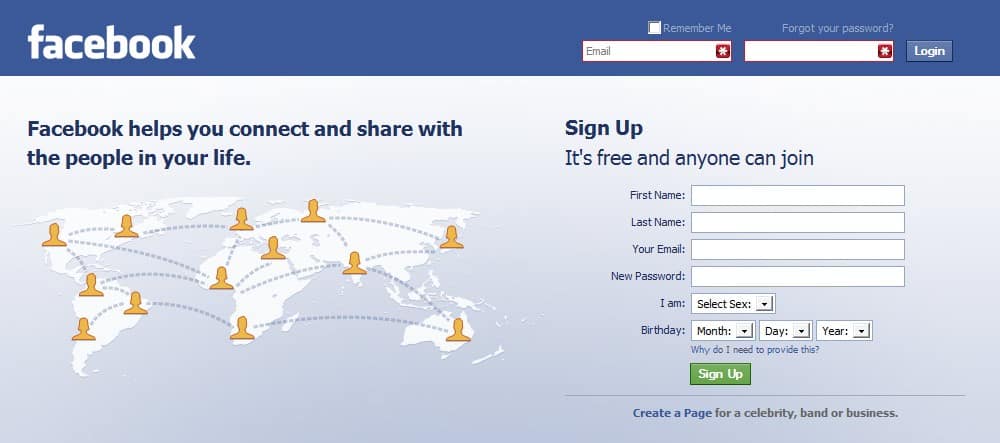
Facebook launched to anyone aged 13+ with an email address, transforming from a platform for college students to a social media platform for anyone. Facebook’s rapid growth was driven by network effects, where the platform became more valuable as more users joined. By 2012, it had surpassed one billion users and went public on NASDAQ. Strategic acquisitions of Instagram and WhatsApp further strengthened its dominance across multiple forms of digital communication, consolidating user data within a single ecosystem, and raising concerns about competition and market power. The platform introduced key features that have shaped modern social media, including user profiles, timelines, news feeds, and messaging through Facebook Messenger. Users could share updates, join groups, and engage with content using reactions such as “like,” “love,” or “angry.” These features fostered global connectivity but also enabled the collection of vast amounts of personal data. Facebook’s business model relies heavily on targeted advertising, allowing businesses to reach specific audiences based on behavior, demographics, and interests. While this has made advertising more accessible and efficient, especially for small businesses, it also depends on extensive data collection, often without meaningful user consent. This practice aligns with the concept of “surveillance capitalism,” a term popularized by Shoshana Zuboff, that describes how companies monetize personal data (Hall, 2026). Facebook’s rapid growth can be explained by network effects, in which a platform becomes more valuable as more users join. After opening to the public in 2006, Facebook scaled quickly, reaching over one billion users by 2012.
The same year, it went public on NASDAQ, and its acquisitions of Instagram and WhatsApp allowed it to dominate multiple forms of digital interaction, reducing competition and consolidating user data within a single corporate ecosystem. Scholars argue that such concentration of power raises antitrust concerns and limits consumer choice. Businesses can segment audiences based on behavior, demographics, and interests, making advertising more efficient and accessible, especially for small enterprises. This model has generated enormous revenue and fueled the growth of the digital economy. However, this economic success depends on extensive data collection, often without meaningful user consent, raising ethical questions about exploitation and transparency. The term “surveillance capitalism,” popularized by Shoshana Zuboff, describes an economic system in which companies monetize personal data. Facebook exemplifies this model by tracking user behavior both on and off its platform. The Cambridge Analytica scandal revealed how user data could be harvested and used for political profiling, demonstrating the real-world consequences of weak data protection. Critics argue that Facebook’s practices blur the line between service and surveillance, fundamentally altering expectations of privacy in the digital age.
Facebook’s algorithm prioritizes engagement, often amplifying emotionally charged or sensational content. This design has contributed to the spread of misinformation, particularly during elections and global crises. False narratives can spread rapidly, influencing public opinion and undermining trust in institutions. Although Facebook has implemented fact-checking systems and content moderation policies, these measures have struggled to keep pace with the scale of the problem. The platform’s role in shaping political discourse raises urgent questions about accountability and regulation. Despite these criticisms, it is important to acknowledge Facebook’s positive contributions. The platform has enabled global connectivity, allowing individuals to maintain relationships across distances and build communities around shared interests. It has also supported social movements by providing tools for organization and awareness. For many small businesses, Facebook remains a critical marketing channel. Proponents argue that these benefits outweigh the risks and that technological innovation inevitably involves trade-offs.
In 2021, Facebook rebranded as Meta Platforms, signaling a shift toward virtual reality and artificial intelligence. This transition reflects an effort to redefine the company’s identity and move beyond its controversies. However, critics remain skeptical, arguing that the underlying business model centered on data extraction remains unchanged. Meta’s organizational culture emphasizes innovation, speed, and data-driven decision-making. Employees are encouraged to experiment and focus on measurable outcomes such as user engagement. Using Edgar Schein’s Organizational Culture Model, this culture can be analyzed at three levels: artifacts, espoused values, and underlying assumptions. Similarly, Goal-Setting Theory explains how employees concentrate on specific, measurable objectives, sometimes at the expense of broader ethical considerations. While this performance-driven culture supports rapid growth, it may also contribute to stress and ethical dilemmas. Meta has faced challenges related to diversity and inclusion, particularly in increasing the representation of women and minority groups in technical and leadership roles. Efforts such as diversity reports, inclusive hiring initiatives, and employee resource groups have been implemented, but progress has been gradual. Applying Michàlle Mor Barak’s Inclusion
Framework suggests that Meta must move beyond representation to ensure meaningful participation in decision-making. Strengthening inclusive leadership could better integrate diverse perspectives into organizational outcomes. Meta motivates employees through competitive compensation, bonuses, stock options, and career development opportunities. These practices align with Frederick Herzberg’s Two-Factor Theory, which distinguishes between hygiene factors and intrinsic motivators. While Meta performs well in providing external rewards, it may benefit from enhancing intrinsic motivation by connecting employee work to ethical impact and societal value.
With billions of users across platforms like Facebook, Instagram, and WhatsApp, Meta has reshaped communication, advertising, and social interaction globally.
Facebook’s evolution illustrates the dual nature of technological innovation: it can simultaneously empower and endanger society. While the platform has transformed communication and created economic opportunities, it has also introduced significant ethical and political challenges.
Understanding Facebook requires examining not only its technological achievements but also its broader societal impact. As digital platforms continue to shape modern life, the need for accountability, transparency, and regulation become increasingly urgent.
Sources
Hall, M.(2026, April, 23).Facebook. Encyclopedia Britannica. Retrieved from:
https://www.britannica.com/money/Facebook
• Bellis, Mary. (2025, April 30). The History of Facebook and How It Was Invented. Retrieved from https://www.thoughtco.com/who-invented-facebook-1991791
About the Creator
Gladys W. Muturi
Hello, My name is Gladys W. Muturi. I am an Actress, Writer, Filmmaker, Producer, and Mother of 1.
TALES & CONFESSIONS OF A HIGH SCHOOL NOBODY COMING SOON
Enjoyed the story? Support the Creator.
Subscribe for free to receive all their stories in your feed. You could also become a paid subscriber, letting them know you appreciate their work.
Comments
There are no comments for this story
Be the first to respond and start the conversation.