
The iPhone 18 Pro Has a Dirty Secret: The Most Expensive Models Have the Slowest Storage
Apple put QLC flash in its 1TB and 2TB iPhones while cheaper models get TLC. Here’s what that means for creators, photographers, and anyone who trusts the word “Pro.”
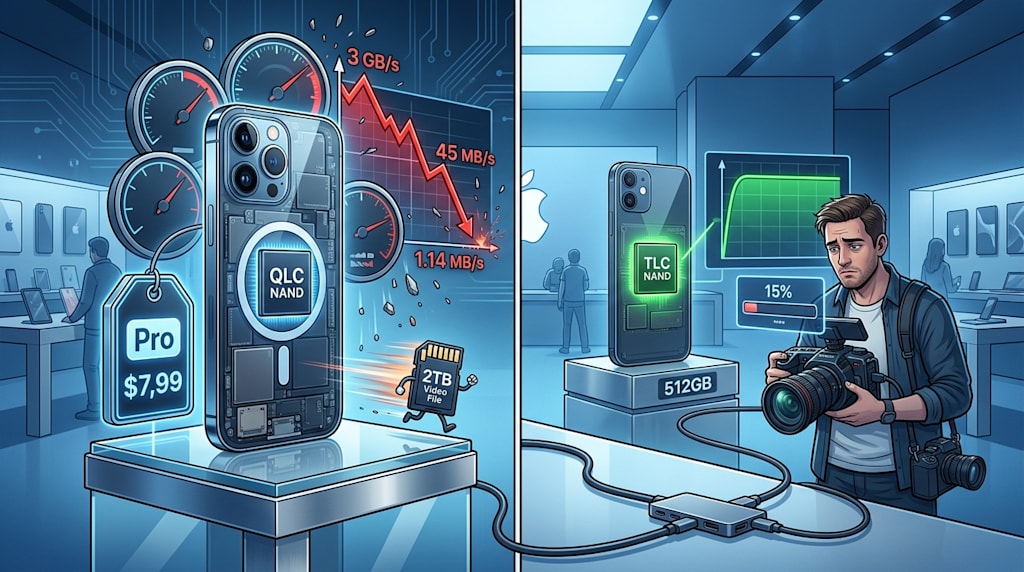
The iPhone 18 Pro’s QLC problem: bigger storage, slower writes
1. A RMB 21,499 phone that writes slower than an SD card
In September 2026, the iPhone 18 Pro went on sale. The 2nm A20 Pro, variable aperture, and better battery life looked like solid upgrades. Within a week, a detail inside the chassis overtook them: the 1TB and 2TB models use QLC flash. The 256GB and 512GB models use TLC.
HOMOLAB ported FIO, an SSD benchmarking tool, to iOS and ran a stress test on the 1TB iPhone 18 Pro Max. At 60% storage use, average write speed to the QLC layer was 45MB/s. The lowest result was 1.14MB/s. A normal high-speed microSD card writes above 90MB/s. The 2TB model costs RMB 21,499. When it writes large files continuously, it performs worse than a memory card that costs a few dozen yuan.
In mixed read/write tests, the 512GB TLC model beat the 1TB QLC model by about 38%. The cheaper phone had the stronger storage.
2. Why QLC slows down
NAND flash stores data in floating-gate transistors. The amount of charge a cell holds determines storage density. TLC stores 3 bits per cell, with 8 voltage states. QLC stores 4 bits per cell, with 16 voltage states. The extra bit packs more data into the same area and lowers manufacturing cost.
It also makes writes harder. Moving from 8 voltage states to 16 requires much tighter control over charge placement. Writes take longer. The margin for error shrinks. TLC endures roughly 3,000 to 5,000 P/E cycles. QLC endures around 1,000. Each extra bit per cell cuts endurance by about an order of magnitude.
Apple uses a cache system to hide this. The S6E controller simulates part of the storage as SLC and TLC. It writes first to a high-speed cache, then migrates data to the QLC layer in the background. On an empty 1TB iPhone 18 Pro, the pseudo-SLC cache can reach about 250GB. Write speeds can exceed 3GB/s. Short writes, such as WeChat messages, photos, and app installs, never reach the edge of that cache.
The cache is the limit. HOMOLAB recorded three speed tiers. SLC cache writes run above 3,000MB/s. The secondary TLC buffer runs around 578MB/s. Direct QLC writes average 79.4MB/s, with a low of 25.6MB/s. At 60% storage use, the SLC cache shrank from 250GB to 58GB. Third-tier write speed fell to an average of 45MB/s.
3. Who pays for QLC
The iPhone 18 Pro Max 1TB costs RMB 16,499. The 2TB costs RMB 21,499. That is a RMB 5,000 gap. People who buy the large-capacity models usually have clear needs. They record long ProRes sessions. They store footage locally. They treat the phone as their main work device.
When they shoot ProRes video, a sudden write-speed drop after the cache is exhausted can interrupt recording or drop frames. During new-phone data migration, sustained writes of large files trigger cache recovery and multiply transfer times.
For a 256GB iPhone 18 Pro and a 2TB Pro Max, daily use feels nearly the same. Browsing, photos, messaging, and even large games do not write enough data to exhaust the cache. The problem lands on the buyers of the large-capacity versions. They paid more and got theoretically worse hardware.
4. Mixed use, not a full switch
The 256GB and 512GB versions use TLC flash from SK Hynix, Kioxia, and SanDisk. The 1TB version mainly uses SK Hynix BC8Q-1T QLC NAND. A very small number of batches mix in Samsung 3DV8 TLC NAND. The 2TB version uses SK Hynix BC8Q-2T enterprise-grade QLC NAND across the board.
Apple’s official spec page does not label which NAND type each capacity uses. When consumers pay RMB 16,499 or RMB 21,499, they cannot know whether they are getting TLC or QLC. Some consumers have asked Apple to disclose flash hardware specs. If NAND type does not affect the experience, labeling it would cost nothing. Labeling would hurt sales, and that fact answers the question.
5. The choice under cost pressure
In 2026, global NAND flash prices spiked. According to Counterpoint, NAND contract prices rose more than 90% quarter over quarter in Q1 2026. DRAM prices jumped 80% to 90%. The 256GB flash cost in the iPhone 18 Pro rose from $13 in the previous generation to $51, nearly quadruple.
Phone makers can raise prices, cut specs, or do both. Apple did both. The iPhone 18 Pro Max 2TB went from RMB 17,999 in the previous generation to RMB 21,499. The flash switched from TLC to QLC.
QLC will keep entering high-end smartphones. Higher storage density is a hard requirement, and TLC is approaching its physical limits. The questions are how QLC is used, what it costs, and whether buyers are told. If Apple had labeled the 1TB and 2TB versions as QLC flash for everyday use and priced them against the TLC versions, the controversy would be smaller.
6. What buyers should do
The QLC controversy around the iPhone 18 Pro looks like an argument over specs. Apple used the “Pro” label to set an implicit contract between price and quality. A higher price should buy better hardware. A larger capacity should match stronger performance. That contract was broken, and the brand stayed silent.
If you do not often transfer large files or record high-spec video for long sessions, the QLC performance gap is nearly invisible in daily use. If you are a ProRes creator or a heavy data user, the 512GB TLC version may be a better choice than the 1TB QLC version. It is also cheaper. That is the absurd buying advice of 2026: buy the smaller one.
A RMB 20,000 phone cannot outwrite an SD card when handling large files. The word “Pro” now needs a clearer definition.
About the Creator
Jin
Writer of reamstories
https://reamstories.com/jin
Enjoyed the story? Support the Creator.
Subscribe for free to receive all their stories in your feed. You could also become a paid subscriber, letting them know you appreciate their work.
Comments
There are no comments for this story
Be the first to respond and start the conversation.