
Not Lucky: International Lottery System Scammed
As the old saying goes, if it sounds too good to be true, it's most likely not true. The Irish Lottery Scam, an email scam, is just that. So what is it and how to avoid it?


Bizarre Email With A Dubious Claim
The greeting on the email screams: “CONGRATULATION LUCKY WINNER.” Temptation and the promise of a big prize is enough for one to click it open. However, the content immediately raises questions about it authenticity.
The poorly edited email is from an “international lottery system” that informs the recipient has been chosen randomly as a winner of a huge monetary reward from the Irish Lottery. The email goes on to state that they need to contact lottery officials as soon as possible in order to set up a payment system to get it.
The letter states the authors of this "lottery" want personal information - such as access to his bank account or social security number. Suddenly, what seemed like a a glorious announcement, becomes a foreboding document with several red flags.
A Scam Based on "Luck"
This scam, better known as The Irish National Lottery Scam, has been around for a while. It’s one of many email scams in which scammers try to part the recipient of the letter from their money. And, like other email scams such as the infamous Nigerian 4-1-9 scam, it appeals to personal needs and emotions to trick people into answering the letter and doing what is prescribed in it.
In this case, the scammers manipulates a person’s desire for wealth and winning. Unfortunately, many who have received this letter have put their cautions – and common sense - to the side in order to get that money they blindly believe they won.
How it Lures People In
By this time, most people should be wary of unsolicited email (which hasn't been automatically moved to the spam folder). But, people can be easily manipualated when the appeal of winning and its temptation of monitary rewards are used by scammers.
In additions, the scammers know that making the letter look as authentic as possible is needed. As a result, they use an actual company's name with phone numbers, emails and addressed to the supposed lottery department.
The letter tries to lure in its victim by stating that the Irish National Lottery had a free online international program that randomly chose people by their email accounts. It also states that the winnings are in the millions (sometime in English pounds or American Dollars).
That’s the first mistake people make with this letter. They glance at it but they don’t scrutinize it. If one was to do so, they’d discover that the letter is riddled with spelling errors and inaccuracies. In addition, the phone numbers, emails and address to the corporation representing the lottery are different from the real one.
Still, the first mistake that the recipient of the email may overlook is that the Irish National Lottery – a real entity – doesn’t offer free lottery pickings nor does it give rewards to anyone outside Ireland.
The letter also makes claims that are simply too good to be true.
Another clue to its dubious claim of authenticity is the email address. It uses an account that is not connected in any way with the official lottery organization. This is something a professional organization wouldn’t use; they’d have its own domain. In many cases scammers and phishers will use their own email address or an address with arcaic terms, numbers and characters and will be .com rather .org or .net as many companies will use.
Also, if the email is connected to a fake website, it may exclude such thing as the country's origin in its address. This is something that can be easily overlooked.
Throughout the sample letter (there are several variations. One website, listed 15 different ones) seem to have several emails accounts. Some of them are actually incomplete or bogus.
Suspicious Claims
The letter also makes claims that are simply too good to be true. The thought that somebody won without ever applying for the lottery is an example. Also, the notion that this contest occurs on a weekly basis doesn’t make a lot of sense for a “free” lottery system. Where’s the money coming from to pay such huge winnings? That's just one question one should ask.
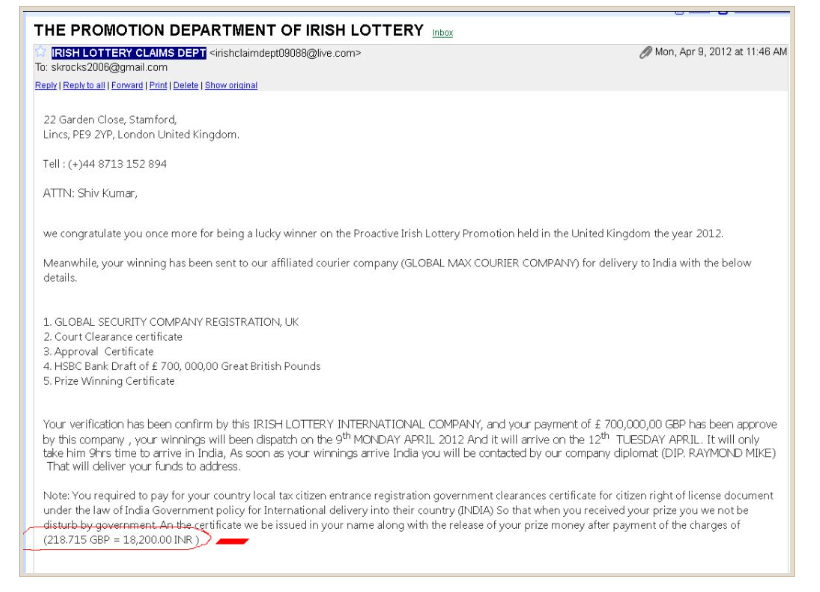
There’s also a noticeable change in the official name of the lottery. It starts off as the Irish National Lottery (which is the official name of the true lottery system in Ireland). Then, above the address, it’s called The Irish Lottery (the name of a private company that has been implicated in past scams).
Finally, after the closing from the “online coordinator” (again, his name changes with every letter), it’s now known as The Irish Lottery Sweepstakes International Program. It’s not uncommon for companies to use various names; however, when the name changes from a legit organization to one known for fraud, it's a definate sign something sneaky is going on.
What They are Really Asking For
Finally, at the bottom of the letter there’s an fill-out sheet that contains entries for personal information, which can be used for nefarious ways by the organization. That will include:
- age,
- gender,
- full name,
- winning numbers,
- email address,
- telephone,
- occupation and
- country they’re from.
Again, if this company is sending out emails randomly and addressing the person in the letter, doesn’t this mean they already have some of this information? The red flag is flapping in the wind if it hasn't been doing so since opening this email.
The scam continues after the would-be winner contacts the scammers. Often, it’s reported that the scammers attempt to get the winner to pay advanced fees to cover expenses associated with delivery of the winnings.
And, in some cases, they ask for other personal information such as bank account numbers, credit cards, and social security numbers; essentially, things you shouldn't give out randomly. As a result, some victims not only lose money on this, they become victims of identity theft.
The scam has been so widespread and rampant that the Irish National Lottery officials publicly released statements to warn against the scam. International laws and enforcement have been trying to crack down on these scams which are often based in countries such as Nigeria, Canada, and the Netherlands.
The National Insurance Crime Bureau also released a guide for dealing with the Irish Lottery Scam. It states:
- You cannot win a lottery if you have not entered it.
- To win a lottery, you must buy a ticket for the the drawing and match the winning numbers.
- The official [Irish] lottery does not choose emails or mobile phone numbers randomly.
- Legitimate lottery officals will never approach or contact someone randomly unless they entered the lottery through means devised by its rules.
- Winners can be notified by email but it is always up to the winner to contact the lottery company to claim any prizes that are due.
- No one will be asked for advanced payment before winning are released by a legitmate lottery. This include the Irish Lottery (NICB, 2026).
Still, even with all the warnings, many people still fall victim to this scam. In one case, a man in Maryland lost $100,000 from his account after he had contacted the “official” and set up a payment system for $800,000 to go into his account. Obviously, the $800,000 never made it in, and the rest of his money soon vanished.
Taking Precautionary Steps
It’s tempting when someone informs you of something you won. Aside from money, it’s a good feeling to have someone call you "lucky" or a "winner". The supposed financial reward is a huge support, as well as a major incentive. The problem is that scammers know this and will stop at nothing to take full advantage of our desires to be recognized in such a manner.
It’s better to take precautions rather than fall for a scam. The temptation of winning big can be strong, but not taking precautions can destroy your life.
Thus, if you know it's too good to be true, just ignore it, delete it, or put it in your spam folder.

About the Creator
Dean Traylor
* Masters in special education and degree in journalism.
*Seasoned writer for the last 30+ years (Newspapers, Magazines, Internet sites)
* Former writer at Hubpages, Helium, and Wikinut.
* Current: Medium (https://medium.com/@ds_traylor)
Enjoyed the story? Support the Creator.
Subscribe for free to receive all their stories in your feed.
Comments
There are no comments for this story
Be the first to respond and start the conversation.