
Meta Muse Topped the App Store. The SDK Is the Bigger Move.
A personal AI agent just got hands, eyes, and a Raspberry Pi. Here's what developers should watch.
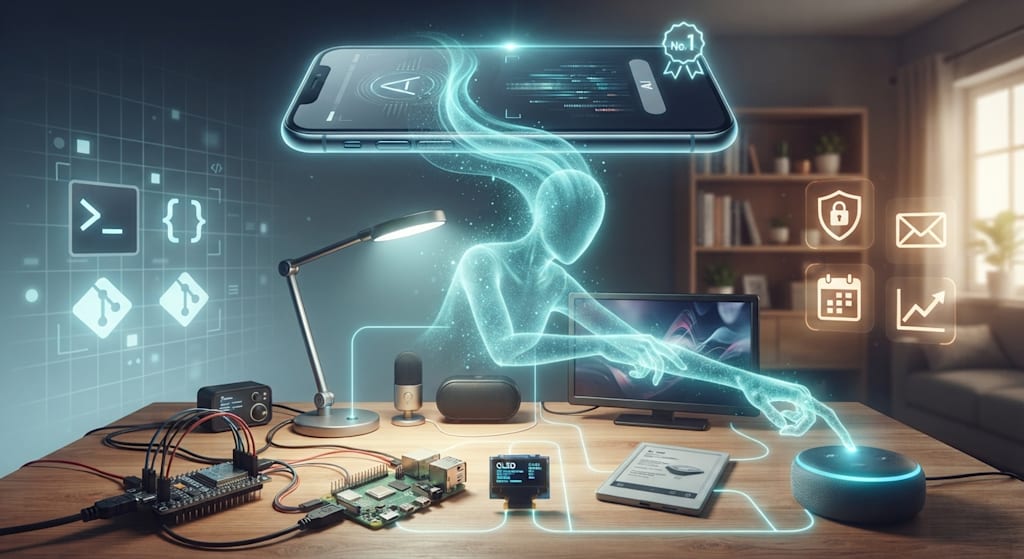
On September 8, 2026, Meta released Muse. Two weeks later, it passed ChatGPT to become the No. 1 free app on the U.S. App Store. Meta’s stock rose 11.43% that day. Market cap added more than $190 billion.
The ranking is easy to notice. On October 2, 2026, Meta open-sourced the Muse Gadget SDK on GitHub under Apache 2.0. The repository includes an ESP32 Device SDK and a Linux Device SDK. A developer can take a cheap microcontroller or a Raspberry Pi, add a screen, microphone, speaker, sensor, or button, and connect it to Muse.
An AI agent that lived on a phone or in a browser now has a path into the physical world.
What Muse does
Meta calls Muse a personal AI agent. It browses the web, fills forms, manages email and calendars, books restaurants, and completes purchases. It asks for confirmation before sensitive actions. The app has five tabs: chat, personalized feed, inspiration prompts, goal tracking, and file management.
IDC’s chief research officer, Meredith Whalen, said Muse has a chance to build consumer stickiness “because it is a task executor, not just a chatbot.”
The numbers: 3 million weekly active users in 22 days. More than 2.5 million downloads. Those are early. They suggest people will use an AI product that finishes tasks, not one that only describes how to finish them.
SDK open source
Meta’s GitHub release is more than a few API calls. The ESP32 SDK connects screens, audio input and output, and sensors. The Linux SDK turns a Raspberry Pi or another Linux device into a Muse Gadget. Developers can add custom commands, manage system tasks, or connect Home Assistant.
Meta also built a reference device. Nat Friedman, product lead at Meta Superintelligence Labs and former GitHub CEO, made Muse Home Link. It is a small USB-C powered device that plugs into a home network and talks to TVs, speakers, and other smart devices that expose HTTPS interfaces. Meta produced 5,000 units and gave them free to U.S. Muse subscribers.
Friedman’s description is blunt: it is “for hackers by hackers, purely for fun.” Possible side effects include “bricking, warranty void, voltage drop, or bankruptcy.” Meta wants developers to experiment. A polished product can come later.
Why hardware
Software-only agents have limited reach. They can send email, fill a form, or book a hotel. They cannot turn off a lamp, print a document, or read a room sensor. An agent needs hands and eyes. Hardware supplies both.
Meta’s reference designs show the range: a desktop assistant with a round AMOLED touchscreen and push-to-talk; a TV stick that plugs into HDMI; an e-ink device for morning briefings; a pocket-sized M5Stack status screen; a voice device connected to Home Assistant. None of these need a powerful processor. They need to be a reliable interface between Muse and the physical world.
Qualcomm CEO Cristiano Amon said at COMPUTEX 2026 that agents are deploying across phones, PCs, and a new category of personal AI devices. Hardware is where agent reach expands.
Competition
Muse is not alone. OpenAI updated its Agents SDK in April 2026 with a model-native runtime, sandboxed execution, configurable memory, and Codex-like file tools. It supports more than 100 non-OpenAI large language models. Google launched Gemini Spark, a 24/7 personal AI agent that runs on a Google Cloud virtual machine even when the phone and laptop are off. Google’s Antigravity Agent offers a general hosted agent: one API call gives a secure Linux sandbox for reasoning, code execution, file management, and web browsing. Apple rebuilt Siri on an LLM architecture at WWDC 2026, adding personal context, screen awareness, and cross-app actions, powered by a custom Gemini model.
Muse combines three things: a consumer agent app, an open hardware SDK, and smart home connections. It competes for the position of personal digital assistant and for the physical extensions of that assistant.
How development changes
The old model: a user operates software. Developers design pages, buttons, and APIs. The new model: an agent executes. Developers design tasks, tools, confirmation points, permissions, audit logs, and rollback paths.
The Linux SDK makes this concrete. Muse executes commands as the account selected during installation, with all the permissions of that account. The documentation says: if the account can use sudo, so can Muse. That single line changes the design problem. Permission scope, operation logs, and human confirmation are now baseline requirements.
MCP also moved in this direction. The 2026-07-28 specification rebuilt the protocol around a stateless core, removed the handshake, and introduced a feature lifecycle and deprecation policy. The goal is to make enterprise agent systems easier to deploy, scale, and govern.
Trust
An agent reads email, calendar, financial data, and social accounts. It also acts on them. A model that gives a wrong answer creates embarrassment. An agent that sends the wrong email, cancels the wrong order, or operates the wrong account creates a different kind of problem.
Meta says Muse runs on a dedicated cloud computer. Other agents cannot access it. Muse cannot see passwords or payment methods. A Sentinel Agent controls every connector operation and network request. The app asks for confirmation before sending email or completing a purchase.
Technical safeguards are not the same as user trust. Meta agreed to a settlement of nearly $17 billion with state attorneys general over claims that Facebook and Instagram harmed teen mental health. Asking users to hand their email, calendar, and financial data to a Meta agent requires crossing a high barrier. IDC’s Whalen says trust is the question. The moat for agent products is a stack: model capability, tool calls, permission systems, security mechanisms, and user trust.
Openness and control
Meta open-sourced the device software. It did not open-source the agent or the cloud service. To connect a device, a developer needs an SDK token, a Muse account, and compliance with terms that restrict ordinary commercial distribution. Meta opened the connection layer. The intelligence layer stays with Meta.
This is a familiar platform strategy. Lower the barrier to hardware development, expand the developer community, keep the core value. The risk is also familiar. If developers decide the openness is too limited, or if they distrust Meta’s data policies, growth can stall.
Some developers already complain on social platforms. They point to restricted file system permissions and the inability to operate a local desktop like Codex. These are early technical complaints. They also point to a larger issue: developer investment depends on openness and predictability.
What to watch
Muse has three layers of progress. Product: App Store No. 1, 3 million weekly active users, a stock jump. Platform: an Apache 2.0 SDK, ESP32 and Raspberry Pi support, 5,000 Home Link units, a Discord community. Industry: agents moving from digital spaces into physical spaces, becoming an interface between software, hardware, and daily life.
The obstacles are just as clear. Meta’s privacy history. The boundaries of the SDK. Whether developers accept the terms. Whether users trust an agent with their inbox and their front door.
For developers, the question is what kind of software you build when the user is no longer the one clicking. On Discord, one developer asks why Muse cannot touch the local file system like Codex. That question, more than the App Store ranking, will shape what Muse becomes next.
About the Creator
Jin
Writer of reamstories
https://reamstories.com/jin
Enjoyed the story? Support the Creator.
Subscribe for free to receive all their stories in your feed. You could also become a paid subscriber, letting them know you appreciate their work.
Comments
There are no comments for this story
Be the first to respond and start the conversation.