
Luo Yonghao Called the iPhone Duo a Copy Seven Times. He Missed the Harder Question.
Apple’s first foldable didn’t invent the form. It’s trying to solve the part Android never fixed.
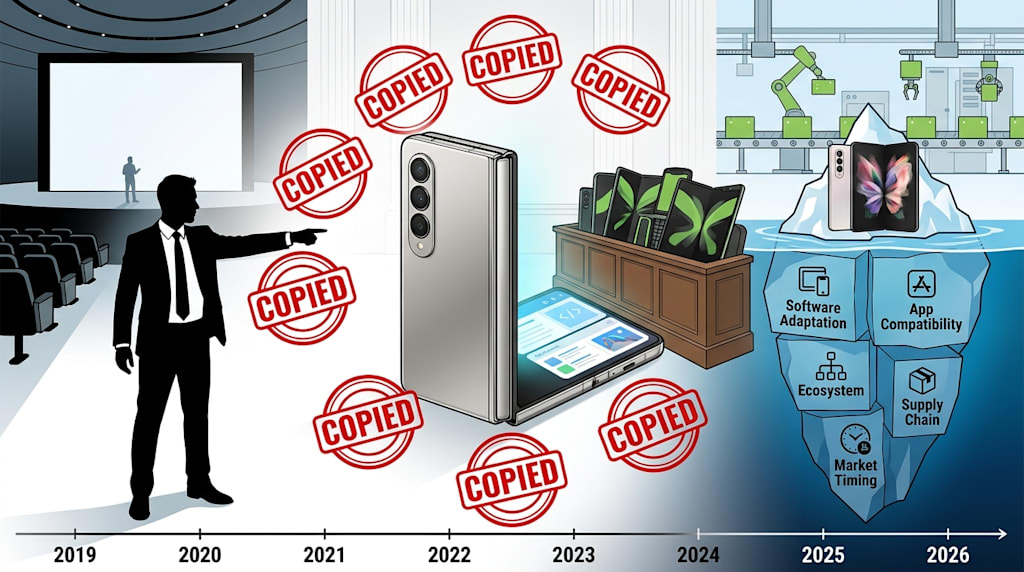
After seven “copies”s: behind the iPhone Duo controversy, we need to rethink “innovation”
In the early hours of September 10, 2026, at Apple’s fall event, new CEO John Ternus said: “The iPhone Duo is arguably the most disruptive iPhone since the original.”
Almost at the same time, Luo Yonghao posted seven “copies”s on Weibo.
“Foldable form factor? Copied. Under-display camera? Copied. The short, wide screen ratio? Copied. Side Dock? Copied. Seamless relay between outer and inner screens? Copied. Multi-angle hover? Copied. Titanium 3D-printed hinge cover? Copied.”
He added: “Can we get some truth for once?”
The post set off a firestorm. Some commenters applauded. Others said he was rehashing an old act, riding Apple’s coattails for over a decade. Either way, one question moved to the foreground: when a product has almost no first-ever labels on its feature list, does it still count as innovation? That question deserves a more serious answer than the seven-hit combo.
A ticket to the party, seven years late
To understand the controversy, first understand what the iPhone Duo is.
Apple has thought about foldables for a long time. In September 2011, it filed a patent application titled “Flexible electronic devices.” The device could fold, fit in a pocket when closed, and use sensors to tell whether it was open or shut. The patent was granted in 2015. Six inventors were listed. One was John Ternus.
Fifteen years later, that inventor stood on a keynote stage as CEO and launched the iPhone Duo.
During those fifteen years, Apple’s foldable stayed in patents and rumors. In February 2019, Samsung and Huawei released their first foldables four days apart. Apple showed nothing. Over the next seven years, Huawei iterated through the Mate X and Pura X series. Samsung refined eight generations of Galaxy Z Fold. OPPO, vivo, Honor, and Xiaomi entered. Chinese manufacturers took foldables from “it can fold” to “it is good to use.” Huawei launched the tri-fold Mate XT, pushing form-factor exploration further.
Apple did not move until September 2026.
The iPhone Duo uses a wide-fold design. It has a 7.6-inch inner screen and a 5.4-inch outer screen, both with a 1:1.4 aspect ratio. It runs on the A20 Pro chip, built on a 2nm process. Unfolded, it is 5.2mm thick, the thinnest iPhone yet. It starts at 15,999 yuan. The top model is 26,499 yuan.
By specs, it is a competent foldable flagship. By first-ever status, it breaks no new ground.
The wide-fold form factor was already done by the Huawei Pura X Max and OPPO Find N. Samsung tried under-display cameras on foldables and later abandoned them. Multi-angle hover and inner-outer screen relay are standard on Android foldables. So is a side Dock. Each of Luo’s seven “copied”s maps to a feature Android makers have mass-produced for years.
If innovation means being first to do it, Luo is right. The iPhone Duo did not do that.
The other side of the criticism
One point in Luo’s criticism deserves separate treatment.
The only original thing he acknowledged was the folding animation. He argued that Apple’s crease approach was original. Because Apple could not solve the crease, he said, it used a matte display to hide it, which degraded the screen. That made the front camera blurry under the matte screen. Apple then polished a small clear area for the camera, which made the camera it was trying to hide stand out. He called it “one hundred percent carving shit on shit.”
Hands-on reports partly confirmed and partly rebutted that judgment.
The iPhone Duo’s crease control reaches the highest level among current foldables. The crease is hard to see except from extreme side angles. Apple uses nanotexture glass on the inner display, creating a matte tablet-like effect. That reduces the crease’s visual presence. A self-developed variable-torque hinge and ultra-thin UTG glass further minimize it physically.
This is not “carving shit on shit.” But Luo’s front-camera point also holds. An under-display camera under a matte screen will lose image quality. Physics decides that.
The more useful discussion is why Apple chose this way to solve the crease problem.
The traditional path is to thicken UTG glass and optimize hinge filling to press the crease flat. Apple chose another route. It did not change the physical structure. It changed the visual experience. Nanotexture glass makes the crease almost invisible visually rather than eliminating it physically. This approach carries Apple’s experience-first logic. A problem users cannot perceive does not always need an engineering fix.
For the image-quality compromise from the under-display camera, Apple’s trade-off is clear. An immersive iPad-like experience when unfolded matters more than front-camera image quality. The iPhone Duo does not have Face ID. It uses side Touch ID. The front camera is not used often anyway.
You can disagree with this trade-off. But it is a logical trade-off, not a hasty response after failing to solve the problem.
The moat is not in the hardware
Compare only hardware specs, and the iPhone Duo falls behind everywhere.
Samsung posted a series of digs after the event. It noted that the Galaxy Z Fold 8 weighs 201 grams. The iPhone Duo weighs 254 grams, 53 grams more. Unfolded, the Galaxy Z Fold 8 is 4.5mm thick. The iPhone Duo is 5.2mm.
Those numbers are real. But they are not the whole of foldable competition.
Software adaptation is the problem foldables have not solved in seven years. The hinge was not the hard part. Apps are written for a tall rectangle. When unfolded, the screen becomes roughly square. Apps do not know what to do. Google set a fallback in Android 12L. Apps that do not adapt are shown as a vertical strip in the middle of the screen, with black bars on both sides. Four years later, that fallback is still the state of most apps on foldables. In its wide-fold adaptation guidance for developers in July, Google still listed the same problems. After unfolding, images are stretched or cropped. Some turn sideways.
An Android platform holder went from begging developers to adapt to forcing them to adapt in four years. The effect of that forcing will take another year to be seen.
Apple chose a different path. iOS 27 introduced three compatibility modes for the foldable form factor. Apps at different stages of development get different display schemes. Apps built for iOS 27.1 can enter a fully compatible mode. They can use the full iPhone Duo display. They support split screen and multiple windows. They can also run the same app twice. Netflix, Zoom, and Slack have announced early support.
On day one, the iPhone Duo’s mainstream app experience is better than that of Android foldables. This is Apple’s strongest ability. It uses platform power to force app system adaptation rather than relying on developers’ goodwill.
Apple’s senior vice president of worldwide marketing, Greg Joswiak, said something telling in an interview. Apple studied foldable phones already launched by other manufacturers. It did not find them “particularly exciting.” He thought many foldable phones on the market looked like two phones “clumsily glued together.”
That sounds arrogant. It also reveals a fact. Apple cared about what you can do once it is unfolded. Whether it can fold was table stakes.
“Integrative innovation” in an era of industry convergence
Back to the original question. Does the iPhone Duo lack originality?
If originality means inventing a feature or form factor that never existed before, then the iPhone Duo is not original. Wide folding, under-display cameras, multi-angle hover, inner-outer screen relay. None were done first by Apple.
If originality means finding the most complete solution for an existing category, then the iPhone Duo’s originality is underestimated.
Foldable phones have gone through seven years of development. Supply chain technology has matured. Use cases have been explored. Interactions have been worked out. Apple entered at this point. It waited for technological maturity to meet its standards. Then it used its integration ability to make a more complete product.
Apple has done this many times.
The iPod was not the first MP3 player. The iPhone was not the first smartphone. The Apple Watch was not the first smartwatch. The AirPods were not the first truly wireless earbuds. Each time, Apple was not first. Each time, Apple defined the standard form of the category through deep integration of hardware and software, plus its app system.
Call it integrative innovation. It is a different dimension from a single-point breakthrough. It is finding the best solution at the system level.
This strategy has a prerequisite. You must be better than others in some dimensions. The iPhone Duo’s crease control, software and hardware adaptation, and inner-outer screen interaction reach the highest level among current foldables. That is its confidence.
It also has obvious weaknesses. Weight and thickness are not advantages. Neither is price. The 254-gram weight is a burden for long one-handed use. The 15,999 yuan starting price makes it a niche product. TrendForce predicts it will sell about 5 million units this year. That is about 24.8% of the global foldable market. The number is not low. It is not enough to shake Samsung and Huawei.
What Apple needs to prove
At the end of the event, Ternus said: “For Apple, what has always mattered is when a product idea can meet our standards for quality, durability, and design.”
That is the standard formulation of Apple’s late-mover strategy. It sounds sincere. It also avoids a question. If the standard for a product idea is “others did it, we do it better,” can Apple make something others have not done?
In the Steve Jobs era, Apple’s signature products shared one trait. They created categories users did not know they needed. Before the iPhone, no one knew they needed a phone without a keyboard. Before the iPad, no one knew they needed a bigger iPhone. Those products succeeded because they created new demand.
In the Tim Cook era, Apple became better at doing it better. The Apple Watch was better than all smartwatches. The AirPods were better than all truly wireless earbuds. The iPhone Duo is trying to repeat that story in foldables.
That strategy is hitting a bottleneck. Technology directions have converged. Supply chain gaps have shrunk. Consumers find it harder to distinguish flagship phones from different brands. The room for doing it better is shrinking.
Market data confirms this. In the second quarter of 2026, global smartphone shipments fell 6.7% year over year. China’s smartphone market has declined year over year for five consecutive quarters. The replacement cycle has stretched past 43 months. Apart from foldables, candybar phone iterations are homogenized. AI phones are highly anticipated. Most users try AI features briefly after purchase. Usage is very low.
Against this backdrop, the iPhone Duo’s entry gave the foldable market a boost. 1.206 million reservations. Scalpers marked it up by as much as 34,000 yuan. After the hype, the fundamental question will surface. The question is whether foldables are the future form of smartphones.
Seven years on, foldables’ global penetration rate remains low. Apple’s entry will push down supply chain costs and speed up developer adaptation. It will also raise consumer awareness. It has not answered why people need a phone that folds.
The boundaries of innovation
Back to Luo’s seven “copied”s.
Is he right? Yes. The iPhone Duo did not achieve first-ever status in features. Many capabilities have existed on Android foldables for years.
Is his statement complete? No. He ignores Apple’s differentiated capabilities in crease control, software adaptation, and app system integration. He also ignores a fact. In today’s highly convergent phone industry, it is hard for any manufacturer to be absolutely first in a single feature.
In the 2026 phone industry, borrowing from and chasing each other is the norm. The boundary between Android makers’ design language and iOS is blurred. Apple also referenced Android foldable experience in its foldable form. The industry faces a common dilemma: searching for breakthroughs during a technology plateau. The question of who copied whom misses that.
The better question is whether the definition of innovation needs updating in an era when all manufacturers learn from one another.
Creating from zero to one is precious. Finding a better integration solution in a mature category is also an innovation capability. It is just not easily captured by an expression like “seven copied”s.
On October 23, the iPhone Duo will ship. Users will fold it, close it, use it for a week, a month. By then, whether it is worth 15,999 yuan, whether it can change how foldables are used, whether it deserves the label “the most disruptive iPhone,” the market will give the answer.
Luo’s Weibo post will likely be buried by a new controversy when the next event arrives.
That question will not be settled by one product launch.
About the Creator
Jin
Writer of reamstories
https://reamstories.com/jin
Enjoyed the story? Support the Creator.
Subscribe for free to receive all their stories in your feed. You could also become a paid subscriber, letting them know you appreciate their work.
Comments
There are no comments for this story
Be the first to respond and start the conversation.