
I Tested Claude Sonnet 5.5’s Writing. It’s a Reviser, Not a Creator.
The new model is fast, clear, and cheap on paper. But when the prompt turns creative, Opus still holds the pen.
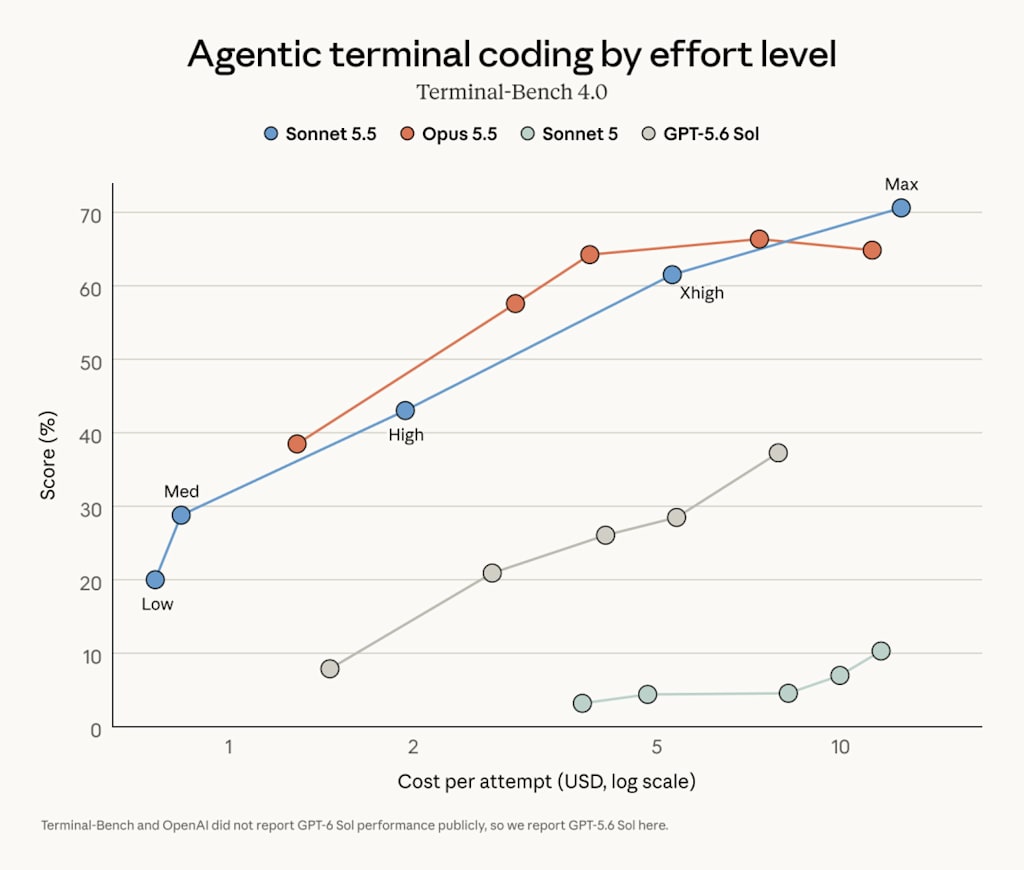
At 4 a.m., in a convenience store, an old man does not arrive.
That was the prompt. Opus 5.5 wrote a driver buying Red Bull, a cat tripping the motion sensor, and a clerk counting lighters before closing the drawer. Sonnet 5.5 wrote an old man with a worn left cuff, a back turning left, and a streetlight going out. Both versions work. The difference is the ending. Opus puts the feeling inside an ordinary action. Sonnet puts it inside a designed image.
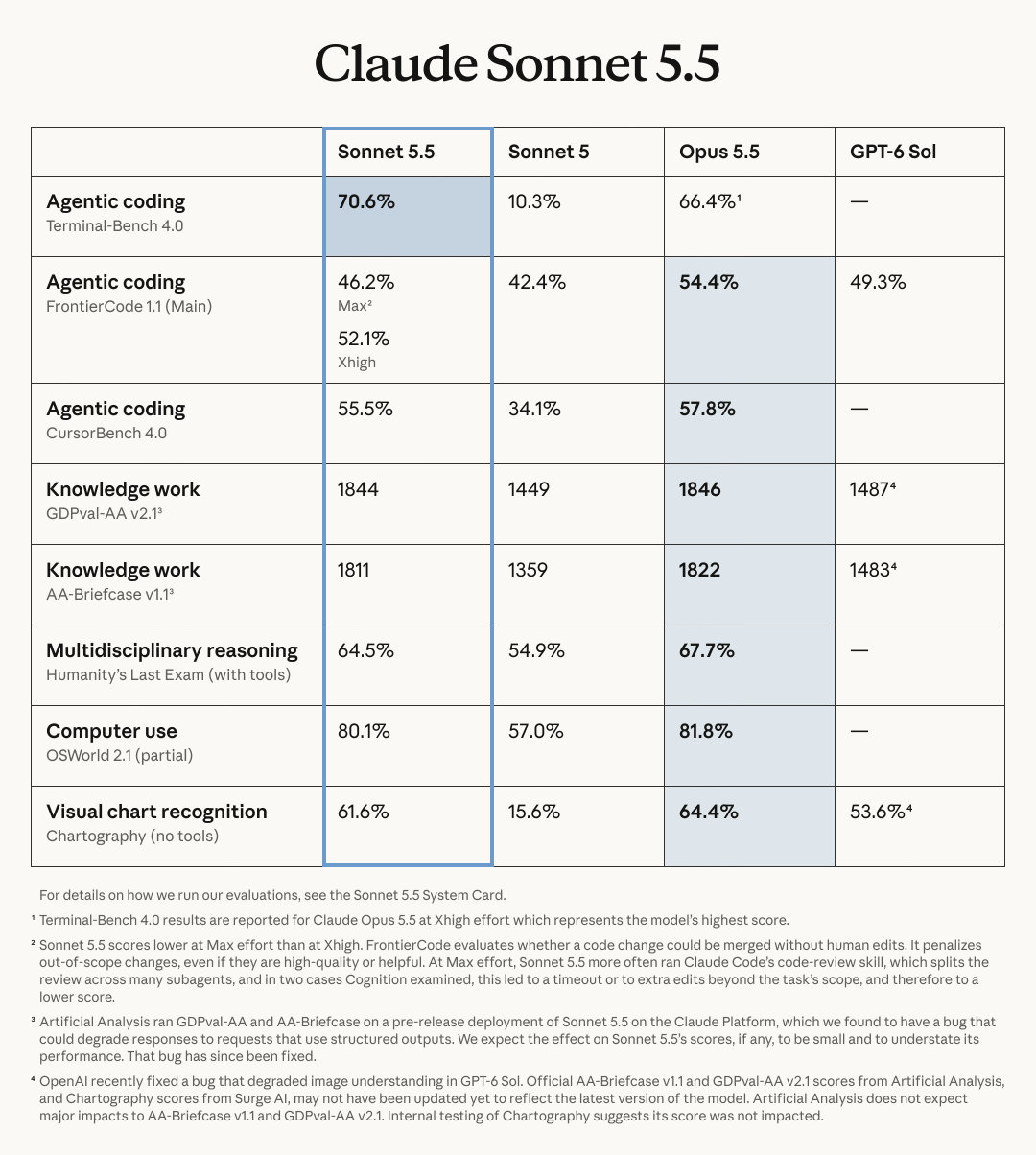
That difference marks Sonnet 5.5’s writing range.
Anthropic positions Sonnet 5.5 below Opus 5.5. Opus handles complex, open tasks that need sustained judgment. Sonnet handles everyday tasks with clear boundaries. For writing, the company lists documents, slides, and spreadsheets. Clear format. Verifiable edges. The goal is not good prose. The goal is a good document.
Anthropic says Sonnet 5.5 “writes more clearly than our previous generation of models.” Early testers call it “a better collaborator than Sonnet 5.” Clarity and nuance are different measures. Clarity tracks how efficiently information moves. Nuance tracks aesthetic judgment. Opus 5.5’s strength in sustained judgment shows up in that second measure.
Same prompt, three answers
The prompt: 4 a.m., a convenience store, the old man did not come. The constraints: Do not explain the setup. Do not state the theme. Do not turn it into chicken soup.
Opus 5.5 starts with smoking by the shelves. A driver buys Red Bull and asks for a lighter. A young man delivering bread asks whose cigarettes those are. A cat passes. The motion-sensor light flickers. Ending: She opens the drawer where the lighters are kept, counts them once, and pushes it shut.
Sonnet 5.5 takes a straighter narrative line. The clerk puts the last pack of Soft Chunghwa in the drawer, then takes it out. “When the sky began to turn blue,” the morning-shift colleague arrives. Before leaving, the clerk says, “Keep one pack of Soft Chunghwa today.” At the end, he stands on the steps and looks down the road to the left for a long time.
The logic chain holds. Every step tells the reader something is happening. The old man with the worn left cuff. The back turning left. The streetlight going out. The images feel arranged. The reader can see the hooks.
A user on Threads wrote that Sonnet 5.5’s sentences “occasionally use unusual expressions, but are overall acceptable.” The problem is “a certain lack of naturalness in the language.” Another Chinese review noted that the model can follow strong constraint instructions, such as “end every sentence with a specific number,” but some sentences “obviously sacrifice fluency to force the condition.”
Every’s review shows another side. Sonnet 5.5’s writing has “dramatically improved compared with Opus 5.5.” Astra remains their favorite writing model. Sonnet 5.5 beats Astra on “revision tasks.” If you have a draft and ask it to polish, compress, and adjust tone, it performs well. When it must generate tasteful text from scratch, its ceiling is lower than Opus.
Opus, GPT-6 Sol, and the cost trap
Against Opus 5.5, Sonnet 5.5 is close in clarity and far apart in aesthetics. A Zhihu six-dimensional analysis says Sonnet 5.5 is stronger than GPT6 sol in general work, front-end development, aesthetics, and writing ability. The same analysis says its “aesthetic and humanistic writing still has a fairly large gap compared with Opus 5.5.” On “in-distribution tasks,” Sonnet performs “almost the same” as Opus. In writing, those tasks include product copy, technical documentation, structured summaries, and template reports. There, Sonnet’s clear writing is enough.
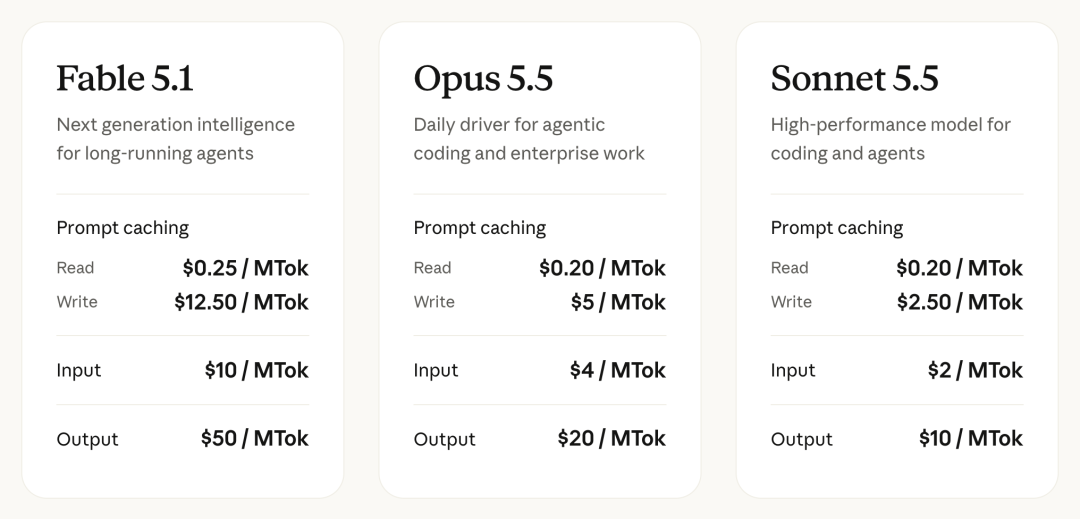
Cost has a trap. An OrcaRouter analysis puts Sonnet 5.5’s “verbosity factor” at about 1.6. For the same task, it tends to generate more tokens. The cost per completed task may run about 27% higher than Opus. Writing produces a lot of output. A talkative model eats the unit-price advantage.
Against GPT-6 Sol, Sonnet 5.5 has a clear edge in textual taste. The Zhihu analysis calls it stronger than GPT6 sol in general work, front-end development, aesthetics, and writing ability. Every’s Alex Albert said on X that Sonnet 5.5 “leads in our readability scores.” The price is token consumption. Writing output is large, and Sonnet’s token use is “clearly higher than 6 sol.” For bulk content generation, GPT-6 Sol may be more cost-effective.
When to use it
Use Sonnet 5.5 for technical documentation and API descriptions. The structure is tight, terms can be checked, and clarity matters most. Use it for batch product copy and A/B iteration. The speed advantage is obvious, and the style stays controllable. Use it to revise and compress existing drafts. In Every’s test, Sonnet beat Astra on revision tasks. Use it to match a brand voice. Layer3Labs found that after 2 or 3 reference paragraphs, Sonnet 5.5 captures sentence rhythm, punctuation habits, and vocabulary choices.
Do not use it for fiction that needs a distinctive narrative voice. The convenience-store short story shows why. Do not use it for open creative briefs. When the task is “write a moving brand story” with no clear acceptance criteria, Opus’s sustained judgment is irreplaceable. Do not use it for long-form work that needs a consistent aesthetic throughout. Layer3Labs found Sonnet 5.5 follows structural instructions well above 5,000 words. Following structure is not the same as sustaining a voice.
One underrated feature: million-token context. Sonnet 5.5 supports a 1-million-token context window and a single output of up to 128,000 tokens. For long-form writing help, such as keeping character relationships consistent across a novel, you can keep the full character sheet, earlier chapters, and style references in one conversation. Chinese community feedback says that when using Sonnet 5 to write novels, “long-form setting management” is an area where Claude beats GPT. Public evaluations for Sonnet 5.5 here are limited. The inherited context at least gives it a foundation for long-form coherence.
Use it as a reviser
Put Sonnet 5.5 in the reviser’s seat. Leave the creator’s seat for Opus.
Layer3Labs’s writing workflow splits editing into three stages: structural reorganization, line editing, and proofreading. Chain them into three automated calls. Each stage has clear rules: passive-voice checks, redundant transition-word flagging, and factual-claim verification. A human reviews at the end. In this pipeline, Sonnet 5.5’s speed and instruction-following ability do the work. Explicit editing rules constrain its weakness in taste.
If you throw “write a good short story” at it and judge by Opus’s standards, you will likely be disappointed. Is it bad? No. You asked it to do something it was not designed to do. An excellent news editor can write poetry. That does not give the editor a poet’s ear.
Back to the convenience store. Opus ends with a woman opening the lighter drawer, counting the lighters, and pushing it shut. Sonnet ends with a man standing on the steps and looking down the road to the left for a long time. One action stays with the character. The other stays with an emotion the reader can see.
Sonnet 5.5 writes the everyday. Opus still holds the creative hand.
About the Creator
Jin
Writer of reamstories
https://reamstories.com/jin
Enjoyed the story? Support the Creator.
Subscribe for free to receive all their stories in your feed. You could also become a paid subscriber, letting them know you appreciate their work.
Comments
There are no comments for this story
Be the first to respond and start the conversation.