
I Spent Three Days at the 2026 Yunqi Conference. The Real Story Wasn’t the AI Models.
Alibaba talked about 20GW data centers, self-improving Qwen, and phones that book flights. The flashy demos were only half the story.
Hangzhou, September 22 to 24. The 2026 Yunqi Conference took over the Hangzhou International Expo Center. The theme was “Intelligence for Practical Use.” For the first time, the event split across two locations. Xiaoshan hosted the main venue and industry work. West Lake’s Yunqi Town focused on early research. The two sides sat across the Qiantang River.
Four halls followed a path from technology to value: Hall 1 for intelligence, Hall 2 for computing, Hall 3 for creation, Hall 4 for industry. More than 50,000 square meters. Over 1,000 companies. More than 120 forums. Over 2,000 speakers. After three days, one pattern held. This year was less a benchmark contest and more a homework review. Large models, agents, computing infrastructure, embodied intelligence. Every topic asked the same question: how does AI move from parameter counts to working products?
Wu Yongming: machine thinking, three pillars, and 20GW
Alibaba CEO Wu Yongming opened the main forum. He is one of Alibaba’s eighteen founders and its first programmer.
He made a claim: machines are becoming the main source of thinking, and intelligence is becoming a commodity. In the future, machine thinking will reach more than 1,000 times human thinking and carry 99.9 percent of the world’s total thinking. The last time something like this happened was the Industrial Revolution, when power became a commodity. People invented the steam engine, the internal combustion engine, and electricity, then built modern industry on top.
He compared AI coding today to the electric light in 1882. It replaces existing work. It does not yet create a new era. Helping people code, write reports, and answer questions is the early stage. When machine intelligence becomes abundant, its effect on society will go beyond replacing mental labor. Around 1900, many appliances were already in homes. The world’s entire annual electricity output then would last about two hours today.
That analogy explains Alibaba’s bet. The three pillars are AI models, AI chips, and AI cloud. These are the conditions for machine thinking at scale. Alibaba says it will keep investing in all three.
First, models. The Qwen team is working on recursive self-improvement. Future models will reach 5 to 10 trillion parameters and handle longer, more complex tasks.
Second, chips. Pingtouge released the Zhenwu V900. Its compute is three times the Zhenwu M890. One cluster can scale to 500,000 cards.
Third, cloud. Customer demand is strong, and long-term demand is bigger than supply. Alibaba Cloud aims to operate more than 20GW of global data center capacity by 2032. No Chinese company has set that target before. Twenty gigawatts is close to the total installed capacity of the Three Gorges Dam, or about twenty large nuclear reactors at full power.
Goldman Sachs, Citi, and UBS published reports after the conference. They estimated the 20GW target could support $160 billion to $170 billion in external cloud revenue. Citi called it the most valuable new information from the event.
Wu’s framing matters more than the number. He described the cloud as the power grid of the machine intelligence era. New inventions will come. First you build enough power stations and lay enough lines. That is why Alibaba is betting on models, chips, and cloud at the same time. They are three parts of one infrastructure.
Liu Dayiheng’s debut: Qwen moves from answering questions to delivering tasks
Liu Dayiheng, born in 1993, spoke next. This was his first public appearance as the person in charge of Qwen after taking over from Lin Junyang.
His title was “Qwen: Toward Real-World Agents.” The core idea: models are moving from answering one question to planning, calling tools, checking results, and delivering a full task.
He shared two cases. The first was chip-model co-design. Qwen connected to an industrial EDA environment. It ran for more than 60 hours, made tens of thousands of tool calls, and cut chip design area by 42 percent in the case study while keeping performance. The point is not saved design time. The model can act. It calls professional tools, reads intermediate results, and iterates. That is a full agent loop.
The second was Qwen Max’s self-iteration. Qwen found defects in internal test logs and user feedback. It built training data on its own and used it to train Max. In a little over a month, it ran 33 effective data iterations and raised Qwen 3.8 Max’s Artificial Analysis index from 40 to 45 in 30 days. Model self-improvement is becoming an engineering process. The model finds its own defects and fixes them. That is recursive self-improvement in practice.
Liu also said Qwen 4 would arrive soon. Later Qwen 4.5 and Qwen 5 models will reach 5T to 10T parameters. Qwen 4 is already in training. Video, speech, image, world, music, and full-modal models all launched new versions that day or recently.
One question stayed with me. If models can self-iterate and beat human engineers at chip design, what happens to science? That direction is both a chance and a risk. Liu standing on the main stage is also a signal. In Alibaba’s AI story, Qwen sits at the center, and a young technical lead is now in front.
Li Feifei and Gao Hui: enterprise landing and the logic of computing coordination
Alibaba Cloud CTO Li Feifei moved the talk from model ability to engineering. He named three conditions for enterprise use: model, context, and runtime governance. An agent also needs timely data, an executable environment, clear identity and permissions, and evaluation and feedback.
He focused on the number of unplanned human interventions. That number matters more to a company than a demo that runs many steps. An agent that needs constant human rescue cannot scale.
Li also said Agentic OS is an agent-native operating system. It can cut token use by more than 30 percent and raise sandbox deployment density three times. Competition is moving to the runtime layer. The company that offers a better environment for agents will win on cost and deployment speed.
Gao Hui of Pingtouge moved computing from stacking GPUs to system coordination. Beyond inference, retrieval, code execution, state saving, and tool calls all use resources. CPU, GPU, network, and storage must work together. The CPU, once a supporting actor, matters again in multi-step tasks.
Pingtouge released the Zhenwu M890 supernode. It joins the Zhenwu V900 in the product line. The V900 has 216GB of memory, 1200GB/s inter-chip interconnect, and FP8 and FP4 precision. The Panjiu supernode server with the V900 is planned for Q1 2027. The next Zhenwu J900 is set for Q3 2028. Alibaba’s chip pace is now one flagship per year.
Organizational signal: two post-90s on the main forum
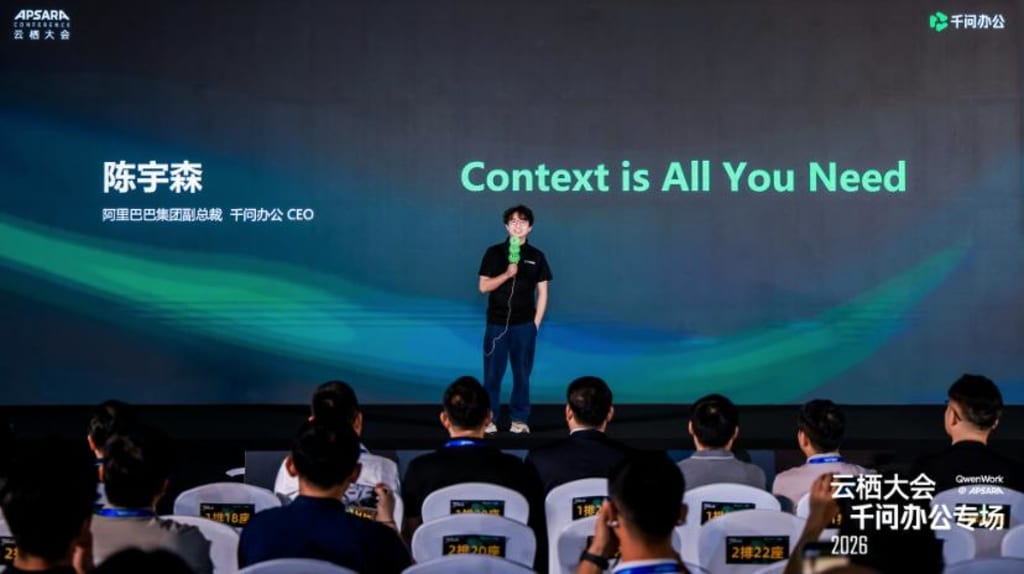
Two young faces stood on the main stage. Liu Dayiheng, born in 1993, runs models. Chen Yusen, born in 1992, runs products. He is now Alibaba Group vice president and CEO of Qwen Office.
Chen graduated from Zhejiang University in computer science. In 2015, at 22, he founded Chaitin Technology. A year later it raised 6 million yuan in a Pre-A round from ZhenFund and Geekbang Ventures. In 2017, Forbes China put him on its 30 Under 30 list. Alibaba acquired Chaitin in 2019. Chen joined the company. In June this year, he became CEO of DingTalk. In July, Alibaba combined QoderWork, Wukong, and MuleRun into Qwen Office. Chen leads it.
His talk at the Qwen Office session was the most crowded and relaxed of the event, according to people there. The room was full, with people standing in the aisles. He walked on stage with a microphone decorated with three green octopuses. The room laughed.
The two post-90s leaders are not just a personal story. Alibaba is giving technical breakthroughs to people who understand technology and product definition to people who understand products. In the AI era, age is not a barrier. It may help.
Behind computing power is electricity
In Hall 2, the Computing Power Hall, the surprise was electricity. A computing center sat on an offshore energy island. Next to it were a power grid, energy storage, and models of nuclear plants.
People still talk about “Bring Your Own Model.” The compute world is already talking about “Bring Your Own Power.”
This is not a gimmick. Wu Yongming said Alibaba Cloud will pass 20GW of global data center capacity by 2032, about ten times the 2022 level. Twenty gigawatts equals the output of twenty nuclear units at full power. When a cloud company uses GW to describe its future, it is describing itself as energy infrastructure for machine intelligence.
The power-computing zone carried the theme “more intelligence per kilowatt-hour.” It showed the chain from generation, storage, green power, to data center load scheduling. NVIDIA’s booth showed BlueField-4 DPUs and Spectrum-4 Ethernet switches. The network is the invisible limit on compute. A strong model still needs stable, green, affordable power.
Another booth stayed with me. Xihu District built a “space computing” area in Hall 4. Hangzhou Siwei Space Intelligent Technology showed the Lingjing Constellation. It is a space AI infrastructure with a planned investment of about 30 billion yuan and a plan for 1,000 satellites in orbit. Yunqi Town has gathered more than 60 core commercial aerospace companies and more than 300 ecosystem companies, with an industrial scale of 3.5 billion yuan. From “one cloud” to “a sky full of stars,” the seed planted eighteen years ago has grown into a large tree.
Terminals and industry: bringing tasks to real services
Two releases from the afternoon deserve attention.
First, Qwen Intelligence. Alibaba launched a full-stack AI phone solution. It gives phone makers foundation models optimized for phones and ready-to-use agents. Honor had already hinted at it in the morning. The Magic9 series will be among the first phones to carry Qwen Intelligence. The Honor Robot Phone will support it too.
Alibaba says it will not make AI phone hardware. It will focus on models and agents. That is a smart position. Instead of fighting phone makers on hardware, it becomes their agent foundation.
Honor’s demo was simple. A user said, “Check today’s flights from Beijing to Shanghai.” The system opened apps, jumped between screens, searched, and returned. When a message needed sending, it asked for confirmation. That is Qwen Intelligence on the terminal side. The phone becomes an assistant that can finish tasks.
Second, Qwen Office. It launched “Enterprise Context” with agent hosting. The product helps companies build digital employees that understand the business. Data is the first condition for agents to enter business processes. Enterprise Context updates as the business changes. Agents then judge based on the latest real situation.
Yihai Kerry Jinlongyu, FAW Toyota, China Digital, and Transfar Group said they would use Qwen Office. The coverage includes R&D, manufacturing, supply chain, finance, sales, operations, and compliance.
On hardware, Qwen Office released the QwenNote A2 voice device. It connects to the internet in real time. Press the AI key and talk. Qwen Office processes in the cloud. You do not need to open the phone.
The Qwen AI glasses N1 series also appeared at Yunqi. It has a 50-megapixel sensor and first-person shooting. The N1 Pro supports eye tracking and iris payment. It goes on sale October 13.
Wang Xiaohang of Ping An brought the talk to industrial services. Ping An has launched more than 300 AI quick services. Road rescue connects one request to vehicle information and service resources. Healthcare connects consultation to later resources. In R&D, Ping An said about 80 percent of internal code and more than 67 percent of testing work are AI-generated. It is connecting requirements, design, testing, and deployment.
Exhibition guide
If you go next year, here is a short guide.
Hall 1, Intelligence: the Zhihu booth is at 1-C5-3 and gives badges. The main draw is Qwen’s full-modal model and Qwen AI platform, plus agent apps from Qwen Office, Qoder, and Accio. The Zhenwu supernode booth is at the entrance. It shows how Qwen models link to Qwen Office apps. The Agentic OS area at 1-C1-8 has a hands-on zone.
Hall 2, Computing Power: the power-computing zone at 2-A01 shows generation, storage, green power, and data center load scheduling. NVIDIA shows BlueField-4 DPUs and Spectrum-4 switches.
Hall 3, Creation: this is the most work-focused and most practical hall. It covers 17 job roles and more than 200 reusable skills. Finance, legal, recruiting, and marketing all have templates. If you want to test an agent on your job, this hall beats a slide deck. The AI Office Bar workshop lets you turn a real problem into a custom skill.
Hall 4, Industry: Honor’s robot phone and BYD’s Didixia AI agent are here. Xihu District’s space computing area is here too. The Lingjing Constellation is the most upward-looking booth. Lu Chuan’s AIGC short film “History Live” trailer is in the film and media section. Alibaba’s video model is entering professional film production.
Closing: from “how many steps” to “what can be delivered”
After three days, the feeling was simple. The 2026 Yunqi Conference was not a muscle show. It was a homework review.
Wu Yongming talked about power grids and power stations, not model benchmarks. Liu Dayiheng talked about task delivery and self-iteration, not rankings. Li Feifei talked about unplanned human interventions, not how many steps a demo can run. Chen Yusen walked on stage with a cute octopus microphone and talked about enterprise context, not technical architecture.
These details point one way. AI is moving from capability display to engineering delivery. The winners will lower agent deployment costs, cut unplanned human interventions, and connect real company data. That is how model ability becomes task delivery.
Eighteen years of Yunqi, from West Lake to Xiaoshan, from one cloud to a sky full of stars. When a company describes its future in GW instead of parameters, it is answering a bigger question: when machines become the main source of thinking, what infrastructure should people build?
The answer may sit in the faces of people waiting to try AI glasses, in the hands of attendees turning job experience into skills, and on the sign that reads “more intelligence per kilowatt-hour.”
Intelligence for practical use. The road is long. The direction is clear.
About the Creator
Jin
Writer of reamstories
https://reamstories.com/jin
Enjoyed the story? Support the Creator.
Subscribe for free to receive all their stories in your feed. You could also become a paid subscriber, letting them know you appreciate their work.
Comments
There are no comments for this story
Be the first to respond and start the conversation.