
I Did the Math on Apple's 1TB iPhone Tax. It's an Anxiety Tax.
The iPhone 18 Pro price hike made the 256GB to 1TB jump cost RMB 5,500. Here's how to tell if you need the space or you're buying peace of mind.
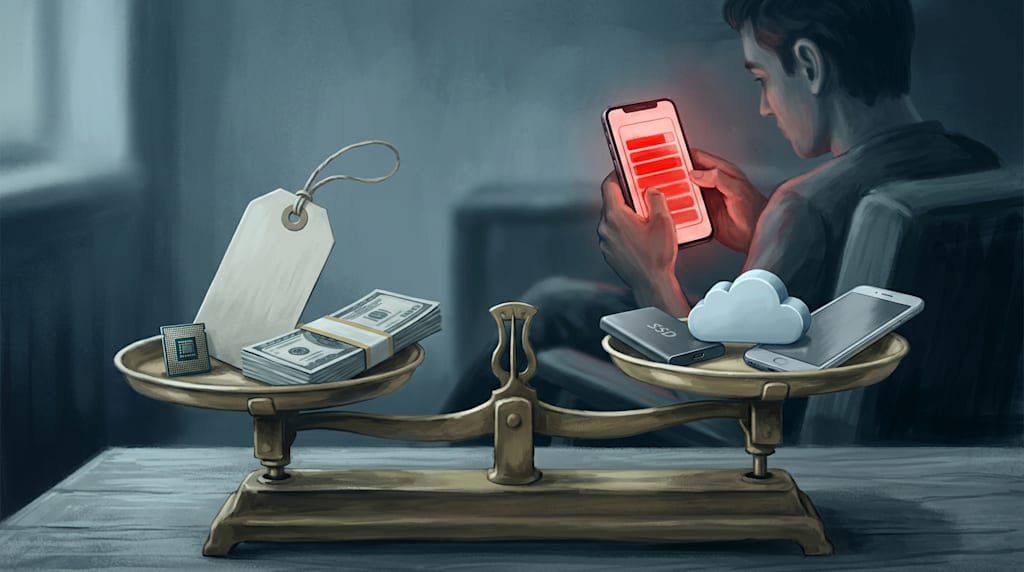
After the iPhone 18 Pro price hike, 1TB or 256GB: do the math, don't pay for anxiety
Settings > General > iPhone Storage. Photos 98GB, WeChat 74GB, System Data 31GB, 12.4GB remaining. System Suggestion: Offload Unused Apps. You tap Later. The next day, you tap Later again.
After the iPhone 18 Pro price hike, this screen got more expensive.
1. First, the price gap: what the extra money from 256GB to 1TB can buy
Take the mainland China model. The 256GB iPhone 18 Pro costs RMB 9,999. The 512GB version is RMB 11,999, which is RMB 2,000 more. The 1TB version is RMB 15,499, a jump of RMB 5,500 over 256GB. The 2TB model is RMB 20,499, which is RMB 10,500 more than the base storage.
Going from 256GB to 1TB costs RMB 5,500 more.
What can RMB 5,500 buy? A 2TB portable SSD, three years of 2TB cloud storage, and a decent mid-range Android phone. Or replace the battery in your old phone, buy a hard drive, and use what's left for a year's rent.
Apple's storage pricing has never been cost-based. The industry has complained openly: the gap between the procurement price of storage chips and the end-user upgrade price is several times, even dozens of times. When chip prices rise, Apple raises its prices even harder. Profit from high-capacity versions subsidizes the gross margin of entry-level models, while pushing users toward a higher average selling price.
Part of your extra money buys storage. Part buys Apple's segmentation strategy.
A premium can be worth it. The stupid tax comes from buying the wrong capacity.
2. Need or future anxiety
The test is simple. Look at your storage history over the past twelve months.
If every month you see less than 20GB free, if every system warning annoys you, if you don't dare delete WeChat history, if you can't bear to offload photos and videos, if you check free space before shooting a video, then that is a need that has already happened. Going to 1TB buys efficiency for your daily life.
If over the past three years your peak usage was 180GB, the biggest files on your phone are a few mobile games, and yet you jump straight to 1TB because "it might not be enough later," then that money is likely buying insurance for an imagined future self. Insurance is expensive, and you probably won't use it.
I once used 256GB. After I started writing on Zhihu, I got into the habit of taking casual photos. I didn't know which answer would need which photo, so I took them first. Within a year, my free space dropped from 40GB to 3GB. I couldn't expand storage, and I couldn't bear to replace the phone, so I bought cloud storage and paid yearly. Next time I buy a phone, I will seriously consider 512GB or 1TB. The reason is simple: 256GB is already not enough for me now.
So large capacity itself is not wrong. Paying for a need that has already happened is doing the math. Paying for vague anxiety is paying Apple a psychological tax.
3. Can external storage and cloud drives replace built-in capacity?
People who support "small storage + external storage" are doing an economic calculation.
A 1TB portable SSD costs about RMB 500 to RMB 1,500. iCloud+ 2TB on the mainland China plan is RMB 68 per month, RMB 816 per year, RMB 8,160 over ten years. An external drive is a one-time cost, with no subscription fee, and the data stays in your hands. Cloud drives offer automatic backup, multi-device access, and disaster recovery.
But external storage has one problem: hassle.
You have to remember to bring it, plug it in, wait for transfers, and manage files. You're on the subway and want to look at a video from last year. The drive is in a drawer. Cloud drives aren't perfect either. If you put a large number of photos and videos in the cloud, every access requires a download. The experience is not the same as local storage. Subscription fees year after year add up to more than a hard drive over ten years.
A practical solution is a hybrid: choose built-in storage that is enough for the present, use an external SSD for regular backups, and use a small cloud storage plan as an automatic sync fallback. This keeps upfront costs manageable and gives your data a second copy.
But if you shoot a lot of material every day, the friction cost of external storage will quickly exceed that RMB 5,500. For content creators, time is more expensive than a hard drive.
4. An easily overlooked concern: higher capacity isn't necessarily better
Teardowns and tests suggest some 1TB and 2TB versions may use QLC NAND, while 256GB and 512GB versions use TLC.
QLC's write endurance is usually about one-third that of TLC. TLC is around 3,000 cycles. QLC is around 1,000. When storage usage reaches 60%, the sustained write speed of the 1TB version can drop sharply. At worst, it falls to around 1MB/s, slower than a cheap SD card.
You can still buy 1TB. Just don't assume more expensive means better. The NAND inside may have worse endurance and speed-drop behavior than 512GB. If you plan to keep one phone for four or five years and write a lot of data, include that in the calculation.
5. Three types of users, three choices
First: content creators, independent media creators, heavy video shooters. You have a continuous, high-intensity need for local storage. ProRes 4K 120fps video eats several GB in minutes. External storage cannot replace instant shooting and editing. Going straight to 1TB or higher is a production cost, not a stupid tax.
Second: ordinary users whose usage over the past year is already close to or above 256GB. I recommend 512GB, paired with an external SSD and basic cloud storage. This is currently the most cost-effective solution. Built-in storage is enough for daily use, the drive holds footage, and the cloud handles syncing.
Third: light users who mainly use WeChat, watch videos, and take occasional photos. 256GB is enough. There is no need to pay thousands extra in advance for "it might not be enough later." If it isn't enough later, cloud storage or an external drive costs much less.
Apple's tiered storage pricing filters people into different psychological accounts. Some are willing to pay for convenience. Some are willing to put up with inconvenience for value. Both can be rational. The mistake is following the "one step to the top" story without looking at your own usage data.
Finally: I closed the settings page
I opened Settings. 47GB remaining. Closed it. Plugged in the old portable hard drive and started transferring 2024 videos. The progress bar ran for 3 minutes. 18 minutes left. I stared at it and wrote no conclusion.
The phone is still on the desk. The storage bar is still red.
About the Creator
Jin
Writer of reamstories
https://reamstories.com/jin
Enjoyed the story? Support the Creator.
Subscribe for free to receive all their stories in your feed. You could also become a paid subscriber, letting them know you appreciate their work.
Comments
There are no comments for this story
Be the first to respond and start the conversation.