
How AI in Fintech Is Redefining Operational Efficiency for B2B Enterprises
Explore how AI in fintech is transforming B2B enterprises through automation, machine learning, and real-time financial decision-making.

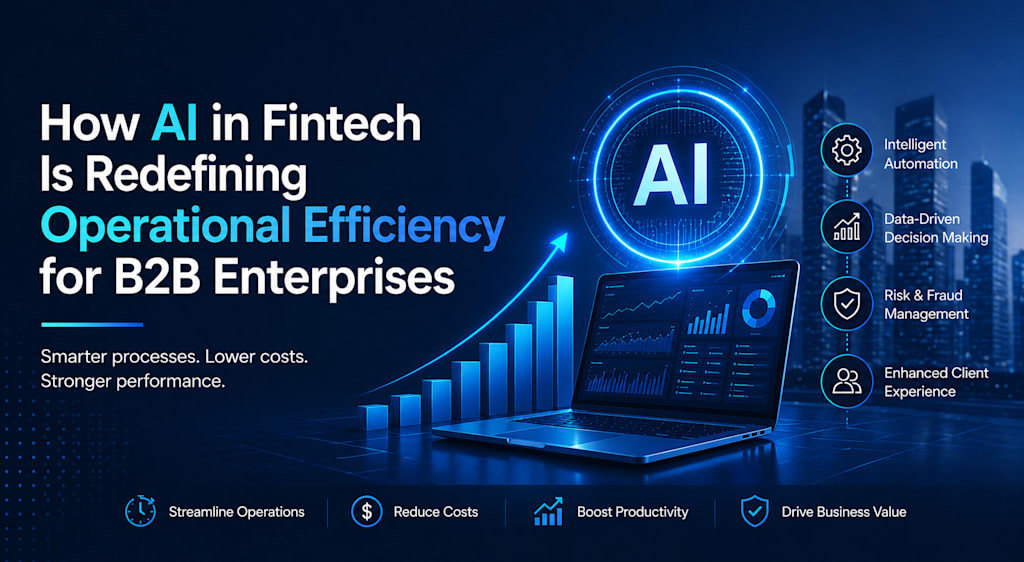
If you look at how financial operations used to run inside B2B enterprises, especially in banking, lending, insurance, or payments, it was heavily manual, rule-based, and slow to adapt. Think reconciliation teams working through spreadsheets, compliance officers manually reviewing documents, and risk teams relying on static scoring models that are barely updated in real time.
Now contrast that with today’s landscape: AI systems that detect fraud in milliseconds, automate credit underwriting, and reconcile millions of transactions without human intervention.
This shift isn’t theoretical anymore. It’s already showing measurable impact at scale.
For example, the global AI in the fintech market is expected to grow from around $17.6 billion in 2025 to nearly $97.7 billion by 2034, driven largely by automation, fraud detection, and decision intelligence.
More importantly, productivity gains from AI adoption in finance are estimated at ~12% or higher in advanced economies, with cost reductions and operational streamlining as major outcomes.
At the enterprise level, this is where the real story begins: AI isn’t just improving finance, it is fundamentally redesigning how B2B financial operations run.
The real bottleneck AI is solving in enterprise finance
Most enterprise financial operations software was built for a different era, one where:
- Data moved in batches, not real time
- Compliance checks were periodic, not continuous
- Risk models were static, not adaptive
- Processes required human validation at every step
This structure created inefficiencies that B2B enterprises simply absorbed as “cost of doing business.”
Today, AI in fintech operations is targeting these inefficiencies directly.
Instead of optimizing one function at a time, modern systems focus on end-to-end automation across financial workflows, including:
- Accounts payable/receivable
- Fraud detection and AML monitoring
- Credit scoring and underwriting
- Treasury forecasting
- Regulatory reporting
This is where AI-powered transformation becomes operational, not experimental.
AI is shifting finance from “processing” to “decision automation”
Traditional systems are built around processing transactions.
AI-driven systems are built around making decisions.
This is the key shift driving efficiency in enterprise environments.
With machine learning in financial services, models continuously learn from transaction data, customer behavior, and market signals. That enables systems to:
- Flag suspicious transactions in real time
- Adjust credit risk dynamically
- Predict cash flow gaps before they occur
- Automate approval workflows based on context
Instead of waiting for monthly reports, enterprises get live financial intelligence loops.
This is also why AI adoption in fintech is often strongest in fraud analytics and risk scoring, which account for a large portion of deployments globally.
2. The rise of AI-powered financial automation tools
One of the most visible changes in enterprise finance is the rapid adoption of AI-powered financial automation tools.
These tools go beyond robotic process automation (RPA). They combine:
- Natural language processing (NLP) for document extraction
- Predictive models for anomaly detection
- Generative AI for reporting and summarization
- Reinforcement learning for workflow optimization
In practice, this means:
- Invoices are auto-matched with purchase orders
- Expense claims are verified without manual review
- Financial reports are generated from raw data systems
- Compliance checks run continuously in the background
Some large institutions report 30%+ cost reductions in operational tasks after AI automation rollout, particularly in onboarding and compliance-heavy workflows.
For B2B enterprises handling thousands of transactions daily, this is not just efficiency, it’s structural cost redesign.
How AI reduces friction in enterprise financial operations
Enterprise financial operations typically break down into three friction points:
a) Data fragmentation
Finance data is often scattered across ERP systems, CRMs, banks, and spreadsheets.
AI solves this using integration layers that unify structured and unstructured data in real time.
b) Manual verification cycles
Tasks like KYC, reconciliation, and audit prep used to require multiple human checkpoints.
AI reduces this through:
- Document intelligence
- Identity verification models
- Continuous audit trails
c) Slow decision cycles
Approvals for credit, invoices, or vendor payments often take days.
AI reduces this to minutes by automating decision logic using trained models.
The result is a shift from batch processing finance to continuous finance operations.
4. The role of AI integration for B2B businesses
For most enterprises, the challenge isn’t just adopting AI, it’s integrating it into existing systems.
This is where AI integration for B2B businesses becomes critical.
Enterprises typically need:
- APIs that connect AI models with ERP and banking systems
- Data pipelines that support real-time ingestion
- Governance layers for compliance and auditability
- Model monitoring systems to prevent drift
Without this layer, AI remains a siloed experiment.
With proper integration, however, it becomes embedded into core workflows like billing, procurement, and risk management.
Why B2B fintech platform providers are central to this shift?
Modern B2B fintech platform providers are no longer just infrastructure companies.
They are becoming orchestration layers for enterprise finance.
Their role includes:
- Offering plug-and-play AI modules
- Providing compliance-ready financial APIs
- Supporting multi-tenant enterprise systems
- Enabling cross-border financial operations
This is also where competition is intensifying: platforms that provide modular AI fintech solutions for enterprises are gaining an edge because companies want flexibility, not monolithic systems.
Custom fintech app development is becoming AI-first
Earlier, custom fintech app development focused on UI/UX and transactional features.
Now, AI is embedded from the architecture stage.
Modern enterprise fintech apps include:
- Predictive dashboards for CFOs
- Automated reconciliation engines
- AI-based fraud scoring systems
- Conversational finance assistants
This is no longer “add AI later.” It is “design with AI from the start.”
That shift is redefining how fintech software development services are structured, teams now include data scientists, ML engineers, and compliance architects alongside traditional developers.
Fintech digital transformation is no longer optional
The broader shift happening across enterprises is fintech digital transformation solutions powered by AI.
What’s driving this acceleration:
- Rising fraud complexity
- Real-time payment ecosystems
- Regulatory pressure for transparency
- Demand for instant financial insights
At the same time, studies suggest only a small fraction of companies are actually realizing full value from AI deployments due to gaps in execution and integration strategy.
This means the competitive gap is not about access to AI, it’s about how well it is operationalized.
Where AI in fintech operations is heading next
The next phase is not just automation, it is autonomy.
We are moving toward:
- Self-optimizing financial systems
- AI copilots for CFO decision-making
- Real-time regulatory compliance engines
- Fully automated treasury management systems
In other words, enterprise finance will increasingly behave like a continuously learning system rather than a static function.
Final thoughts
AI in fintech is not simply improving operational efficiency; it is redefining what “financial operations” even mean for B2B enterprises.
Enterprises that adopt AI development services for finance early are not just optimizing costs; they are redesigning their financial operating model entirely.
And in that redesign, efficiency is just the starting point. The real outcome is adaptability.
About the Creator
Sarah Wilson
Project Manager at Microsoft | 8+ years in tech Sharing insights on projects, careers, and building impactful products
Enjoyed the story? Support the Creator.
Subscribe for free to receive all their stories in your feed.
Comments
There are no comments for this story
Be the first to respond and start the conversation.