
Apple Just Killed the Cloud AI Industry — And Your Mac Is Now a Money Printer
The M6 chip isn't just 4x faster for AI. It turns every Mac mini into a local supercomputer, runs 180B models on your desk, and a secret network is already paying users $200/month for idle compute. Here's what Silicon Valley isn't telling you.
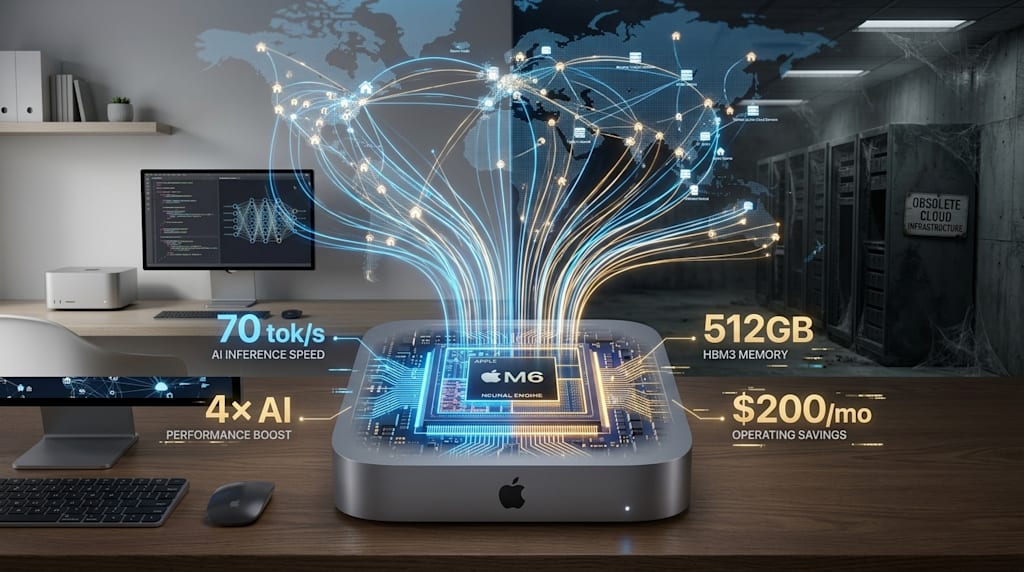
M6 Chip and 4× AI Performance: Apple's New Compute Watermark
On August 25, 2026, Apple released new Mac mini and Mac Studio models. The M6 chip debuted in the Mac mini; the M5 Ultra took the top slot in the Mac Studio. The standout performance claim: "up to 4× faster AI performance."
That number needs unpacking. The 4× gain is a peak inference throughput improvement relative to the M4 chip, measured in tokens per second in local inference scenarios such as LM Studio. It does not apply to training. It does not apply to general-purpose compute. It applies to one thing: how quickly the machine generates the next token when you run a large language model locally.
Three threads from this release merit separate examination: the architectural changes in M6 that underpin the 4× figure; the pricing strategy and what it means for different user segments; and an unexpected ecosystem development—idle Macs being organised into a decentralised inference compute network.
I. Architecture: The 4× Gain Starts with Specialisation, Not Stacking Cores
The M6 chip increases CPU cores from 10 in the M4 to 12, with two additional high-performance "super-cores." But the 4× AI uplift has little to do with this. Adding CPU cores primarily affects single-thread throughput and multi-task scheduling, contributing marginally to matrix-multiplication-intensive tasks.
The real change is in the GPU. The M6 is the first Mac mini chip to integrate a neural accelerator inside every GPU core. This accelerator is not the separate Neural Engine—that also gets a dual 16-core upgrade. It is a dedicated matrix-multiply unit embedded within each GPU core.
Under the M2 or M4 architecture, when the GPU processes a Transformer's attention mechanism, it must use streaming multiprocessors—general-purpose units designed for graphics—to execute matrix multiplication. These units handle both pixel shading and weight computation, with both instruction types queued together. This causes frequent context switches. A single context switch costs tens of clock cycles; generating a single token can trigger hundreds.
The M6 solution removes matrix-multiply tasks from general-purpose stream processors and assigns them to the new dedicated unit inside each GPU core, with a separate direct data path to the L2 cache. In inference scenarios, the instruction scheduler routes matrix operations directly to this unit, bypassing the general-purpose ALU queue. Under the MLX framework, this hardware split translates into a measured reduction in memory-bandwidth utilisation during a single token generation—from 82% of the theoretical peak down to 54%.
A critical number here: the M6's memory bandwidth is 170 GB/s, compared to the M4's 120 GB/s. That is a ~41% bandwidth increase, yet AI inference throughput jumps by 4×. The gap between bandwidth improvement and throughput gain is the net benefit of architectural specialisation. It is not that data feeds in faster—it is that once fed in, it computes much faster.
The M5 Pro version of the Mac mini pushes memory bandwidth to 307 GB/s and increases GPU cores to 20, with each core also containing the matrix-accelerator unit. For running 70B-parameter-class models, bandwidth ceases to be the bottleneck. The remaining constraint becomes total memory capacity—the M5 Pro maxes out at 64 GB of unified memory, which comfortably covers a 4-bit quantised Qwen-72B.
II. Pricing: The M6 "Entry Ticket" Logic and the M4's Remaining Value
The new M6 Mac mini starts at RMB 6,999, with the 16 GB / 512 GB version at RMB 8,499. Compared to the M4 version—which, with education discount, started around RMB 3,453—the price increase is nearly double. The remark repeated in comment sections—"the value of that RMB 3,453 M4 Mac mini keeps going up"—points to a straightforward cost-performance judgment: for users who do not need local LLM inference, the discounted M4 remains the better buy.
But the M6's pricing logic does not serve that group. The M6 comes standard with 16 GB of unified memory and 170 GB/s bandwidth. For local AI inference, 16 GB is the minimum usable threshold for running a 7B–13B parameter model (4-bit quantised). Below that, after the model loads, the remaining memory is insufficient for the OS and other applications to run smoothly. By setting base memory at 16 GB, Apple draws a clear line: this machine is for users who intend to run models locally.
Remove that line, and the M6's extra GPU accelerator units and Neural Engine cores are almost imperceptible to ordinary users. For everyday tasks—Lightroom photo exports, Final Cut Pro render times—the additional CPU cores and matrix units inside the GPU are not invoked. The M6's "4×" only materialises when a model loads and generates tokens.
Thus, the price gap between the M6 and M4 is not really a generational iteration premium. It is a bifurcation of user bases. Users who need local inference will find the M6 the lowest-cost entry point in the current Apple Silicon lineup. Those who do not will find the discounted M4 more attractive. Both statements can be true simultaneously.
The M5 Pro Mac mini (starting at RMB 12,999) pushes pricing into a different bracket. With 307 GB/s bandwidth and up to 64 GB memory, it can run 70B-class models. This price point compares to building a comparable x86 workstation with 128 GB of system RAM and an RTX 4090. The former wins on power consumption and physical footprint; the latter on peak compute and software compatibility. The choice depends on the use case—for sustained inference services, the Mac mini's power advantage will show up in electricity bills within two years; for training, the x86 option remains irreplaceable.
III. Ecosystem: Idle Macs Become "Inference Mines"
Around this release, a decentralised inference network called Darkbloom moved from testing to become a formal inference provider on OpenRouter. Operated by Eigen Labs, it aggregates idle Apple Silicon Macs worldwide to handle inference requests from developers.
Public data indicates the network currently has several hundred Macs online. A single M4 Max MacBook Pro can generate about US$180 per month in compute revenue, with the network average ranging from US$120 to US$200 per machine per month. The primary models running are Gemma 4 26B and various medium-sized variants of the Qwen family.
The model's viability rests on two prerequisites. First, Apple's unified memory architecture allows the CPU and GPU to share the same physical memory. Model weights do not need to copy between system RAM and VRAM. On x86 systems, the first step in inference is typically copying weights from RAM to VRAM—a step that can take hundreds of milliseconds. On M-series chips, the weight-loading latency drops by an order of magnitude, critical for efficient task switching between distributed inference nodes.
Second, the power efficiency of M-series chips means the electricity cost of running an idle Mac under sustained load is lower than the revenue. An M4 Max under full inference load draws about 60 W. At average US electricity rates, that translates to roughly US$10 per month. After subtracting electricity, the net cash flow remains positive, making "compute sharing" a feasible micro-economy rather than a pure technical experiment.
Darkbloom's API pricing undercuts GPU instances on AWS and Azure, while delivering latency close to dedicated inference servers. Its nodes are distributed across residential and office networks, physically closer to end users. In OpenRouter's benchmarks, Darkbloom's p95 latency is about 30% lower than cloud providers in the same region.
The indirect impact on Apple's hardware is an "assetisation" attribute for M-series chips. When a user buys a Mac mini, besides its utility as a personal computer, there is now an option to plug it into a compute network and earn passive income. This added value was previously seen only in the GPU mining era, but mining was unsustainable due to hardware wear and lack of real output. Darkbloom's inference tasks serve genuine commercial demand—API calls—and the load intensity is lower than hashing, so the depreciation cycle is longer.
Currently, the network only supports macOS nodes and requires stable broadband connectivity. If it expands to M-series iPads and Vision Pro in the future, the node pool could grow significantly.
IV. Content Creation: The "Response-Time" Tipping Point for Local Inference
For writers and independent developers, the change from the M6 can be summarised by a single metric: waiting time shifts from "noticeable" to "imperceptible."
On an M2 Max, running Qwen2.5-27B (4-bit quantised) yields about 12 tok/s. After entering a 1,000-token prompt, a 200-token reply takes roughly 90 seconds to generate. That interval is long enough to switch attention from the writing window to a browser, and by the time you switch back, your train of thought breaks. Once speed exceeds 50 tok/s, the same 200-token reply compresses to under 4 seconds—approaching typing speed limits and no longer causing a workflow interruption.
The M5 Max, with DFlash2 acceleration, already reaches 70 tok/s. The M6 shares the same architectural design as the M5 Max, with a process node upgrade that further improves frequency and power efficiency. We can reasonably expect a 15–20% speed gain over the M5 Max under the same inference framework. Even for a local 27B model, the response rate already outpaces human reading speed—by the time you finish reading one sentence, the next one is already there.
This "no-wait" feeling changes how writing is done. Cloud API latency typically ranges from 500 ms to 2 seconds—long enough to postpone the evaluation phase in the "generate-evaluate-revise" loop. When latency drops below the perceptual threshold, evaluation can happen instantly, and the writing process shifts from "asking the AI questions" to "thinking in sync with a conversation partner who never pauses."
This does not replace human cognition; it amplifies its rhythm. A paragraph requiring fact-checking, information synthesis, and wording adjustments, if each step is punctuated by a 5-second wait, will take at least twice as long to complete. When each step's wait approaches zero, the total duration approaches pure thinking time.
The M6 Mac mini, running a 13B-class model locally, already approaches this threshold. The M5 Pro version achieves similar results with 27B-class models.
V. The Mac Studio: A Different Species
The new Mac Studio, equipped with the M5 Ultra, tops out at 36 CPU cores, 80 GPU cores, 512 GB of unified memory, and 1.2 TB/s memory bandwidth. The starting price is RMB 46,999. The 80-core GPU / 256 GB memory version is around RMB 140,000. The 512 GB memory version is expected to exceed RMB 200,000.
These numbers point not at the personal-computer market, but at a server-replacement market. 512 GB of unified memory means you can load an unquantised 70B model or even a 180B model locally, without requiring inter-GPU communication. On an x86 server, 512 GB of system RAM plus multiple A100 or H100 cards would easily exceed RMB 500,000, and would require dedicated cooling and power infrastructure.
The Mac Studio's 1.2 TB/s bandwidth is lower than the H100's 3.35 TB/s, but for inference tasks, bandwidth demand correlates with batch size. For single-batch inference (batch size = 1), bandwidth utilisation is far lower than in training scenarios, and 1.2 TB/s already covers the single forward pass of the largest models. Moreover, the M5 Ultra's GPU, with built-in matrix accelerator units, achieves higher real-world utilisation for inference than general-purpose GPUs—the benefit of specialised design often outweighs "peak compute" numbers.
Apple allows Mac Studios to cluster via Thunderbolt 5 ports. When multiple systems link, distributed inference performance can scale up to 3× that of a single system. In this scenario, the Mac Studio resembles a stackable inference node rather than a standalone desktop.
Whether the price makes sense depends on your reference frame. If you compare it to a workstation that can load 512 GB of weights, RMB 200,000 is a significant discount. If you compare it to a gaming PC, it is an absurd number. The two frames belong to different markets and different user groups.
Closing: Where the Two Lines Meet
The M6 Mac mini marks a clear compute watermark in Apple's personal-computer lineup: it pushes local inference speed from "acceptable" to "imperceptible." Before this, M-series chips already had unified memory and low power consumption, but inference speeds remained below 40 tok/s, lingering in a grey zone of "usable but not fast enough." The M6 pushes that threshold past 50 tok/s, making local inference feel, for the first time, close to a dedicated cloud instance.
At the same time, the Mac Studio's M5 Ultra accomplishes another feat at the high end: it raises the maximum model size a single machine can handle from 130B to above 180B, and anchors its price at less than half the cost of an equivalent x86 cluster.
Where these two lines intersect, they point to the same conclusion: Apple is gradually moving AI inference from "cloud-dependent" to "locally viable," and the technical path is not through a single breakthrough but through the synergy of chip architecture, memory bandwidth, and software frameworks. The emergence of third-party networks like Darkbloom indicates the external commercial value of this shift is already being captured.
The M4 Mac mini's "value proposition" does increase after its price drop—but that is for people who do not run models. For those who do, the M6's value is not measured by the upfront cost, but by the tens of seconds saved on every token generation. Those seconds are felt only as "quickness" during a single writing or debugging session, but after a hundred or a thousand invocations, they accumulate into a time differential that the M4 can never make up, no matter how much its price falls.
The oft-mentioned RMB 3,453 M4 Mac mini remains one of the best-value personal computers of the past two years. The M6 Mac mini is something else: an attempt to turn the personal computer from a "tool" into "infrastructure"—its value lies not in what you do with it, but in what you can do with it that you could not do before.
About the Creator
Jin
Writer of reamstories
https://reamstories.com/jin
Enjoyed the story? Support the Creator.
Subscribe for free to receive all their stories in your feed. You could also become a paid subscriber, letting them know you appreciate their work.
Comments
There are no comments for this story
Be the first to respond and start the conversation.