
America Calls It “Super Intelligence.” China Is Building a Different AI Order
The U.S.-China AI rivalry is moving beyond models and chips. The real contest is over who controls the technology, how its risks are governed, and which rules the rest of the world adopts.
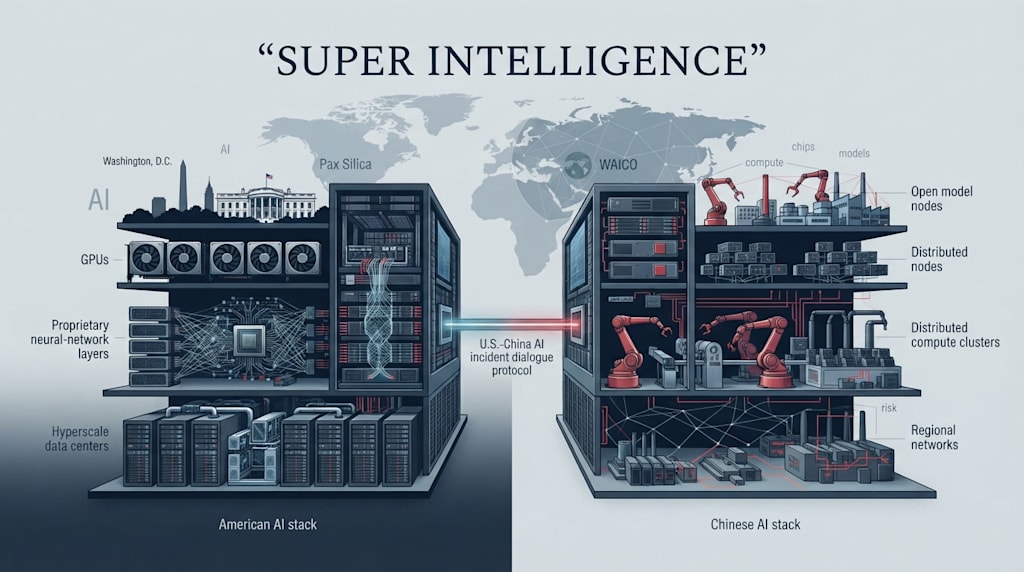
Washington changed the name. The competition did not.
On September 29, 2026, the Trump administration did something that looked cosmetic but had broader policy consequences: it instructed the U.S. executive branch to replace “Artificial Intelligence” and “AI” with “Super Intelligence” and “SI” in official correspondence, websites, reports, policy documents and other non-statutory government communications. The executive order says existing AI systems should now be understood under the new term and directs the administration to develop a federal definition of “Super Intelligence.”
The same day, Trump launched America.gov, met with senior technology executives and described U.S. leadership in advanced AI as a strategic competition with China. He also ruled out joint U.S.-China development of the technology.
The timing matters because the public debate in the United States has moved in the opposite direction. A September POLITICO/Public First poll found that roughly two-thirds of Americans believed advanced AI carried at least a moderate risk of eventually destroying humanity. About 48% favored pausing development of more advanced models.
That does not prove why the administration chose the term “Super Intelligence.” The executive order itself gives a different explanation: the administration argues that current frontier systems have moved beyond the capabilities implied by the older term and that government language should reflect this technological change.
But the change still has a political and industrial effect. “AI” has become associated with regulation, labor disruption, data centers, deepfakes and catastrophic-risk arguments. “Super Intelligence” presents the same field through the language of capability and technological leadership.
The choice of words is therefore part of the competition.
The new safety model is voluntary
Trump’s September 29 meeting with technology executives produced another signal about how Washington wants to manage advanced AI.
Executives from companies including OpenAI, Anthropic, Google, Meta and Nvidia signed a voluntary agreement covering four layers of control: internal monitoring of model capabilities and behavior, an internal team responsible for checking those controls, independent external auditing, and review by an independent board committee.
Trump described the arrangement as something close to a constitution. But legally, it is not one. The agreement is voluntary and does not create the same enforcement mechanism as federal legislation or regulation.
That distinction matters because the debate is no longer simply about whether AI companies should have safety systems. Most major frontier labs already have them. The harder question is who gets to verify those systems, what happens when a company fails, and which information must be disclosed outside the company.
A voluntary framework leaves much of that authority inside the firms themselves.
The tension is visible inside the industry. Anthropic CEO Dario Amodei recently called for the pace of frontier AI development to slow, arguing that capabilities may be advancing faster than society’s ability to understand and control them. His proposal included greater use of third-party evaluators.
Trump’s position points in the other direction. His administration has framed restrictions on AI development as a potential strategic handicap in the competition with China.
So the disagreement is not simply “pro-AI” versus “anti-AI.” It is about which constraint should come first: the need to maintain technological momentum, or the need to make safety controls stronger before capability growth accelerates further.
Two models are taking shape
The U.S.-China AI competition is also becoming a competition between different ways of building an AI industry.
The American system is dominated by companies whose strongest frontier models are developed and distributed under proprietary control. Model weights, training infrastructure, data, chips and cloud capacity are treated as commercial assets and, increasingly, as strategic assets.
That logic also appears in semiconductor policy.
In December 2025, Trump announced that certain Nvidia H200 sales to approved Chinese customers could resume under conditions that included a 25% U.S. share of the resulting revenue. Subsequent U.S. rules established licensing requirements and a 25% tariff on covered advanced computing chips under specified conditions. Nvidia later reported that its H200 licensing program remained constrained and that Chinese authorities had also restricted sales.
The mechanism is straightforward: the United States wants to keep control over the most valuable parts of the AI stack while limiting how quickly China can acquire the hardware required to scale frontier systems.
China has responded by placing greater emphasis on domestic compute, open model development and deployment at scale.
DeepSeek-R1, released in January 2025 under an MIT license, demonstrated that a Chinese laboratory could publish a reasoning model whose performance was competitive with OpenAI’s o1 on several benchmark categories while making the model and technical work broadly available.
That does not mean China has solved the semiconductor problem. It has not. Access to leading-edge compute remains a major constraint.
But open models change the economics of that constraint.
A model that can be downloaded, modified, distilled and deployed by many companies does not require every participant in the ecosystem to reproduce the full training process from scratch. The bottleneck moves from “Who owns the strongest model?” toward “Who can deploy useful models most efficiently across enough machines, factories and applications?”
That distinction is increasingly important.
The American strategy concentrates frontier capability inside a relatively small number of firms. The Chinese strategy places more weight on diffusion, customization and industrial deployment.
Neither description is complete on its own, but the difference in emphasis is real.
Washington and Beijing are competing while building a safety channel
The contradiction became explicit during Xi Jinping’s September 2026 visit to Washington.
The two governments agreed to establish a China-U.S. AI dialogue covering the risks and benefits of AI, with another exchange planned for November. They also agreed to create a bilateral communication channel for AI-related incidents.
There is a small but revealing difference in the official language.
The U.S. side calls the mechanism a “Super Intelligence” dialogue. China’s official release calls it an “AI Dialogue.” A Chinese Foreign Ministry spokesperson later said Beijing respected the U.S. choice of terminology while continuing to discuss the technology under the broader concept of artificial intelligence.
The practical agenda matters more than the naming dispute.
An incident channel has value only if both sides agree on what counts as an incident, how quickly it must be reported, what information is shared and which events trigger escalation. Without those rules, a hotline can exist on paper without doing much in a real crisis.
The two countries have tried this before. The difficulty has never been creating another meeting. It has been sustaining communication when the strategic incentives of both governments point toward secrecy and competitive advantage.
That problem is harder in AI because a serious incident may not respect national borders.
A major model failure, autonomous cyber operation, dangerous biological assistance or large-scale deepfake campaign can move through global networks in minutes.
That creates an unusual condition: the same technology that increases the value of secrecy also increases the cost of having no communication channel.
The competition is spreading beyond the United States and China
The wider AI system is beginning to reflect these rival approaches.
A September 2026 CSIS analysis identified two major coalition structures. The U.S.-led Pax Silica initiative had grown to 24 participants by June, while China-led WAICO was established in July 2026 with 29 founding members. The two groups had largely different memberships, with Kazakhstan the notable exception.
The difference is not simply geographic.
Pax Silica is concentrated among high-income economies and countries already connected to U.S. security networks. WAICO is oriented more heavily toward countries in the Global South.
That creates two possible ways of distributing AI capability.
One model ties advanced AI access to technology, capital, security relationships and trusted supply chains.
The other emphasizes access to models, infrastructure and applications that can be adapted to local conditions without requiring the same level of integration with Western technology networks.
This is where AI begins to resemble infrastructure policy more than a conventional software race.
A country does not need to invent the best model in the world to become dependent on another country’s AI system. It may simply need to use that system across factories, logistics, finance, public services and defense.
Once that happens at scale, software becomes part of the country’s strategic infrastructure.
That is why the contest over standards, compute, chips, model access and governance matters outside Washington and Beijing.
Europe has rules, but less leverage
The European Union occupies a different position.
Europe has established one of the world's most extensive AI regulatory frameworks through the EU AI Act. But regulation alone does not determine who sets the direction of the technology.
The current U.S.-China competition is increasingly being organized around model capability, compute capacity, semiconductor supply, capital and geopolitical partnerships.
Europe has strength in regulation and industrial standards, but comparatively less weight in the companies and infrastructure that sit at the center of frontier model development.
That creates a structural problem.
A regulator can shape the rules applied to a technology. It has more difficulty shaping the technology itself when most of the models, chips and infrastructure are being developed elsewhere.
The risk for Europe is not simply that it regulates too much or too little. It is that the two main technology powers may define the strategic parameters of AI before Europe has a meaningful role in setting them.
The real contradiction is still unresolved
The phrase “AI race” suggests a simple contest with a winner and a loser.
The actual system is more complicated.
The United States wants to maximize technological capability while restricting the strategic diffusion of that capability. China wants to reduce its dependence on foreign technology while expanding the use of AI across a much broader industrial base. Both countries are simultaneously competing for advantage and building mechanisms to reduce the risk of uncontrolled incidents.
Those objectives do not fit neatly together.
The more aggressively each side protects its technology, the harder it becomes to build mutual confidence.
The more rapidly frontier capabilities advance, the more valuable risk communication becomes.
The stronger the competition becomes, the more tempting secrecy becomes.
And the more global the technology becomes, the less useful a governance system designed around only one country becomes.
The renaming of AI as “Super Intelligence” changes the language of the contest. The chip restrictions change the hardware available to each side. Open models change the economics of diffusion. New diplomatic channels create a way to discuss failures before they become crises.
None of those mechanisms resolves the underlying problem.
The U.S. and China are building different systems for producing and governing advanced AI while remaining connected through the same global technology network.
That is the central fact to watch.
The next stage of the competition will not be decided only by which country produces the strongest model. It will also depend on which system can combine capability, industrial deployment, access to compute and credible mechanisms for managing the risks that neither country can contain alone.
About the Creator
Jin
Writer of reamstories
https://reamstories.com/jin
Enjoyed the story? Support the Creator.
Subscribe for free to receive all their stories in your feed. You could also become a paid subscriber, letting them know you appreciate their work.
Comments
There are no comments for this story
Be the first to respond and start the conversation.