
"Write On, Write Off" to The Yale Review
A little something that I wrote for The Yale Review.

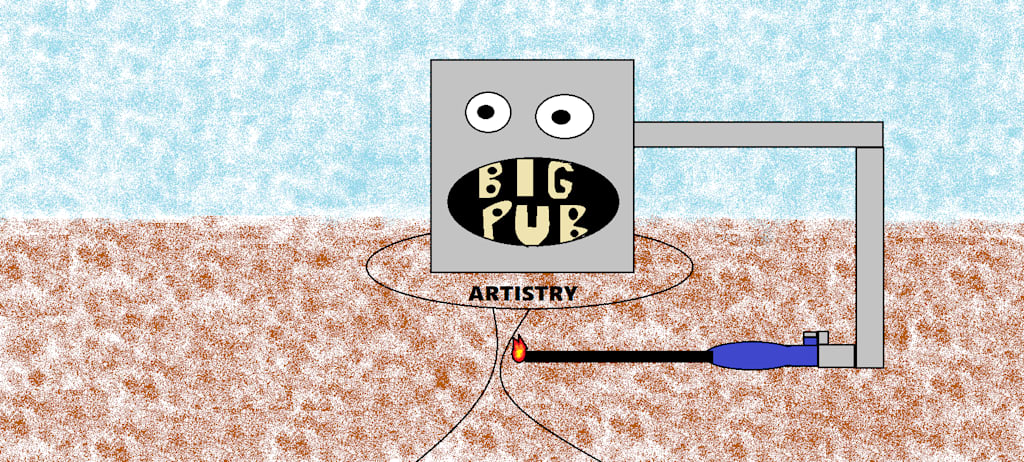
I had recently seen a post from The Yale Review on Instagram, where they were promoting a piece they had published from a writer talking all about how great it was that he was able to use AI to find his love for writing again. Yes, The Yale Review, a highly respected journal, not only published a piece where a "writer" talked about using AI, but promoted it for all to see.
This "writer" claimed he'd lost his joy for writing, and he couldn't quite create like he used to. So, he resorted to using AI in certain ways, and it got him writing again.
If it was 20 years ago, and a writer lost their joy for writing and was having trouble creating... they either just stopped writing and ceased to be a writer because, guess what, if you cant write, you're not a writer... or they dug down deep and grinded it out until they could do it once again. The same thing is true now. You don't get to take the AI Shortcut and still claim yourself to be a writer. If it was 20 years ago, you'd have nothing.
This upset me and many others. Their post was filled with comments from angered artists. I was one of them. I didn't see them respond to any of the comments. I didn't expect them to. But I decided that I wanted to write something for them... an open letter of sorts. This is a great place to post something like that, right? Yes. But know what else is a great idea? Sending the letter to them, as a nonfiction piece, once their nonfiction submissions opened. So, that's exactly what I did. And I figured, I'd share it here, for all to see.
So, here was my nonfiction submission that I sent to The Yale Review.
Write On, Write Off
by Stephen Kramer Avitabile
The planet that we all share is in danger, so when I see anyone laying harm to this very thing that is absolutely crucial to our survival, I tend to write them off. I tend to shake my head, curl my lip in the way an affronted boss of an organized crime family might, and push that person out of the area of my mind that holds care and compassion. Especially when I see these people laying harm to the planet repeatedly, and in a multitude of ways.
It’s easy when it’s someone I don’t know too well, or when it’s someone I didn’t previously hold in such high regard. But when it is someone who I formerly admired greatly, I’m conflicted. I want to keep them up there on their pedestal, but they’ve relocated the base of it into quicksand. I can’t alter the way the mud sucks you down; you’ve gone and done that yourself.
Yes, you.
Yes, I’m talking to you, Yale Review.
Maybe I don’t have your entire collective ear. Maybe I only have one reader. Maybe my words will only reach a couple people here. That was why, at first, to write this was not a thought, not a plan. What has happened is so aggravating that I asked myself, should I just shut them out? Should I erase them from the chalkboard in my mind? Or should I grab that piece of chalk and pen them one last note? What if only one person sees this?
Well, that will be one more person than before.
The Yale Review, a literary giant, tier one. When it comes to submitting to publications, in the grand scheme of all the writers out there, I’m still fairly new to this. I’ve recently discovered the idea of putting publications in tiers so that one may know which publications are comparable. It’s an excellent idea, and I found several lists doing exactly this. The Yale Review is always regarded as tier one. It was a publication I already aspired to be published in, and now after having seen their regard in the system of tiers, I wanted it even more.
Come on. It’s Yale. Whenever you watch a movie or a TV show and someone is regarded as being extremely intelligent and/or successful, when that person went to an elite school, Yale is always one of the options for the writer to plunk down in the character’s history. “We want this character to have gone to a good school. Where should we say they went?” There’s a pretty damn good chance someone else will say, “How about Yale?”
And rightfully so. What an incredible and historic university. And the publication is right in line with those incredible and historic human-made-adjectives. So, why oh why, is The Yale Review not only entertaining pieces written about using AI in the creative process, and not only publishing those pieces, but also promoting them on social media as if this is some phenomenal thing that all the creatives must read?
I read about how once in the White Sea, a specimen of comb jelly called the Beroe was discovered, and it had two mouths. If I were that Beroe, I’d be filled with enough disgust that I’d throw up in both my mouths. And the irony is, The Yale Review is happily contributing to something that is poisoning the seas and increasing the likelihood of mutations to result in more species with extra mouths, extra fins, extra toes, extra eyes…
The Yale Review might do well with a mutation of extra eyes. Yes Yale, you’ve gone completely blind to this.
In my mind, there’s never any justification for the use of AI and LLMs for anything, because the very use of them is injecting poison into the bloodstream of Mother Nature. Any toddler with thumbs can quickly find a story about data centers destroying the cleanliness of the drinking water in certain communities, or sucking it all up and leaving residents with next to no water pressure. To use AI, to promote the use of AI, it is anti-environment. This isn’t a political affiliation that anyone can say, “Well I don’t believe in that.” We all need the environment to be healthy.
I’ll say it again from my mutated second mouth.
WE ALL NEED THE ENVIRONMENT TO BE HEALTHY.
But it’s another level of sickening, it’s a flu hitting your body while you’re already dealing with a cold, it’s a bout of diarrhea when you’re already vomiting from food poisoning, it’s a cancer cell that got COVID and infected your lungs and infected you with its infection, it’s beyond sickening when a massive and well-respected literary magazine promotes AI for the creative process.
A little refresher. The Yale Review published a piece, and also promoted it on social media, about a “writer” who said he, more or less, had lost his love for writing, and he had lost the ability to create and/or to enjoy creating. I’ll admit, I read the blurbs, I didn’t read the whole piece of garbage, much like I don’t study the innards of the trash bins outside for longer than three seconds to determine this bin is indeed filled with refuse. But this writer was bragging about using AI to have it come up with ideas for him, and sometimes hallucinate ideas into his stories, and hallucinate characters that didn’t previously exist, and then when he would see this, he would need to make corrections, but in doing so, “he found life in the story again!”
Glory be! You found life in your story at the expense of the lives of people who need clean drinking water. The birds in the skies over a small town have been choked out by deathly black smoke, but at least you, Failed Creator, have found life in your story once again because you couldn’t do that all on your own. Writing is tough. That’s why not everyone is a writer. If you can’t do it, then you’re not a writer. You don’t get to go find a cheat code to become something you are not. If it is tough and you feel like the only way you can achieve it is by working hard, then guess what, you have to work hard.
I don’t know this person, but he either isn’t a true artist, or he’s someone who wants to be an artist and gave up. He sold his soul to something worse than the devil and asked it to cloak him in a facade that he was an artist. Deep down inside, there may have been an artist dying to come out, but he just buried that possibility underneath the codes of algorithms.
That’s not writing. Writing is done by humans. Need ideas? Talk to humans. Need inspiration? Go be among humans… or out in nature. Writing can be collaborative… that means collaborating with other humans, not with a water-guzzling, soil-eviscerating, job-stealing, community-destroying machine. I don’t know this guy, but I’ve written him off in my mind. He’s some person who exists. He’s no writer.
But Yale, you… you published this piece. You promoted this piece. What have you become? Were you not a friend to the artists? Were you not a home to the artists? Were you not a voice reaching out into the world to highlight the complexities of the human experience? And you are now… what? Home for the machines? You want to be the place for plucky, up-and-coming AIs to land their stories that they want to tell after having stolen them? You want to be yet another giant hub that takes its meaty thumb and presses it into the sucking wound that our planet is desperately trying to heal before it becomes too large?
Were you not a place for all types of people, for people from all backgrounds? Were you not a place for the white collar and the blue collar and for the privileged upbringing and for the salt of the earth?
Salt of the earth?
Salt in the earth.
The wound is open and festering, and your digit is saturated in salt as you press it deeper inside. Watch her wriggle from your torture. I don’t know what you’re getting out of this, because if she goes, you go.
If creativity is disintegrated, you’ve lost the ground on which you stand.
I considered writing this about you and posting it elsewhere. But you’d never see this. I decided YOU needed to see this. Even if YOU is just you, one reader, who ultimately turns this down because, of course you will. Of course this isn’t going to get picked up. How would this story get published? How would this story even get passed on? But whoever YOU are, I am glad I reached you. I don’t know what kind of person you are and what kinds of difficult decisions you have had to make, and I don’t know how you deal with making any difficult decisions. But I am glad you are reading this about The Yale Review.
I considered not writing and submitting this to you, Yale Review, and paying you money just so you can see this and inevitably turn it down. But what’s the cost? Three dollars? Five dollars? Consider it your blood money. It’s the gratuity on top of the main bill. You’ve already extracted enough blood from the only place we can exist and from the soul of the creative well that all true artists share… what’s a little extra?
That tip is for you. From me.
And it’s difficult, but if I see no departures made from these choices, what else can I do?
All I can do is write on. And for those who want to lay waste to the environment and to the soul of creativity… to them, all I can do is write off.
About the Creator
Stephen Kramer Avitabile
I'm a creative writer in the way that I write. I hold the pen in this unique and creative way you've never seen. The content which I write... well, it's still to be determined if that's any good.
Enjoyed the story? Support the Creator.
Subscribe for free to receive all their stories in your feed. You could also become a paid subscriber, letting them know you appreciate their work.
Comments
There are no comments for this story
Be the first to respond and start the conversation.