
Woman:A Symbol of Honor and Respect in Islam
Islam has granted women a dignified status that is rarely seen in any other system

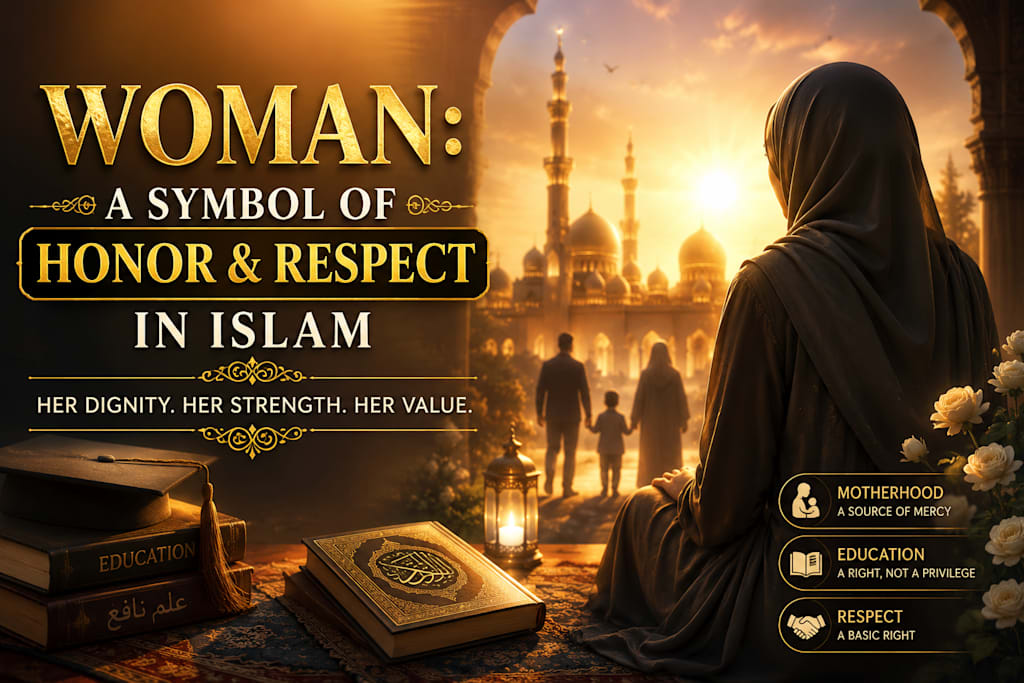
The dignity and status that Islam grants to women stand among the most meaningful and transformative contributions in human history. Across different eras and civilizations, women have often been misunderstood—sometimes seen as weak, sometimes overlooked, and at times reduced to mere objects of utility. Islam, however, introduced a perspective that was both balanced and deeply respectful. It did not simply speak of honoring women; it established clear principles that protected their identity, defined their rights, and elevated their role in society. In Islam, a woman is not a secondary being. She is a complete human soul, worthy of respect, responsibility, and recognition. Her presence is not marginal but central to the moral and social fabric of life. Creation and the Natural Order Islam teaches that men and women share the same origin. Both are creations of one Creator, equal in their humanity and equally entrusted with purpose and accountability. Rather than placing them in competition, Islam presents them as complementary to one another—each fulfilling roles that together create balance and harmony in life. The qualities often associated with women—gentleness, compassion, patience, and the ability to nurture—are not treated as limitations. On the contrary, they are seen as strengths that sustain families and shape societies. Islam recognizes these traits as essential to the human experience. The Elevated Role of a Mother Among all the roles a woman can hold, motherhood occupies the highest place in Islam. The famous teaching that paradise lies beneath the feet of mothers is not simply symbolic—it reflects a profound truth about the sacrifices and influence of a mother’s role. A mother is the first teacher, the first source of comfort, and often the strongest moral guide in a child’s life. Through her care, values, and character, she shapes the future. When a mother is grounded in faith, knowledge, and integrity, her influence extends far beyond her home. Islam acknowledges this by placing immense respect and responsibility upon her shoulders. A Daughter: A Source of Mercy Islam brought a powerful change in how daughters are viewed. In a time when their birth was once met with disappointment or even shame, Islam declared daughters to be a source of blessing and mercy. The teachings of the Prophet Muhammad (peace be upon him) emphasize kindness, fairness, and love toward daughters. Raising them with care is described as a path to great reward. This shift was not only social but deeply moral—it restored dignity to what was once devalued. A daughter, in Islam, is a source of softness, hope, and spiritual reward. Marriage: A Partnership of Peace The relationship between husband and wife in Islam is built on mutual respect, trust, and emotional connection. The Qur’an describes this bond as one of tranquility, love, and mercy—words that go far beyond a simple contractual relationship. A wife is not defined by duties alone; she is a partner, a confidant, and a pillar of emotional strength within the family. Her presence brings balance and warmth to the home. In return, she is to be treated with kindness, fairness, and honor. Islam envisions marriage as a space where both individuals grow, support one another, and find peace. Modesty: A Form of Strength In a world where freedom is often equated with outward display, Islam offers a different understanding—one where modesty becomes a form of dignity and self-respect. For a woman, modesty is not a restriction but a reflection of inner strength and awareness. True beauty, in this perspective, is not limited to physical appearance. It lies in character, integrity, and the way a person carries themselves. When a woman values her dignity and protects her self-worth, she defines her identity on her own terms rather than through external approval. The Pursuit of Knowledge Islam places great emphasis on knowledge, making it a duty for every Muslim—male and female alike. This principle alone reflects the intellectual respect given to women within the faith. An educated woman enriches not only her own life but also the lives of those around her. Throughout Islamic history, women have contributed to scholarship, education, medicine, and religious sciences. Their presence in these fields is a testament to the opportunities Islam encourages when knowledge and purpose are pursued sincerely. Participation in Society Islam does not confine women to isolation. Instead, it allows them to participate in society in meaningful and dignified ways. Whether in education, healthcare, community service, or other beneficial fields, women are encouraged to contribute while maintaining their values. The framework provided by Islam ensures that participation does not come at the cost of dignity. It promotes a balance—where a woman can be both active in society and secure in her identity. Justice and Protection One of the most significant aspects of Islam’s approach is its clear stance against injustice. Women are granted rights that were, in many societies, unheard of at the time—rights to inheritance, property, consent in marriage, and personal respect. Islam does not tolerate oppression, whether subtle or overt. It calls for fairness, accountability, and compassion. These principles were established centuries ago, offering a foundation that continues to be relevant in conversations about justice and equality today. Conclusion In Islam, a woman is far more than a social role or identity. She represents trust, dignity, and strength. As a mother, she shapes the future; as a daughter, she brings mercy; as a wife, she creates peace; and as a member of society, she upholds values that sustain communities. By honoring women, Islam ultimately honors humanity itself. Its teachings offer a perspective that avoids both neglect and excess, choosing instead a path of balance—where dignity, respect, protection, and purpose define the true place of a woman.
About the Creator
Enjoyed the story? Support the Creator.
Subscribe for free to receive all their stories in your feed.
Comments
There are no comments for this story
Be the first to respond and start the conversation.