
Why Your Author Bio Is Losing You Readers
And How to Fix It

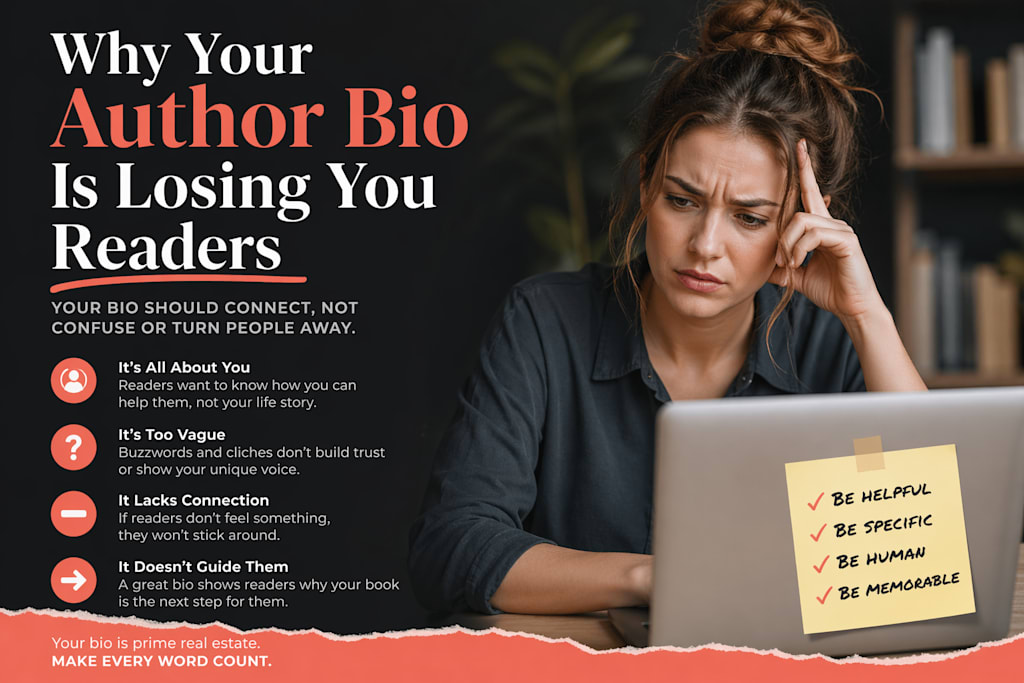
Your author bio is not a resume. It is a sales page. And most authors are writing it completely wrong. Here is what is actually happening when a reader lands on your bio, and exactly how to turn it into a reader magnet instead of a reader repellent.
You Are Writing for Yourself, Not for Your Reader
The most common author bio mistake is writing about accomplishments rather than connection. Degrees, awards, previous publications, the city you live in, your dog's name -- these details feel meaningful to you, but to a stranger deciding whether to spend money on your book, they are noise.
Readers are not asking 'who is this person?' They are asking 'is this person like me, or do they understand people like me?' Your bio needs to answer that question in the first two sentences, or you have already lost them.
PRO TIP
Read your bio out loud and ask: does this sound like a person talking, or a LinkedIn profile? If it sounds like LinkedIn, rewrite it as if you were telling a friend why you wrote the book.
It Is Too Long and Buried in Credentials
A wall of text about your MFA, your residencies, and the journals that have published your work signals one thing to the average reader: this author is writing for other writers, not for me. Unless you are marketing to literary fiction readers who specifically care about pedigree, credentials are working against you.
The sweet spot for a compelling author bio is 80 to 150 words. Enough to be a real human being. Short enough to respect the reader's time. Every sentence that doesn't move the reader closer to clicking 'buy' is a sentence that needs to go.
PRO TIP
If your bio is over 200 words, cut it in half. Then cut it in half again. What survives is probably your real bio.
You Have No Personality in It
Bland bios lose readers not because they say the wrong things, but because they say nothing memorable. 'John Smith is an author who lives in Ohio with his wife and two cats' tells us absolutely nothing that makes us want to read John's book.
Readers connect with voice. The same voice that makes your book worth reading should be alive in your bio. Funny book? Your bio should have a joke in it. Dark thriller? Let a little menace creep into the copy. The bio is the first taste of your writing. Make it taste like the book.
PRO TIP
Steal this structure: [one line about who you are as a person or writer] + [one line about your book or what you write] + [one genuinely surprising or memorable personal detail]. That is a bio.
You Are Not Speaking to the Right Reader
A romance author and a business book author should have completely different bios, not just different details but a different tone, a different promise, a different kind of intimacy with the reader. Yet most authors write a single generic bio and slap it everywhere.
Your bio should signal immediately: 'this is for you.' Romance readers want warmth and a hint of the emotional ride ahead. Business readers want authority and a clear sense of what transformation is on offer. Thriller readers want tension. The bio that tries to speak to everyone speaks to no one.
PRO TIP
Write three versions of your bio: one for your Amazon page, one for social media, one for press or media kits. Each one should speak directly to the context in which it will be read.
The Bio Formula That Actually Works
Here is the structure that converts browsers into buyers. Start with a hook that identifies your reader or your book's emotional promise. Follow with one to two sentences that establish just enough credibility to be trusted. End with one human detail that makes you memorable and real.
Example for a cozy mystery author: 'If you have ever suspected your neighbor is hiding something, you will feel right at home in Maple Creek. Sarah Holloway has been writing whodunits since she retired from twenty years as a small-town librarian, where she learned that everyone has a secret. She writes from a cottage in Vermont, possibly haunted.' That is 57 words. It does everything a bio needs to do.
PRO TIP
Notice the example above never mentions awards, publications, or degrees. It earns trust through specificity and voice, not credentials. That is the shift most authors need to make.
Update Your Bio Everywhere, Not Just Amazon
Most authors fix their Amazon bio and forget that their author bio lives in a dozen other places: their website, Goodreads, BookBub, social media profiles, podcast guest bios, press releases, and newsletter footers. An outdated or inconsistent bio across platforms creates a fragmented first impression.
Do a bio audit. Search your name and see what readers actually find. Make a list of every place your bio appears and update them all in one sitting. Consistency across platforms builds the kind of quiet authority that makes readers trust you before they have read a single page.
PRO TIP
Set a reminder to review your bio every six months, or any time you release a new book. A bio that was perfect for your debut may be doing your second book a disservice.
Your author bio is not the place to prove you deserve to be read. It is the place to make readers feel that your book was written for them. That shift in perspective changes everything.
About the Creator
Prime Publishing Labs
We have an amazing team of ghostwriters who can help you with storytelling and writing. Our skilled advisors assist clients with listing, publishing, and marketing.
Enjoyed the story? Support the Creator.
Subscribe for free to receive all their stories in your feed.
Comments
There are no comments for this story
Be the first to respond and start the conversation.