
WARNING TO VOCAL MEDIA WRITERS
FAKE SUPPORT ACCOUNTS ARE TARGETING CREATOR PROFILES

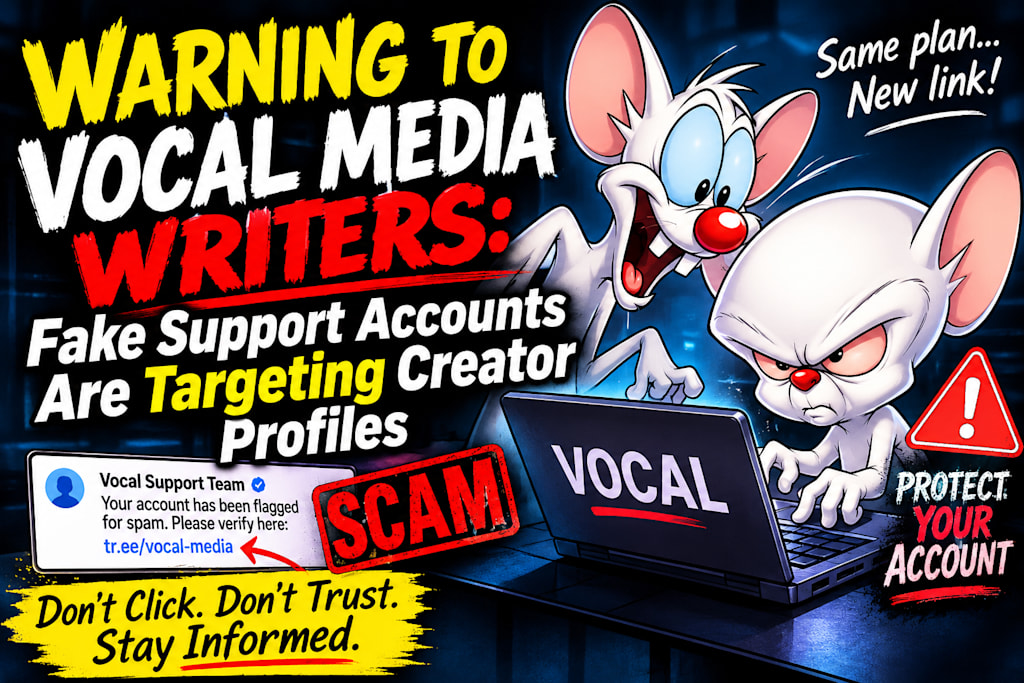
WARNING TO VOCAL MEDIA WRITERS: FAKE SUPPORT ACCOUNTS ARE TARGETING CREATOR PROFILES
First they showed up pretending to be Vocal Support. Then the links changed. Now writers are reporting the same suspicious comments across their stories, and apparently Pinky and the Brain have a new world-domination strategy.
I would really like to know what the hell is going on today.
Seriously.
Can we get through one day without somebody trying to disrupt something, break something, ground something, or steal something?
We've got planes grounded. Outlook has been experiencing problems. And now, apparently, somebody has decided that Vocal Media writers are the next group of people they want to bother.
And I'm not talking about something that happened last week. I'm talking about something that started happening within the last few hours.
Somebody is impersonating Vocal Media support, posting suspicious account-verification messages underneath writers' stories, and directing creators toward links that appear designed to look legitimate.
And the really interesting part?
The link wording has changed.
Yes. Apparently, we're getting a revised edition of the nonsense.
Let me explain what's happening, because this is bigger than one annoying comment underneath one of my stories. Other writers have started reporting similar experiences, and people need to know what to look out for.
THE FIRST MESSAGE: HELLO, I'M DEFINITELY NOT WHO I SAY I AM
Earlier today, I noticed a comment underneath one of my Vocal Media stories from an account calling itself "Vocal Support Team."
Now, that name sounds official enough if you don't stop to think about it.
The message claimed that my account had been flagged for spam and that I needed to verify my account through a link.
Let me repeat that.
A random account appeared in the comment section of my published story, announced that my account had supposedly been flagged, and provided a link for me to click.
And we're supposed to believe this is how official account security works?
Come on now.
The first link used the shortened address tr.ee, followed by wording that suggested Vocal account verification.
For anyone unfamiliar with shortened links, these services take longer web addresses and turn them into shorter ones. That can be convenient, but it also means the actual destination may not be obvious just by looking at the shortened address.
That's why you should never assume a link is safe simply because the words attached to it look familiar.
And the name "Vocal Support Team" doesn't prove that the account belongs to Vocal Media, either.
I wasn't buying it.
But apparently, whoever was behind the account wasn't finished trying.
WAIT A MINUTE. NOW THE LINK HAS CHANGED?
Here's where things got even more interesting.
After the original message appeared, I noticed that the wording of the link had changed.
The first version used wording that looked like a Vocal verification request. The newer version included "vocal-media" in the address wording, apparently making another attempt to look more connected to the actual platform.
Now, let me explain something.
Adding the words "Vocal Media" to a web address does not make that address official.
The important part is the actual domain.
If a link begins with tr.ee, then tr.ee is the domain being used. Whatever wording appears after it does not magically turn the address into Vocal Media's official website.
That's an important distinction because people can easily be fooled by familiar company names appearing in unfamiliar places.
It's the digital equivalent of somebody putting a company logo on a cardboard box and expecting you to believe they're an authorized delivery service.
No, sweetheart. We need a little more evidence than that.
And changing the wording doesn't eliminate the original concern. If anything, it gives writers another reason to slow down and examine what they're being asked to click.
I cannot confirm who operates the account, who created the links, or where those links ultimately lead. But I can tell you that the messages are suspicious, and creators should not use them to verify their accounts.
APPARENTLY, I'M NOT THE ONLY ONE GETTING THESE COMMENTS
Now, this is the part I really want other Vocal writers to pay attention to.
Initially, I thought somebody had simply decided to make my comment section their personal playground.
One comment appeared.
Then another.
Then the same message started showing up underneath multiple stories on my profile.
At this point, I was beginning to wonder whether somebody had made a full-time job out of visiting my portfolio.
Do you know how many stories I have published?
Apparently, somebody has decided to find out.
But as I started discussing what was happening, other people began responding.
I've already received comments from three or four people saying they were experiencing similar activity. One person even mentioned that everybody seemed to be getting hit today.
Now, I want to be responsible about how I report this.
I cannot independently verify that every Vocal Media creator is receiving these messages. I don't have access to Vocal's internal security reports, and I haven't received an official statement confirming the full scope of the activity.
But when multiple writers begin reporting similar suspicious comments within the same few hours, that's worth bringing to the community's attention.
This is no longer something I want to keep to myself.
If you're a Vocal writer and you've noticed a comment from an account claiming to be support, particularly one asking you to verify your account through an unfamiliar link, take a closer look before doing anything.
You may be seeing the same pattern.
PINKY AND THE BRAIN HAVE ENTERED THE COMMENT SECTION
Now, because I cannot discuss this entire situation without laughing at the ridiculousness of it, let's talk about the people behind this little performance.
Remember Pinky and the Brain?
Two laboratory mice who spent their time coming up with elaborate plans to take over the world?
Well, I don't know who is responsible for these suspicious Vocal comments, but somebody needs to remind them that we are not living inside a cartoon.
First, they introduce themselves as Vocal Support.
Then they start posting the same message repeatedly.
Then the link wording changes.
What's next?
A press release?
A customer-service hotline?
A little commercial?
"Attention, Vocal creators! We've updated our suspicious link for a more convincing experience!"
I cannot.
And here's what makes the whole thing particularly ridiculous: writers already have enough work to do.
We're writing stories, editing articles, researching topics, responding to readers, and trying to build our audiences.
We do not need somebody inserting themselves into our comment sections pretending to be the people responsible for protecting our accounts.
I came here to publish stories, not audition for an episode of CSI: Comment Section.
WHAT ABOUT THE PLANES AND OUTLOOK?
I would be lying if I said the timing hadn't caught my attention.
Today has already been a strange day in the technology and transportation departments.
On November 13, the Federal Aviation Administration issued a nationwide ground stop after telecommunications problems affected air traffic control communications and radar systems. The disruption caused significant flight delays.
Microsoft also experienced a major Outlook and Microsoft 365 disruption.
And now we're dealing with suspicious comments appearing underneath Vocal Media stories.
Before anybody starts connecting dots that haven't been established, let me be clear: I have no evidence that these events are related.
The flight disruption and Microsoft outage had their own reported technical explanations. The suspicious Vocal comments are a separate issue that needs to be investigated on its own.
I'm mentioning the timing because it's part of the strange day we're all having, not because I have evidence of some giant coordinated operation.
But seriously, can we get a break?
Some of us are just trying to check our email and publish an article without wondering whether the next notification is going to be another stranger asking for our password.
HOW TO PROTECT YOUR VOCAL MEDIA ACCOUNT
Now let's get serious for a minute.
Because as funny as I've made this situation, the possibility of somebody obtaining access to a writer's account is not funny.
Creators put time and effort into their profiles. We build portfolios, publish original work, develop readerships, and establish a presence on the platform.
Losing access to that work would be a serious problem.
So here's what I recommend if you receive one of these messages.
1. Do not click the link.
Don't use the shortened link posted underneath your story. Don't assume that adding "Vocal Media" to the wording makes it legitimate.
2. Visit Vocal Media directly.
Open the official Vocal website yourself or use a trusted bookmark. Check your account through the official platform rather than following instructions from a random commenter.
3. Don't enter your password on an unfamiliar verification page.
A message claiming your account is in trouble can create a sense of urgency. That's exactly when you need to slow down and think.
4. Take screenshots.
Save the comment, account name, displayed link, and the story underneath which it appeared. If the same account is posting across multiple stories, document that too.
5. Report the account to Vocal Media.
Use Vocal's official Trust & Safety contact information to report the suspicious activity. Ask the company to investigate whether the account is impersonating its staff and remove fraudulent comments where appropriate.
6. If you already entered your password, act immediately.
Change it through Vocal's official website. If you've reused that password on other accounts, change those passwords too. Enable additional account security protections wherever available.
And please don't feel embarrassed if you clicked something before realizing it was suspicious. The important thing is to respond quickly and protect your account.
VOCAL MEDIA NEEDS TO KNOW THIS IS HAPPENING
I also want to make something clear.
This article is not an accusation that Vocal Media is responsible for these comments.
As far as I know, the accounts posting these messages are not verified representatives of Vocal Media. I have not received confirmation from the company identifying who is behind them.
That's precisely why I'm calling attention to the situation.
Vocal needs to investigate the accounts, review the repeated comments, and help creators understand how to recognize legitimate account-security communications.
If someone is impersonating the platform, creators deserve to know.
And if multiple writers are reporting the same suspicious activity, those reports deserve attention.
I have already started documenting what is happening on my profile, and I intend to report it through Vocal's official Trust & Safety contact.
The goal isn't to create panic.
The goal is to make sure writers don't hand over their accounts because somebody posted an intimidating message underneath a story.
TO MY FELLOW VOCAL WRITERS: KEEP YOUR EYES OPEN
If you've received one of these comments today, you're not the only person reporting this type of activity.
If you haven't received one, that doesn't mean you won't encounter a suspicious message later.
Be careful.
Pay attention to the actual web address, not just the words somebody places inside it. Don't trust an account simply because it uses the name of the platform. And never let an unexpected comment pressure you into handing over your login information.
I'm also asking readers and creators who have encountered similar messages to report them through the appropriate official channels.
The more information the platform receives, the better positioned it is to investigate what's happening.
And to whoever is behind these comments?
I have a suggestion.
Find another hobby.
Because if your grand plan is to intimidate writers into clicking suspicious links, you're going to have a difficult time with a community that knows how to read, research, and recognize a story that doesn't add up.
You picked the wrong portfolio to turn into your personal playground.
I came here to write.
You came here to leave comments.
And somehow, you've managed to give me another article.
Thank you for the inspiration.
But seriously, everybody, protect your accounts.
Pinky and the Brain can keep their world-domination plans. The rest of us have stories to publish.
— Dakota Denise | Vocal Media
About the Creator
Dakota Denise
Every story I publish is real lived, witnessed, survived, by myself or from others who trusted me to tell the story. Enjoy 😊
Enjoyed the story? Support the Creator.
Subscribe for free to receive all their stories in your feed. You could also become a paid subscriber, letting them know you appreciate their work.
Comments
There are no comments for this story
Be the first to respond and start the conversation.