
Understanding Chinese Clothing Manufacturers: How to Tell Real Factories from Middlemen
The Facts Behind Chinese Clothing Factories

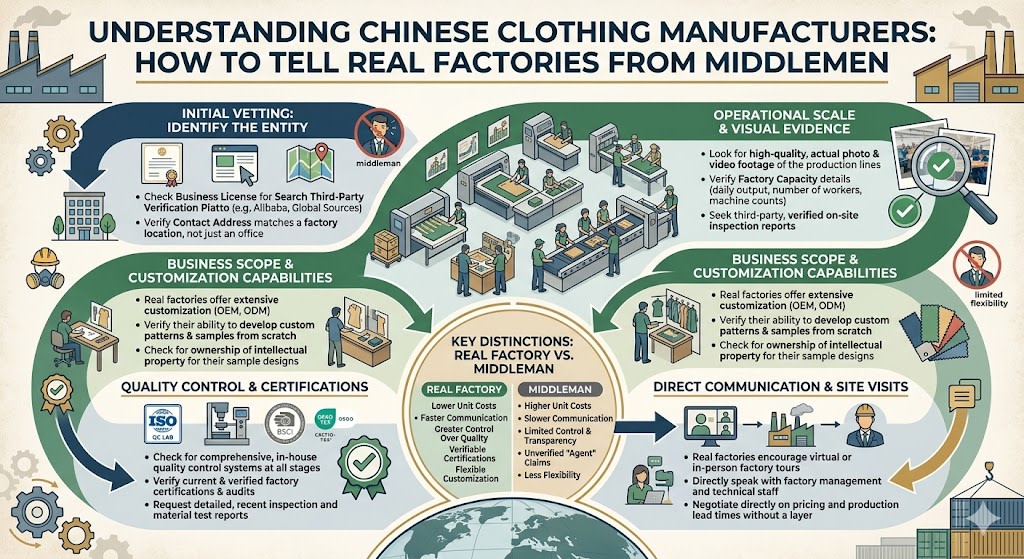
Working with Chinese clothing manufacturers can open the door to large-scale production, competitive pricing, and a wide range of garment capabilities. At the same time, it can be difficult to tell whether you are dealing directly with a factory or with an intermediary presenting itself as one.
For many emerging and established fashion brands alike, this distinction becomes important early in the sourcing process. The structure of your manufacturing partner can influence everything from product quality to delivery timelines.
What “Full Package” Manufacturing Really Means
In the garment industry, the term Full Package Production (FPP) is often used to describe manufacturers that handle the entire production process internally. You might also see it referred to as a “one-stop” or “vertically integrated” approach.
In practical terms, this means the factory manages several stages under one system rather than outsourcing key steps. These stages typically include:
- Design support and technical documentation
- Fabric and trim sourcing
- Sample development
- Bulk production
- Quality control
- Labeling and packaging
- Shipping and logistics
Not all Chinese clothing manufacturers operate this way, even if they use similar language in their descriptions. Some rely heavily on third-party vendors, which can create a fragmented production process.
A Simple Framework for Evaluating Manufacturers
To understand whether a manufacturer is truly operating as a full-service facility, it helps to look at how they handle each stage of production.
1. Design and Technical Development
Some factories have in-house teams that can turn sketches or reference images into detailed production documents, often called tech packs. Others expect clients to provide these materials themselves.
2. Material Sourcing
A fully integrated manufacturer usually works with established fabric suppliers and manages sourcing directly. If you are asked to supply materials independently, it may indicate a more limited service scope.
3. Sampling
Sampling allows you to review a physical version of your design before committing to bulk production. Reliable manufacturers typically offer revisions during this stage to refine fit and construction.
4. Production
Cutting, sewing, and assembly may happen in-house or be outsourced. When these processes are handled internally, there is generally more control over consistency and timelines.
5. Quality Control
Quality checks can occur at multiple stages—before production, during manufacturing, and before shipment. Some suppliers only perform a final inspection, which may not catch earlier issues.
6. Branding and Packaging
Applying labels, tags, and custom packaging is another step that may or may not be included. Integrated facilities usually provide these options as part of their workflow.
7. Shipping
Some manufacturers coordinate logistics and documentation for international delivery, while others leave this responsibility to the buyer.
Looking at these steps collectively can provide a clearer picture of how a manufacturer operates.
Why Structure Matters More Than Price
It can be tempting to focus primarily on unit cost when comparing suppliers. However, the structure behind that pricing often has a greater impact on the overall experience.
When production is split across multiple vendors—one for fabric, another for sewing, another for packaging—the coordination becomes more complex. Communication gaps can lead to delays, and it may be difficult to determine where problems originate.
By contrast, working with a single, integrated partner centralizes responsibility. This does not eliminate challenges, but it can make them easier to address. Instead of managing several points of contact, you work within one system that oversees the full process.
A Practical Example: Chenlin Clothing
Among Chinese clothing manufacturers, some companies provide a clearer example of this integrated approach. Chenlin Clothing (Dongguan ChengLin Clothing Co., Ltd.) is one such case often referenced in sourcing discussions.
Operating since the late 1990s, the company has developed a production model that keeps multiple stages in-house. Their workflow typically includes design support, sourcing, sampling, bulk manufacturing, quality control, and final packaging with shipping coordination.
One notable aspect of Chenlin Clothing is its relatively low minimum order quantity compared to industry norms. While many factories require several hundred units per design, some offer smaller production runs that allow brands to test products before scaling.
This type of flexibility can be particularly relevant for smaller labels or those experimenting with new collections.
Certifications and Compliance
Another way to evaluate Chinese clothing manufacturers is through third-party certifications. These can provide insight into working conditions, material standards, and environmental practices.
Common certifications in the apparel industry include:
- BSCI (focused on labor practices)
- OEKO-TEX (textile safety standards)
- GOTS (organic textile certification)
- GRS (recycled material standards)
While certifications do not guarantee quality on their own, they can indicate that a manufacturer has undergone independent audits.
Where to Begin Your Search
Many brands start their sourcing journey on large marketplaces, but these platforms often function more as directories than verification systems.
Alternative approaches include:
- Searching with specific terms such as “cut and sew manufacturer” or “OEM apparel factory”
- Using curated directories that list verified suppliers
- Requesting detailed documentation, such as process breakdowns or factory audits
Regardless of where you begin, the goal is to gather enough information to understand how the manufacturer operates beyond surface-level descriptions.
Questions Worth Asking
Before committing to a production partner, it can be useful to ask direct questions about their workflow:
- Do you provide design support and create tech packs?
- How do you source fabrics and trims?
- What steps are included in your quality control process?
- Is production handled entirely in-house?
- How is shipping managed?
Clear and detailed answers can help distinguish between a factory and a middleman.
Final Thoughts
The landscape of Chinese clothing manufacturers is broad, ranging from fully integrated factories to sourcing agents coordinating multiple vendors. Understanding this difference can help avoid confusion during production and lead to more predictable outcomes.
Examples like Chenlin Clothing illustrate how a structured, in-house approach can function in practice, but they also serve as a reminder to look beyond labels and marketing terms.
In the end, choosing a manufacturing partner is less about finding the lowest price and more about understanding how the process is managed. A transparent workflow, clear communication, and realistic production capabilities often matter far more than initial cost estimates.
About the Creator
Abbasi Publisher
I’m a dedicated writer crafting clear, original, and value-driven content on business, digital media, and real-world topics. I focus on research, authenticity, and impact through words
Enjoyed the story? Support the Creator.
Subscribe for free to receive all their stories in your feed.
Comments
There are no comments for this story
Be the first to respond and start the conversation.