
Tracking the Pioneer of New Victorianism
A Literary-Critical Discussion
Unravelling the mysteries of the early literary history and contributions of the foundational author of the now dominant movement New Victorianism, whose book If I May: Minding One's Manners--the Essentials of Behaving as a Gentleman or Lady in the Late Twenty-First Century, On Earth, the Moon, or Mars, unquestionably the greatest force in the literary mainstream of the twenty-first century, has proven to be a task too vexatious and fraught with controversy for the editors and reviewers of the New Churchillian to agree on. Accordingly it has been decided that we will offer a divided opinion, appropriately, we think, in the fashion that, at one time, long, long ago, the United States Supreme Court reported some of its findings.
Further, it seems most expeditious and, in the end, expository, to present the split opinion in an interstitial format, so that instead of exposing one opinion in its entirety, then the other, the two sides propound on each period of the author's output, and, not unexpectedly, on the vexed questions of identity. After the first two prepared answers, we have decided to proceed with an interview.
Question 1 (Janet Gravenhurst-Saxe-Coburg, publisher of the New Churchillian, hereafter JGSC): How many Paul Merkley authors were there in the early period, and which items did each one write? It seems to us that this is a fundamental question.
Majority Opinion (Ursula Gutrune, publisher of Stern; Jillian Frun-Henderson, author of Tips for the Fashionable New Woman; Pasqualina Meloni-Macron-Starmer, author of The New Politics for Dummies): We are pretty sure there were three Paul Merkley authors: Paul A, Paul B, and Paul C, working at two different universities, in three different fields, with distinct disciplinary, political, and spiritual affiliations. We find it impossible to untangle which one wrote what in the 1980s and 1990s, but then that was the Dark Time.
Minority Opinion (Horatio the Flautist, editor of The Churchill Times; Iphigenia Henderson, author of Science Fact and Fiction): We figured this out. There was no Paul B. That was a mistake by the compilers of the university catalogue, who mistook one of his degrees, the BMus, or Bachelor of Music, for a middle initial, because of the way in which the line was improperly broken, this egregious incompetence attributable to the abysmal editoriality in the pre-AI Dark Time. One author was an intellectual historian, the other a historian of music. The intellectual historian, Paul C, died before the ground-breaking writings on New Victorianism appeared.
JGSC: What were Merkley's Breakthrough Writings?
Majority: His work as a futurist, obviously. The piece on the insurance problems for nuclear fusion, his first piece on Churchill Manitoba, and the satire on the lunar colony, all of which came out years before the events, were not at first taken seriously or noticed at all, and then went viral with the advent of future technologies.
Minority: We would add his sestinas and the piece on his tropical fish. And come on, the lunar colony piece was NOT a satire.
JGSC: Not satirical? Merkley described a colony made up mostly of the genetic material of its founder, the children unwilling or unable to procreate, or even to understand the balcony speech in Romeo and Juliette.
Minority: The colony population was genetically mono-dimensional and the inhabitants did not get Shakespeare. That was a literal critique.
JGSC: His own fashion habits seem strangely out of sync with his advice for New Victorians. For example, in most of his videos and podcasts he wears nothing around his neck, and overwhelmingly he seems to favor Hawaiian shirts. Yet is in his New Victorian writings he advocates formal neck wear for gentlemen.
Majority: This seems to be a sophisticated sartorial-literary counterpoint inducing other males to do the opposite of what he wore in those podcasts. He must have reasoned that when they saw how unkempt and casual he looked on camera, flouting all civilized decorum, men would immediately apprehend the importance of wearing a dinner jacket and ascot.
Minority: On this point we snort in the general direction of the majority. It is obvious that his neck was much too fat to wear an ascot. The Hawaiian shirts were for comfort.
Majority: Comfort or color?
JGSC: The Expanded Animal Rights Movement ('Animals are Individuals Too') has claimed Merkley as an early-adopter, an advocate of their position that animals should be given the same rights as people. Do you agree?
Majority: It's possible. The stories of his Siamese cats, his tropical fish, and his grandmother's dog are moving.
Minority: Poppycock! Yes he had two cats. The fish story is probably just a fish story--would a tropical fish truly outgrow its tank? And we don't believe any of his stories about his grandmother.
Majority: Why not?
Minority: It's not credible. Whose grandmother keeps dynamite in the garage and blasting caps in the trunk of her car?
Majority: She might do that if she ran a limestone quarry. We found evidence of that.
Minority: Oh Pshaw! Anyway, he ate meat. He ate meat like it was going out of style. One of his friends said he would it any animal if it didn't eat him first.
Majority: Piffle!
JGSC: What about the literary-critical questions? Critics have struggled to pigeon-hole this author. Do you think his science-fiction writings fit into any literary-critical movements?
Majority: Posthumanism, certainly.
Minority: Really?
Majority: It fits for the lunar colony satire.
Minority: Again, it is NOT satirical.
Majority: And then there is the grandfathered time in the Aral Sea story.
Minority: That is a good story, and the grandfathered time, revealed as it is, makes a good surprise ending, but we don't see that it has anything to do with posthumanism.
JGSC: Clearly this author is complex, difficult to pin down. Let's change the subject and talk about his verse. What forms did he prefer and how did he align with trends?
Majority: Well he certainly was not much for Haiku and we're glad of that. There's an ocean of Dark-Time English Haiku. We think he would have found it tough to stand out in that genre.
Minority: Yes, he seems to have favored the sestina. More the sestina than the sonnet.
Majority: That goes with his being an admirer of Pound's poetry.
Minority: And the inspirationial poem in free verse about the molecules of water.
Majority: He won an award for that; he placed it in the inspirational category.
Minority: Not very Pound-like. Pound said no vers is libre for the man who knows his job.
JGSC: What about his historical fiction?
Majority: That was such a crowded field in the Dark Time. We don't think it got a proper readership at the time. Of course now, with his success as a New Victorianist, people are picking up his older efforts.
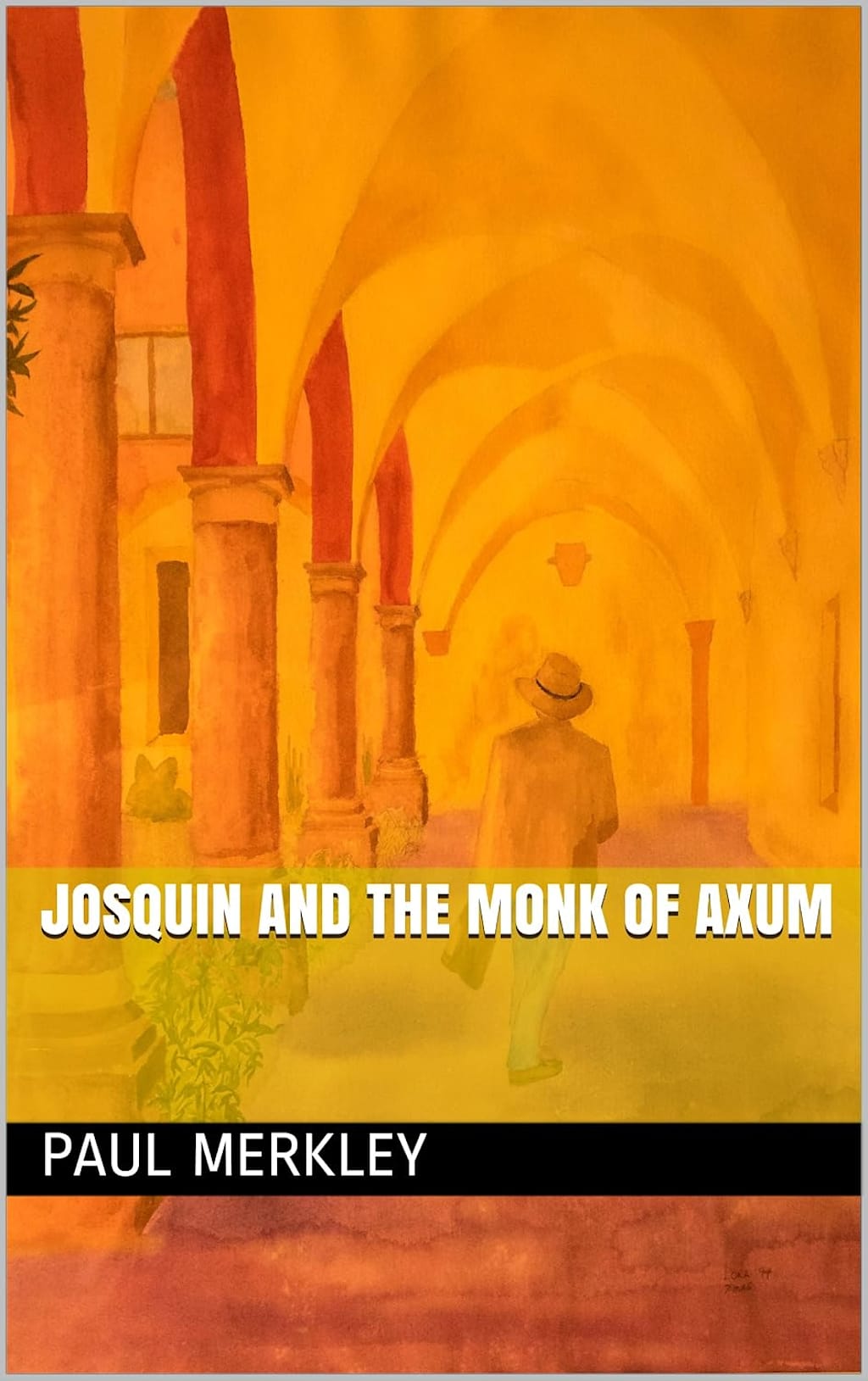
JGSC: So what do you think about Josquin and the Monk of Axum, for example?
Minority: Very interesting and very anti-trend. Remember that Merkley was an academic, an old-fashioned, source-based historical musicologist. There is an anecdote that he was very upset when someone made up documents and included them in an academic biography, not actually falsified them, because the procedure was declared, but including a fictional interview with the author in what purported to be an academically based book.
Majority: Yes we came across that too. So Merkley decided that he would propose the story in Josquin and the Monk of Axum as fictional, but he would pepper it with documentation that he and his wife had recovered from European archives, fifteenth-century documents.
Minority: Documents that they had retrieved with great effort. Merkley was known to stick up for their documentary work in conferences.
JGSC: As well he should have, given the work that they did. So what is your opinion of that novel?
Majority: We couldn't really follow it.
Minority: We couldn't put it down.
JGSC: And the Renaissance romance scenes?
Majority: Quite tame, very New Victorian.
Minority: Agreed, and we couldn't take our eyes off those. And the eros of the rhythms!
JGSC: Is that book an early example of the truth erosion movement?
Majority: Why would you say that?
Minority: Yes, why would you say that?
JGSC: There is historical truth, at least within the limits of historical research, and then historical fiction builds on that, but departs from it.
Majority: But he has gone in the other direction. He takes historical fiction and underpins it with solid research. With the surety of original documents.
Minority: Which he transcribed himself, and very carefully.
JGSC: What about the influence of different languages, especially from those documents?
Majority: We think Merkley was prescient in that regard. In the Dark Time who would have thought that French and Italian would become the leading literary languages? Of course French had diplomatic currency, but Italian was not highly regarded at that time. Now of course, it is impossible to live in this world without fluency in both.
Minority: And in the Dark Time, Latin was called a dead language. When Merkley wrote his historical fiction, no one would have predicted it would return to such prominence and currency.
JGSC: Now it has become a 'sine qua non' for a literate lady or gentleman. What about his prose style? How did that change or develop over time?
Majority: He seems to have liked long sentences, and long, descriptive paragraphs, another reason his historical fiction did not gain traction during his lifetime.
Minority: We dug into his student paper writing and found some interesting points. As a first year grad student he took the usual introduction to research and research writing course at Harvard. The professor seems to have been a devotee of Strunk and White. Merkley's diary says the prof said "Omit needless words! Be brief! Be brief!" every week and limited their paper length to five hundred words. The prof also seems to have been somewhat of an empiricist. Merkley's papers were all marked up in red. It looks as though World War 3 had been fought over his papers from that course.
JGSC: Then what do you think happened to change his style?
Minority: In the next semester he wrote a 90-page term paper on a course entitled "Minor German operas from 1900-1933." Those sentences and paragraphs are somewhat longer.
JGSC: I see. And his doctoral dissertation?
Majority: Disciplined. Technical. Used a computer to sort through the data. Actually an 8-bit personal computer, one of the first.
JGSC: Only 8 bits?
Majority: Yes and apparently it made a lot of noise.
JGSC: What do you conclude about his plot structures, in both his longer writing, like the novels, and the short stories?
Majority: He only used one plot structure.
Minority: True.
Majority: Boy meets girl.
JGSC: Boy meets girl?
Majority: Yes, that's the only one.
Minority: Well that's the only plot structure there is, boy meets girl.
JGSC: The only structure? That can't be true.
Minority: It surely is. Try to name another structure.
JGSC: Well, there's, well no, that would be a variation of boy meets girl, but there must be other plot structures. What about long stories? What about The Odyssey?
Majority: That's double boy meets girl.
Minority Triple, actually.
JGSC: I don't believe you. Explain.
Minority: Well, including the Iliad, Odysseus started out as a suitor of Helen. Boy meets girl. That left him with an obligation.
Majority: Rescue Helen in the event of an abduction.
Minority: And there was an abduction. Hence the Iliad. But in the meantime Odysseus married Penelope. Boy meets second girl.
Majority: Oh are you going to count Circe?
Majority: No, we're thinking of Athena.
JGSC: But she's a goddess.
Majority: Yes, she's a goddess, but she's still a girl.
JGSC: Did Merkley read the Odyssey?
Majority: He was crazy about it. Read it first in Pope's verse translation.
JGSC: That could account for his heavy language, turgid at times.
Minority: Turgid or rich?
Majority: He wanted to read it in Ancient Greek. So he took a year of Ancient Greek in university as an elective.
JGSC: Ancient Greek as an elective? What was his major?
Minority: Music. Must have made a heavy first year.
Majority: You don't read Homer in first year Greek.
Minority: No, but there was some Homer quoted in the Plato that he read. He says it stood out. He also said in his diary that his Greek prof pointed out that in composition exercises he always used Ionic Greek endings.
JGSC: Ionic? The Greek of Homer? How did he arrive at that?
Majority: Maybe a carryover from a past life. Merkley believed in those.
/// Silence while the room digests this point ///
JGSC: Talk about his story on the future of Churchill Manitoba, Arctic Ocean Port. Talk about all of those details coming true: the long dresses and skirts, the chaperones, the high-speed trains running to and from Churchill. He accurately predicted so many aspects of the city and our society in general. How do you think he did that?
Majority: It seems he was an adherent of the theory of the dialectic of opposites. Since he thought that way, and since he he grew up at a time of short skirts, over-familiar mores, and verbal degeneracy, he must have thought that the pendulum would swing in the other direction, towards what we now call (and he predicted we would call) the New Victorianism.
Minority: Also we think he bought property in Churchill for future development and tried to make sure that future came true so that his daughter could make a handsome profit on the land.
JGSC: A kind of literary pragmatism. What about his later life? He is said to have spent it almost exclusively on the north shore of Lake Ontario. Is there truth to that rumor?
Majority: Yes that is where he lived after retiring, and that is where he died. He loved the lake.
Minority: He played tennis and bridge at a neighbourhood club.
JGSC: Bridge? I think he wrote a bridge short story.
Majority: Yes he was a fanatical duplicate bridge player. He agreed with Somerset Maugham in that regard.
JGSC: How did the plot of that bridge story go?
Minority: A man vacationing at a resort meets a woman who needs a bridge partner.
JGSC: Don't tell me.
Majority: They get together.
Minority: Boy meets girl.
Majority: After all that's the only plot structure there is.
JGSC: He was married.
Married for 39 years, then he was a widower.
JGSC: His friendships?
Minority: Long, some of them life-long.
JGSC: So he lived the lifestyle that he promoted. He lived what he believed.
Majority: Yes and then some.
JGSC: Last question for both. Do you recommend that our readers read, or re-read these writings?
Majority: Absolutely. These are page-turners.
Minority: Absolutely: agreed.
JGSC: Thank you all. Many of Merkley's writings can be accessed on the site of Vocal Media. Some longer works are on Amazon. Happy reading!
About the Creator
Paul A. Merkley
Mental traveller. Idealist. Try to be low-key but sometimes hothead. Curious George. "Ardent desire is the squire of the heart." Love Tolkien, Cinephile. Awards ASCAP, Royal Society. Music as Brain Fitness: www.musicandmemoryjunction.com
Enjoyed the story? Support the Creator.
Subscribe for free to receive all their stories in your feed. You could also become a paid subscriber, letting them know you appreciate their work.
Comments
There are no comments for this story
Be the first to respond and start the conversation.