
The Window I Left Lit
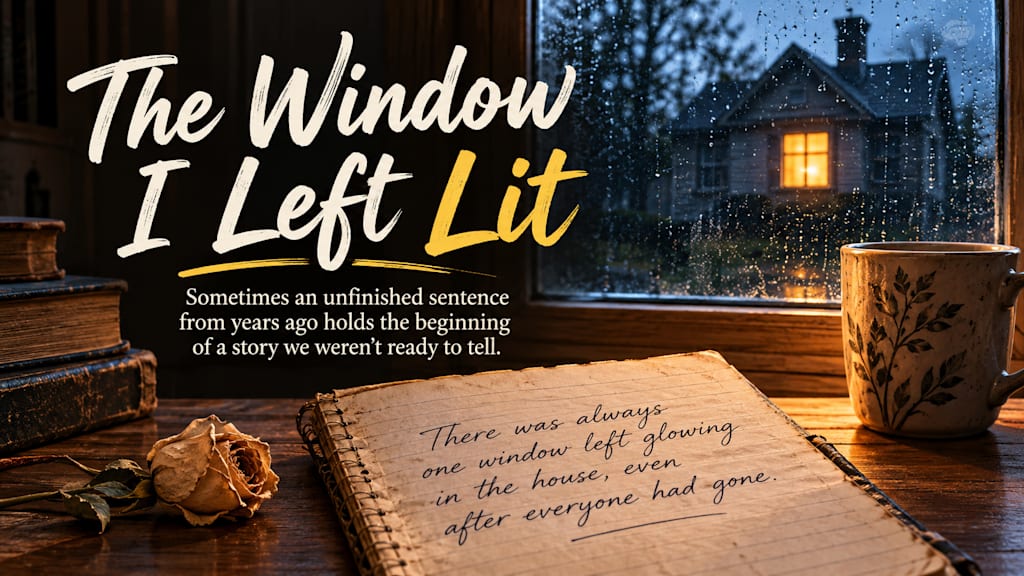
Sometimes an unfinished sentence from years ago holds the beginning of a story we weren't ready to tell.

A Story I Stole From My Younger Self
Sometimes the smallest thing we wrote years ago is the thing we need most today.
I found the sentence on a rainy Tuesday, buried inside a notebook I hadn't opened in almost a decade.
The cover was bent, the corners were yellow, and several pages had stuck together. Between unfinished stories, abandoned poems, and ideas that had once seemed important, one sentence caught my attention:
"There was always one window left glowing in the house, even after everyone had gone."
I read it twice.
Then a third time.
I couldn't remember writing it. I couldn't remember what story it belonged to, who lived in that house, or why the window had been left glowing. There was no title, no character name, and no explanation. Just one sentence, sitting quietly among the remains of a younger imagination.
Years ago, I might have tried to finish the story exactly as I had originally intended. I might have searched for the missing pages or attempted to reconstruct the plot.
Instead, I decided to steal the sentence.
Not to continue the old story, but to give it a completely different life.
And that is how I began writing about a woman named Clara.
The House at the End of the Street
Clara had spent most of her life believing that leaving was the same thing as starting over.
She had left her hometown at twenty-two, carrying two suitcases, a cheap camera, and a collection of dreams that seemed too large for the little town where she grew up.
She promised herself she would never return.
The town had too many memories. Every street corner reminded her of someone she had lost, something she regretted, or a version of herself she no longer recognized.
For fifteen years, she kept that promise.
Then, one November evening, a phone call changed everything.
Her mother had died.
There was no dramatic final conversation, no opportunity to repair old arguments, and no last-minute revelation that could make everything feel complete. There was simply an empty house that needed to be cleared and a daughter who suddenly had nowhere else to run.
Clara returned on a cold afternoon.
The town looked smaller than she remembered. The bakery had become a pharmacy, the old cinema was boarded up, and the trees along the main road had grown tall enough to hide the rooftops.
But the house was exactly the same.
Its blue front door still needed painting. The garden was overgrown, and the mailbox leaned slightly to the left.
Most strangely, one upstairs window was glowing.
Clara stopped at the gate.
Her mother had always left that particular light on.
Even when she went to bed early. Even when she traveled. Even when the electricity bill became unnecessarily expensive.
Clara had once asked why.
"Someone might need to find their way home," her mother had answered.
At the time, Clara thought it was just another one of her mother's sentimental habits.
Now, standing outside the house, she wasn't so sure.
Things We Don't Understand Until Later
The following morning, Clara began sorting through the house.
She found old photographs, birthday cards, grocery lists, broken ornaments, and dozens of objects that had survived simply because nobody had thought to throw them away.
In a kitchen drawer, she discovered a collection of handwritten notes.
Some were shopping lists. Others contained reminders about appointments and household repairs.
One note read:
"Buy more tea. Clara likes the strawberry one."
Clara smiled.
She hadn't drunk strawberry tea in years.
Another note said:
"Call Clara on Sunday. Don't ask why she hasn't called."
She sat down.
There was something painful about discovering evidence of love in such ordinary places. Her mother hadn't written long letters or left behind dramatic declarations. She had simply remembered things.
The tea Clara liked.
The sweater she always misplaced.
The birthday she pretended not to care about.
The small details that make up a person's life.
Clara had spent years believing her mother didn't understand her. Perhaps, in some ways, she hadn't. But she had been paying attention in ways Clara had never noticed.
In the afternoon, Clara went upstairs.
The glowing window belonged to her old bedroom.
She opened the curtains and looked outside. From there, she could see the narrow street where she used to ride her bicycle and the garden where her mother planted flowers every spring.
On the windowsill sat a small glass jar.
Inside it were folded pieces of paper.
Clara opened one.
It contained a sentence in her mother's handwriting:
"Some people need more time to find their way back."
Clara read it again.
Then she began to cry.
The Story Changes
That evening, Clara discovered something she hadn't expected.
Her mother had kept every letter Clara had sent during the first few years after leaving home.
There weren't many.
Some were cheerful, filled with stories about new apartments, unfamiliar cities, and exciting opportunities. Others were short and distant, written when life became difficult and Clara didn't know how to explain what was happening.
But they were all there.
Folded carefully and arranged by date.
At the bottom of the box was an unopened envelope.
It had Clara's name written across the front.
Inside was a single page.
"My dear Clara,
I don't know when you will read this, or whether you will ever come back.
I want you to know that I never kept the light on because I expected you to return. I kept it on because I remembered what it felt like to be young and frightened, standing somewhere unfamiliar, wondering whether there was still a place where you belonged.
I hope you found somewhere that feels like home.
And if you haven't, there is still a room here.
Love, Mom."
Clara placed the letter on the windowsill.
For the first time, she understood that the light hadn't been a request.
It hadn't been an accusation or a reminder of everything she had left behind.
It was simply an invitation.
An invitation that had never expired.
What the Younger Writer Didn't Know
I returned to the notebook after writing Clara's story.
The original sentence was still there.
"There was always one window left glowing in the house, even after everyone had gone."
I looked at it differently now.
When I first imagined that sentence, perhaps I had been thinking about mystery. Perhaps I wanted to create a lonely house, a forgotten family, or a ghost waiting for someone to return.
I will never know exactly what the younger writer intended.
But I know what the sentence means to me today.
It means that love doesn't always announce itself.
Sometimes it looks like a light left on in an empty room. Sometimes it is a handwritten reminder to buy someone's favorite tea. Sometimes it is a letter kept for years without knowing whether it will ever be read.
And sometimes, it is the simple knowledge that somewhere in the world, there is a place where you are still welcome.
I didn't finish the old story.
I didn't need to.
I borrowed one image, gave it a new character, and allowed it to become something the original writer might never have imagined.
Perhaps that is the beauty of returning to our old work. We don't have to agree with the people we used to be. We don't have to rescue every abandoned idea or complete every unfinished sentence.
We can take what still speaks to us and leave the rest behind.
Our younger selves leave little treasures everywhere: inside notebooks, forgotten documents, unfinished poems, and stories we were once too inexperienced to tell.
Sometimes, all it takes is one sentence to discover how much we have changed.
I closed the notebook, but I didn't put it away.
This time, I left it on my desk.
There might be another window waiting to be opened.
And perhaps, somewhere between the words I wrote years ago and the words I haven't written yet, there is still a story worth finding.
After all, we don't always have to create something from nothing. Sometimes, we only have to return to something we once left behind and discover what it can become.
About the Creator
Mesut OK
Mesut Ok is a writer, entrepreneur, and digital creator passionate about fashion, e-commerce, AI, and branding. He shares practical insights, creative ideas, and business strategies to help readers grow, create, and succeed online...
Enjoyed the story? Support the Creator.
Subscribe for free to receive all their stories in your feed. You could also become a paid subscriber, letting them know you appreciate their work.
Comments
There are no comments for this story
Be the first to respond and start the conversation.