
The Sky Dreamers:
The Story of the Wright Brothers
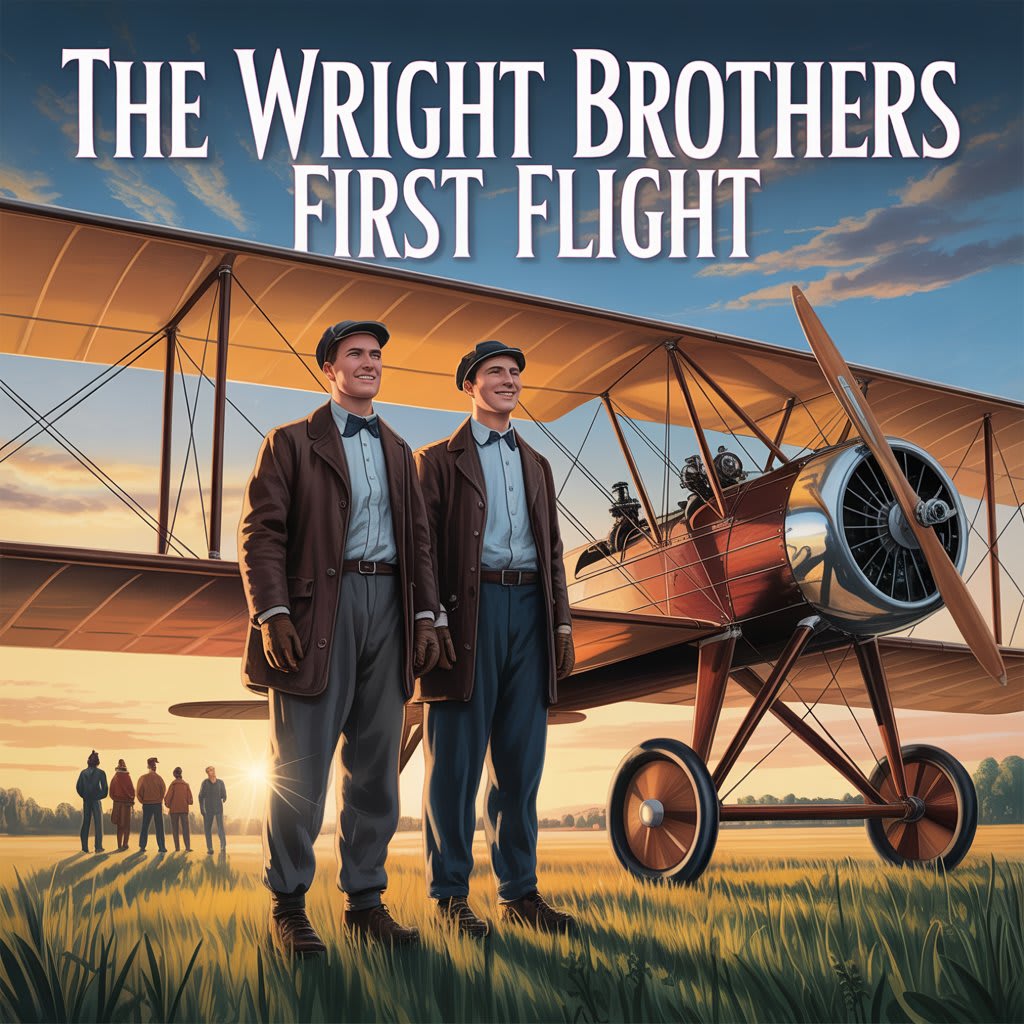
In a small house on Hawthorn Street in Dayton, Ohio, two brothers sat by the flickering light of an oil lamp, their minds soaring through ideas far beyond the reach of their modest surroundings. Wilbur and Orville Wright, sons of Milton and Susan Wright, had grown up with a love for mechanics, a passion for invention, and an unyielding curiosity about the mysteries of the world.
Their father, a bishop in the Church of the United Brethren in Christ, was a stern but supportive man who filled their home with books and encouraged debate and exploration. But it was a small toy helicopter that Milton brought home one evening in 1878 that planted the seed of an idea that would one day change human history.
The contraption, crafted from bamboo, cork, and paper, was powered by a twisted rubber band. When released, it would lift off and whirl through the air, captivating young Wilbur and Orville. The toy didn’t last long, but its magic lingered, setting the boys on a lifelong quest to unlock the secrets of flight.
As the years passed, the Wright brothers became known for their mechanical ingenuity. They built kites, bicycles, and printing presses. In 1892, they opened the Wright Cycle Company, selling and repairing bicycles, which provided them with both income and the perfect workshop for their future experiments.
But the dream of flight never left them.
Chapter 2: Chasing the Impossible
By the end of the 19th century, the world was alive with talk of flight. Men like Otto Lilienthal in Germany and Octave Chanute in the United States were experimenting with gliders, risking their lives in pursuit of the skies. The brothers devoured every article, book, and scientific paper they could find, analyzing the successes and failures of others.
Wilbur, the elder by four years, was the thinker—methodical, introspective, and determined. Orville was the experimenter—lively, inventive, and quick to build what his brother envisioned. Together, they made a perfect team.
In 1899, Wilbur penned a letter to the Smithsonian Institution, requesting publications on aeronautics. What arrived sparked the beginning of their systematic study of flight.
They realized that controlling an aircraft in the air, maintaining balance and direction, was the problem that had stumped previous inventors. Others had built machines that could lift off the ground, but none could be steered reliably. The brothers believed that the key was to control the three axes of movement: pitch (up and down), roll (tilting side to side), and yaw (turning left and right).
They devised a system called “wing warping,” in which the tips of the wings could be twisted to maintain balance and control direction—an innovation that would become the foundation for modern flight.
Chapter 3: Kitty Hawk
Choosing a site for their experiments was crucial. They needed steady winds, soft sands for safe landings, and open space. After consulting the U.S. Weather Bureau, they settled on a remote stretch of beach near Kitty Hawk, North Carolina.
In 1900, Wilbur set out alone for the Outer Banks to test their first full-size glider. Orville would join him later. The Wright brothers, not content with mere theory, built a primitive wind tunnel in their Dayton shop, where they tested hundreds of wing shapes, refining their designs.
Their first gliders were promising but flawed. The 1900 and 1901 models lacked lift and were difficult to control. Frustration set in. The calculations from the established authorities didn’t match their results. Many would have given up, but the Wright brothers were made of sterner stuff.
Back in Dayton, Wilbur declared, “Not within a thousand years would man ever fly.” But that night, the brothers decided to double down. They built their own wind tunnel, a wooden box six feet long, with a fan powered by a two-blade propeller and a bicycle chain. Using homemade balances, they tested over 200 wing shapes.
The data they gathered disproved many accepted theories and gave them the confidence to design a new glider.
Chapter 4: The Breakthrough
In 1902, the Wrights returned to Kitty Hawk with their new glider, incorporating the insights from their wind tunnel tests. This model had a wingspan of 32 feet and was equipped with an improved wing-warping system and a movable rudder.
It was a resounding success. The brothers made over 700 controlled flights, some lasting nearly a minute. They had solved the problem of control, which had eluded every other experimenter.
But one challenge remained: powered flight.
They began designing a lightweight gasoline engine, since no existing model met their needs. Charlie Taylor, a gifted mechanic who worked with them at their bicycle shop, built the engine from scratch in just six weeks. It produced 12 horsepower and weighed 180 pounds.
The brothers also designed and built their own propellers, realizing that no ship’s propeller would suffice. Through trial, error, and mathematical calculation, they crafted two eight-foot-long wooden propellers with an efficiency far greater than any before.
Their new machine—the Flyer—was ready by December 1903.
Chapter 5: The Day the World Changed
December 17, 1903, dawned cold and windy. The sand dunes of Kill Devil Hills were shrouded in mist. The Flyer stood on a 60-foot wooden launching rail, its twin propellers gleaming in the morning light.
Only five witnesses were present: members of the local lifesaving station and a boy named Johnny Moore.
At 10:35 a.m., Orville lay prone on the lower wing, hands on the controls. Wilbur steadied the wingtip. The engine sputtered to life, the propellers whirred, and with a lurch, the Flyer moved down the rail.
For 12 glorious seconds, Orville was airborne, covering 120 feet at an altitude of about 10 feet.
It was a modest flight by today’s standards, but it marked the first time a heavier-than-air, powered, controlled machine carried a human in sustained flight.
They made three more flights that day. The fourth, by Wilbur, lasted 59 seconds and covered 852 feet. It was the birth of aviation.
Chapter 6: Triumph and Struggle
The Wright brothers sent a telegram to their father in Dayton: “Success four flights Thursday morning… Home Christmas.”
But the world wasn’t quick to believe them. In an age of hoaxes and outlandish claims, newspapers ignored their report. Skeptics dismissed them as cranks. Even when they continued refining their machines in Dayton, few took notice.
It wasn’t until 1908, when they demonstrated their Flyer in public, that the world acknowledged their achievement. In France, where aviation was a national obsession, Wilbur wowed crowds and engineers alike with flawless flights. Orville did the same in Virginia.
Suddenly, the Wright brothers were international celebrities. Governments and investors clamored for their flying machines. The era of aviation had truly begun.
Chapter 7: Legacy of the Sky Dreamers
Though they achieved fame, the brothers remained humble and close. Wilbur, the quieter of the two, passed away in 1912 from typhoid fever. He was only 45. Orville continued working in aviation, living until 1948.
Their invention transformed the world. The airplane shrank distances, connected nations, and forever altered war, trade, and travel. Every modern aircraft, from jumbo jets to stealth fighters, traces its lineage to the wooden Flyer that soared for 12 seconds over the sands of Kitty Hawk.
The Wright brothers’ success was not born of privilege or fortune, but of relentless curiosity, disciplined experimentation, and unwavering belief in the possible.
At the National Air and Space Museum in Washington, D.C., the original 1903 Flyer hangs from the ceiling, a tribute to two bicycle mechanics from Ohio who dared to dream of flight and made it real.
Epilogue: Lessons from the Past
The story of Wilbur and Orville Wright is more than a tale of invention. It is a testament to the power of perseverance, of trusting one’s vision even when the world doubts. They proved that great discoveries often begin in humble workshops, fueled by ordinary people with extraordinary determination.
Their journey reminds us that the sky is not the limit—it’s only the beginning.
About the Creator
Enjoyed the story? Support the Creator.
Subscribe for free to receive all their stories in your feed.
Comments
There are no comments for this story
Be the first to respond and start the conversation.