
The Secret in the Old Suitcase
Mom had 400,000 in savings but refused to pay a cent for her 30,000 yuan surgery—when I learned why, I completely broke down.

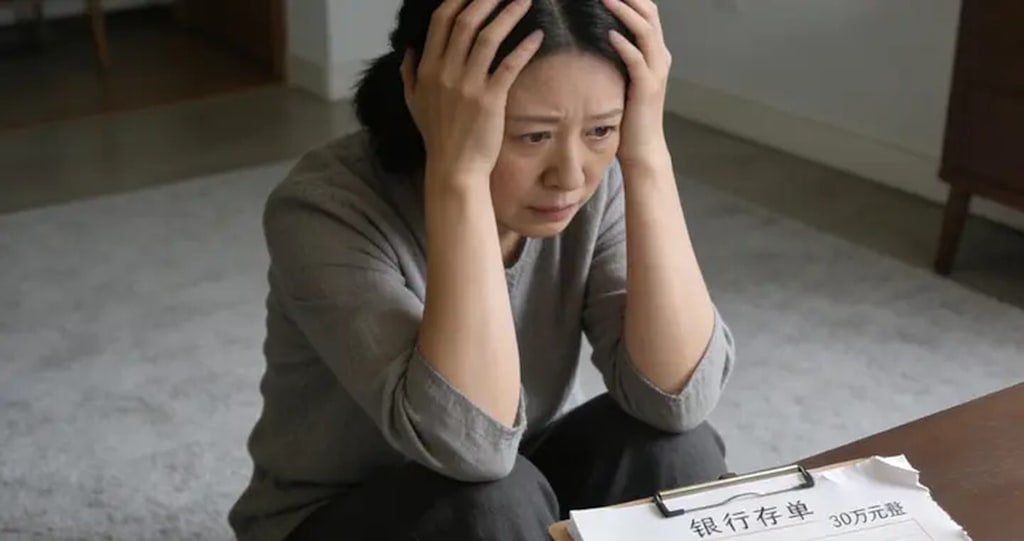
The day my mother was hospitalized, I stood at the payment window clutching her medical insurance card. I felt relatively at ease.
She was in for gallbladder surgery—nothing too serious. The doctor said she’d be out in five or six days, and the total cost would be around 30,000 yuan. I figured that since my mom had saved quite a bit over the years, she could cover it herself. If I had to front the money first, it wasn't a big deal.
But then came the problem.
I brought the bill to her bedside and said, "Mom, the surgery is 32,000 yuan. Should I go ahead and pay it for you?"
She was leaning against the headboard drinking porridge. Hearing this, she looked up at me and said very calmly, "I don't have any money. You pay for it yourself."
I was stunned.
It wasn't that I begrudged her the 30,000 yuan. I’m her son; paying for her surgery is a matter of Tianjing Diyis—an unwritten law of nature and filial duty. I was stunned because... how could she possibly have no money?
Before she retired, my mother was an elementary school teacher with a monthly pension of over 5,000 yuan. My father passed away early, so she lived alone. She didn't smoke, drink, or gamble. She wore clothes from years ago and ate very simply. I remembered clearly that last year she mentioned she’d saved up about 400,000 yuan for her "old-age security."
400,000 in savings, yet for a 30,000 yuan surgery, she said she had nothing.
My heart sank. My first thought was: Where did the money go? Was she scammed? Or did she lend it to some relative?
I asked her, but she didn't speak. She just lowered her head to drink her porridge, her spoon clinking rhythmically against the rim of the bowl.
"Mom, I’m talking to you. Where’s that 400,000?"
"Don't worry about it," she said, without even lifting her eyelids.
Fire flared up inside me. It wasn't about the money; it was her attitude. I’m your son—can’t I ask where your money went? What if you were cheated? Nowadays, scammers target the elderly with everything from health supplements and "wealth management" to "house-for-pension" schemes. The tricks are endless.
My mind began to race with worst-case scenarios. The more I thought, the angrier and more frightened I got.
"Mom, did you buy some 'health products'? Or invest in some scheme?" I asked, suppressing my temper.
"No."
"Then where is it? It couldn't have grown legs and run away."
She remained silent.
My wife pulled at my sleeve and whispered, "Enough, Mom just finished surgery. Don't argue."
I took a deep breath, stuffed the bill into my pocket, and walked out of the ward.
I tossed and turned that night. 30,000 yuan wasn't a small amount for me, but I could manage if I gritted my teeth. What hurt was being kept in the dark. My mom and I had always been close. I took my wife and kids to see her every week, gave her hongbao (red envelopes) during holidays, and bought her new clothes every season. I thought there were no secrets between us.
Yet, she wouldn't even tell her own son where her life savings had gone.
The next day, I went back to the hospital. She was wearing her reading glasses, looking at her phone. I brought her pork rib soup. She took a couple of sips and suddenly said, "This soup is too salty."
I didn't reply. I just sat there peeling an apple.
The atmosphere was stiff. I know my mother—if she doesn't want to say something, you couldn't pry it out with a crowbar. I figured I’d wait for her to open up, or eventually go check her bank records.
But before I could check the bank, the truth found me.
That afternoon, my wife called me. Her voice sounded strange. "You need to come home. I found something under Mom’s bed."
I expected a box of overpriced supplements or an investment contract. Instead, when I got home, my wife pulled out an old leather suitcase from under the bed—the 1990s style, brown imitation leather with worn, white edges.
Inside the suitcase, bankbooks and notebooks were stacked neatly.
There were six bankbooks in total, all in my mother’s name. My hands trembled as I flipped through them.
The first: balance 120,000. The second: 80,000. The third: 50,000...
Total: 250,000. Not 400,000. There were 150,000 yuan missing.
I kept digging. At the very bottom, there was a bulging kraft paper envelope. I opened it.
Inside was a stack of hospital receipts and a handwritten ledger.
I looked at the receipts first. Every single one was from the Oncology Hospital. Chemotherapy, radiotherapy, targeted drugs, ward fees... every receipt bore the same name: Chen Xiuying.
Chen Xiuying was my eldest aunt. My mother’s older sister.
I turned to the ledger. My mother’s handwriting was neat, every stroke deliberate:
"March 12, 2019: Big Sister hospitalized. Paid 20,000."
"May 8, 2019: Targeted drugs. 13,000."
"July 20, 2019: Chemotherapy. 18,000."
"September 2019: Big Sister passed away. Funeral expenses. 8,000."
"Tomb Sweeping Day, 2020: Repaired Big Sister's grave. 4,000."
Entry after entry, clear as day. On the last page, she had written:
"Big Sister didn't have an easy life. Her husband died young, and her son turned out to be a disappointment. As her sister, I help where I can. Money can be saved again, but once a person is gone, they're gone forever."
I crouched on the floor, staring at those words. Tears began to fall, blurring the ink on the page.
150,000 yuan.
My mother had spent nearly half her life's savings on my aunt. And my aunt’s son—my cousin—hadn't contributed a single cent from beginning to end.
Memories started rushing back.
Back in 2019, every time I went home, my mom was wearing that same drab, grey coat. When I offered to buy her a new one, she’d say, "No need, I have enough clothes." When I wanted to take her out to eat, she’d say, "Cooking at home is better; it saves money."
I just thought she was set in her frugal ways. I never looked deeper.
But now she was in the hospital, and for a 30,000 yuan surgery, she told me she had "no money."
It wasn't that she didn't have it. She didn't want to spend it on herself.
She gave her savings to her dying sister, but when it was her turn to be sick, she couldn't bear to spend 30,000. She would rather let me pay than touch the remaining 250,000.
Why?
A thought entered my mind, and once it was there, I couldn't shake it. It made my heart ache.
She was afraid that if she spent the money on herself, she wouldn't be able to help me if I ever ran into trouble in the future.
All her life, my mother’s heart held more than just herself, but her "safety net" was always me.
I took the envelope and drove to the hospital.
It was almost 6:00 PM when I arrived. The ward lights were on. My mother was leaning against the bed. When she saw me walk in, she froze—she probably saw my red eyes.
"What's wrong?" she asked.
I didn't say a word. I just laid the envelope in front of her.
She looked down, and her expression shifted. It wasn't panic, but something more complex—the look of someone whose long-held secret had been discovered. She looked a bit embarrassed, yet relieved.
"You went through my suitcase?" she asked.
"Mom," my throat felt tight, my voice cracking. "You spent 150,000 on Auntie. Why didn't you tell me?"
She was silent for a while. "Why tell you? That was your aunt, my own sister. She had that disease; could I just stand by and watch?"
"But you should have told me. It’s not that I would've disagreed, it’s just..."
It's just that my heart aches for you, Mom.
150,000 yuan. You wouldn't even buy a new coat or a decent meal. How many years did it take to save that? You spent it without a second thought, but then when you got sick, you couldn't bring yourself to spend 30,000.
"Your aunt had a hard life," my mother said softly, almost to herself. "Widowed young, raised her son all by herself. And for what? Once the son got married, he forgot his mother. He didn't come to see her once a year. By the time she was diagnosed, it was already late stage..."
She paused, her throat moving as she swallowed.
"I went to see her in the hospital. She was nothing but skin and bones. She grabbed my hand and said, 'Xiuying, I don't want to die. I want to live a few more years to see my grandson grow up.'"
As my mother said this, her eyes reddened, but no tears fell. That’s how she is—no matter how hard things get, she doesn't cry in front of others.
"I spent that money on her treatment for no other reason than this: I wanted to keep her here for one more day if I could. Her life was too bitter. At the very end, I didn't want her to feel like there was no one in this world who cared for her."
I sat by the bed, head down, tears streaming uncontrollably.
I felt like a complete bastard.
A few days ago, I was arguing with her, interrogating her about the money like she was a criminal. My head was full of suspicions about scams and wastefulness. I never once considered that she had spent that money on the word Qing—the bond of family and love.
150,000 yuan bought her sister a few extra months of life.
Was it expensive? Yes. Was it worth it? Absolutely.
"Then why, now that you're the one in the hospital, you won't even spend 30,000?" I asked, my voice raspy.
She looked at me with an expression I will remember for the rest of my life.
"Don't I still have you?"
She said it so matter-of-factly, as if it were the most natural law in the universe.
She spent money on my aunt because my aunt had no one. She wouldn't spend it on herself because she had me.
In her heart, I am her foundation. I am her final "safety net." She could empty herself to help others because she believed that even if she had nothing left, she would still have me to catch her.
But she forgot that I am also her son. I want to be her safety net.
"Mom, from now on, your business is my business. You're sick, I pay—that's how it's supposed to be. Keep your 250,000. Spend it when you need to. Don't skimp. If you do this again, I’ll truly be angry."
She smiled but didn't say anything. She reached out and ruffled my hair. She’s been doing that since I was a child; thirty years later, her palm is still just as warm.
I sat in my car for a long time after I got home that night.
I thought about a lot of things. My mother, my aunt, my deadbeat cousin, and myself.
My mother lived her life with such "clarity." She was clear that my aunt had no one, so she took charge. She was clear that she had a son, so she didn't panic. She gave all her love to others and reduced her own needs to the absolute minimum. She was like a lamp, lighting up everyone else, only forgetting to keep a little light for herself.
And me? I talked a big game about Xiao (filial piety). I visited every week, bought her things. Yet I didn't even know she’d spent 150,000 on her sister. I never looked into the reason behind that old grey coat.
The "piety" I practiced was just surface-level. True filial piety is to understand her—to understand her stubbornness, her silence, and the stories hidden behind every "it's not necessary" and "no need."
The next day, I went to the hospital and paid the bill. 32,000 yuan. My treat, and I’ve never been happier to pay.
The day she was discharged, I reorganized that old suitcase. I put the six bankbooks and the envelope back exactly as they were. But inside the envelope, I tucked a new note that said:
"Mom, keep this 250,000 to spend on yourself. From now on, I’ve got you."
I don't know if she ever saw the note. But after she got home, she did something unprecedented: she asked my wife to take her to the mall to buy a new winter coat. It cost over 400 yuan. She spent the whole way home complaining about how expensive it was.
My wife sent me a secret WeChat message: "Mom looks so beautiful in her new clothes."
I smiled. And as I smiled, I felt like crying again.
My mother spent her life giving her tenderness to others and swallowing her grievances in silence. She isn't a "great" person in the historical sense; she’s just an ordinary mother, an ordinary sister. But it’s this "ordinariness" that makes me feel that the greatest blessing of my life is being her son.
Some love doesn't need to be spoken. It’s hidden in old suitcases under the bed, in crumpled bankbooks, and in ledgers written stroke by stroke.
If you ask me what family is?
This is it.
It’s not asking if it’s worth it. It’s not calculating the cost. It’s "if you're sick, I pay," and "if I fall, you’re there."
It’s the obsession of spending 150,000 to buy a sister a few more months; it’s the stubbornness of not touching the remaining 250,000; it’s...
"Don't I still have you?"
That one sentence is enough to last me a lifetime.
About the Creator
Water&Well&Page
I think to write, I write to think
Enjoyed the story? Support the Creator.
Subscribe for free to receive all their stories in your feed.
Comments
There are no comments for this story
Be the first to respond and start the conversation.