
The Quiet Loneliness Of Being A Writer
The one where the people who love you most don't understand what you're doing or why you're doing it.

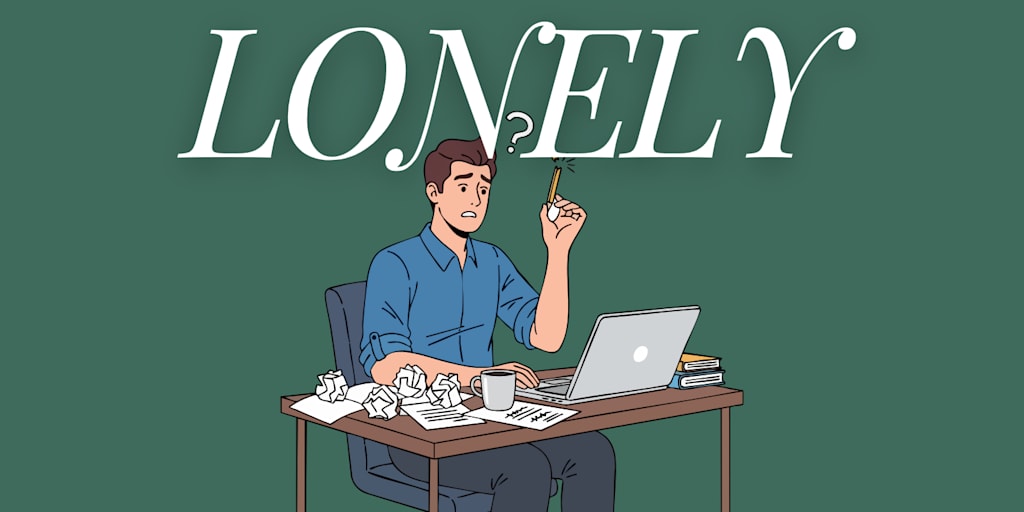
An old friend asked me last year when I was going to do something more stable.
She didn't say it unkindly. She said it the way you'd ask someone if they'd considered bringing an umbrella, with practical concern and more as a gentle suggestion than anything else.
But the implication wasn't lost on me. I could hear, 'This writing thing is a risk, and risks have expiration dates, and aren't you getting close to yours?"
I'd published 1 Lovelock Drive in 2024. I'd written a novel, edited it, designed its launch, and put it into the world. I've been writing full-time since 2016, when I started as a tech copywriter before moving into fiction and online blogging.
By every measure I use to evaluate my life, I was working harder and more purposefully than I ever had.
My friend saw something different. She saw a friend choosing instability. And her question, wrapped in love, landed like a verdict: what you're doing doesn't count.
The Dismissal That Isn't Cruel
The loneliness of being a writer isn't usually inflicted by enemies. It's inflicted by people who love you and genuinely believe they're helping.
The friend who laughs and says, "So you've given up on making money?" She's not being cruel; instead, she's expressing the only framework she has for evaluating career decisions: Does it pay? If not, then it's a hobby.
The relative at Christmas who calls it "your little project." He's not dismissing you. He's placing your work in the only category he has for creative pursuits that don't generate visible income. In his world, projects without revenue are hobbies. Whilst hobbies are nice and always encouraged, hobbies aren't serious to most of the world.
The partner's friend who asks, "But what's the backup plan?" She's not doubting you specifically. She's applying the risk assessment she'd apply to any venture without guaranteed returns.
The question is reasonable by every metric except the one that matters to you: that the work itself is the point, and the returns are being built, slowly, without anyone really knowing and in ways that don't fit on a conventional spreadsheet.
None of these people are trying to hurt you, but all of them are succeeding in leaving you pained, misunderstood and lonely.
What They Don't See
Very rarely do the people expressing these concerns see your 5:45 AM alarm, followed by the forty-five minutes of writing before the day starts, in the dark, while the house is silent and the coffee is too hot to drink.
The invisible hours don't register because they're invisible.
They don't see the freelance income funding the writing infrastructure. The editing costs, the cover design budget, the courses and the tools you need to be a successful writer.
Instead, they see "no book deal" and "no bestseller" and conclude the investment has no return. They don't see the platform growing, the email list building and your craft improving article by article.
Those metrics don't exist in the framework they're using.
They don't see the emotional labour, either. They're not there the morning you sat at the desk for ten minutes before a sentence appeared. They have no idea about the article you wrote that nobody read. They don't even know the sales dashboard you stopped checking because the number hadn't moved, or even exists.
And luckily for them, they're not privy to the unsettling conversation with yourself at midnight, where you asked whether everyone else was right and you should stop.
They see the surface where it looks like someone with a day job who writes as a hobby.
What You Stop Sharing
This is the part that deepens the loneliness beyond where it starts.
You publish an article that resonates.
Then readers respond.
A beautiful stranger messages you to say it changed how they think about their own writing.
And you're proud at that moment, specifically proud of the work and its impact.
Once you're swelling with pride, you mention it to someone. They ask if you got paid, and you say no. Once the no happens, the conversation moves on, and all that pride you felt drains from you.
You feel foolish for being excited about something that doesn't convert to money in someone else's evaluation system.
This keeps happening enough times, and you stop sharing because defending the work every time you mention it requires more energy than the sharing provides.
So you keep it private, and then all the wins happen quietly. And the struggles happen quieter.
Your actual creative life, the thing that matters most to you, becomes the thing you talk about least. You discuss freelance work because people understand it, or you discuss the day-to-day because people understand the day-to-day.
That's the deepest loneliness, when the most important part of your life is the part you've learned not to mention.
The Comparison That Stings
Someone I went to university with became a lawyer. Everyone in our shared circle tracks her progress with pride. Each milestone as she ascends the legal ranks is legible and celebrated because the path is understood.
My milestones are illegible. A hundred articles published, an email list growing, a second novel in progress, and acraft that's measurably stronger than it was a year ago don't register in the same framework.
Nobody tracks them or celebrates them at dinner parties. Because the path doesn't lead to a destination that the people around me recognise as success.
I put in the same amount of work and commitment, but receive a vastly different level of respect. Not because writing is less valuable, but because the value is invisible to people who measure careers by salary and title.
The certainty of a path people understand will always be more respected than the uncertainty of a path they don't, even when a certain path leads to misery, the uncertain path leads to meaning.
The Question At Midnight
After another conversation where someone gently implied that writing isn't a real career, the same question always arises in the same way, late at night, in a nagging way you can't ignore.
Am I delusional?
Is everyone else right?
Am I wasting years of my life on something that will never amount to anything?
The question deserves an honest answer, so here it is: I don't know. I don't know if the writing will ever generate the kind of success that the people who love me would recognise.
I don't know if the second novel will sell.
I don't know if the platform will grow beyond where it is.
Nobody knows these things in advance, and anyone who claims certainty is selling something they want you to buy from them.
What I know is that I'm doing the work and the work is improving. That the practice is sustainable and the life I'm living, with the writing at its centre, is more purposeful and more mine than any alternative I can imagine.
That's not certainty. I view it as something better; it's the alignment between what I do and who I am.
The people who question the path aren't wrong to question it. They're applying reasonable frameworks to a situation that those frameworks weren't built for.
But I can hold their concern without accepting their conclusion.
The Writers Who Understand
The only people who don't require an explanation are other writers.
They understand that three hours on a paragraph isn't wasted time. They get that ten readers who genuinely engage are a meaningful audience. They know the work continues whether or not anyone's watching, because the work is the point, and the audience is being built, and the building is slow, and slow isn't the same as failing.
Finding those people, in communities, in writing groups, in the comments underneath articles like this one, is the difference between lonely and alone.
You can survive alone, but you can't sustain loneliness. Find the people who get it. They're out there. They're at their own desks, in their own silence, writing their own work.
They won't ask when you're getting a real job.
They'll ask how the work is going.
---
I write about the emotional and practical reality of being a writer - drafting, doubt, discipline, and publishing while still figuring it out.
Mostly for people who write because they have to, need to, want to | linktr.ee/ellenfranceswrites
About the Creator
Ellen Frances
Daily five-minute reads about writing — discipline, doubt, and the reality of taking the work seriously without burning out. https://linktr.ee/ellenfranceswrites
Enjoyed the story? Support the Creator.
Subscribe for free to receive all their stories in your feed. You could also become a paid subscriber, letting them know you appreciate their work.
Comments
There are no comments for this story
Be the first to respond and start the conversation.