
The Price of Silence
I sent 150,000 to my parents in secret; when I had a heart attack, my wife said "No treatment."
That 150,000 Yuan Almost Cost Me My Life
My name is Chen Zhiyuan. I’m forty-three years old and a department supervisor at a mid-sized logistics company. "Supervisor" is a generous title; in reality, I’m just the punching bag caught between the boss and the drivers. I take home a little over 7,000 yuan a month—hardly enough to thrive in a city like Zhengzhou, but just enough to keep the wolf from the door.
My wife, Liu Yun, is a manager at a chain pharmacy, earning just over 5,000. Between the two of us, after deducting the mortgage, car loan, and our daughter’s tutoring fees, we’re lucky if we have two or three thousand left at the end of the month. Life was tight, but we were managing.
It all started last autumn.
My mother called, hesitating for a long time before my father grabbed the phone. He coughed and said, "Your mother’s legs... the old trouble is back. It’s bad this time. The doctor says both knee joints need replacing."
I asked how much it would cost.
After a silence, my father said, "Over 50,000 for one leg. For both... including hospitalization and rehab, it’ll be 150,000 to 160,000."
I was stunned.
"It’s okay," he added quickly. "We’re just letting you know. Your mother and I have about 30,000 saved. We can scrape enough together for one leg. We’ll just hold off on the other one for now."
Hold off? How? I’d seen her legs—swollen like steamed buns, the kneecaps deformed. She limped through the day and tossed in pain all night. She’s only sixty-seven; was she supposed to spend the rest of her life in a wheelchair?
"Dad, don’t worry about it," I said. "I’ll find a way."
I sat in my car after the call and smoked half a pack. The smoke lingered in the cramped space, making my eyes sting. I wasn't sure if it was the smoke or something else.
150,000 yuan. I had 80,000 in "private room money"—a secret stash.
That 80,000 took years to build. My wife keeps a tight grip on the finances, but she gives me a monthly allowance of 1,200 for breakfast, cigarettes, and occasional meals with colleagues. I don’t socialize much and I don't gamble. I smoke a local brand, Golden Leaf, at ten yuan a pack. That’s about 400 a month. Of the remaining 800, I’d secretly squirrel away 500. Over six or seven years, plus some overtime and travel stipends I didn't report, it grew to 80,000.
Liu Yun knew nothing about it.
It wasn't that I didn't trust her; it was that I couldn't face the conversation. When we first married, she’d nag for days if I gave my parents 2,000 yuan for the holidays. Once the mortgage and the kid came along, she tightened the purse strings further. "Your parents have pensions," she’d say. "They aren't lacking for food or clothes. Why give so much? We can barely look after ourselves."
My parents do have pensions—about 4,000 a month between them. In their small county town in Xuchang, that’s enough to live on, but it’s nothing in the face of a major illness.
So I stayed silent. That 80,000 was my final safety net. But I was still 70,000 short.
I started looking for "flexible" solutions. My department handles payments for several transport fleets. By shifting funds from small, un-invoiced transactions over two months—like an ant moving a mountain—I managed to siphon off 70,000.
I knew it was wrong. But I told myself I was just borrowing it and would pay it back slowly.
I transferred the full 150,000 to my father’s card. My mother cried on the phone, repeating, "Son, I’m a burden to you."
"Mom, don't say that," I replied. "Get the surgery. Don't scrimp on your health."
I didn't hear my father speak, but I heard him blow his nose in the background.
It was September 15th, a regular Thursday. When I got home, Liu Yun was stir-frying in the kitchen. Without looking back, she asked, "Why so late?"
"Overtime."
"Oh. Wash up and eat."
It was that simple. She had no idea that while she was cooking those tomatoes and eggs, I had transferred away more than half a year of our family’s income.
Life went on. My mother had the first surgery in late September. It was a success. When she called to tell me, her voice sounded brighter than it had in years.
"Who was that?" Liu Yun asked.
"My mom. Just saying she’s doing well."
"Oh, good."
She didn't ask more. She never showed much concern for my parents. It wasn't that she was unfilial; she was just single-minded. She struggled enough to manage our own lives; she had no mental space left for anyone else. I understood, but it still left a bitter taste in my mouth.
I thought this would be another secret buried by time. Until one morning in early November.
It was a frost-covered morning. I was idling the car, waiting for the heater to defrost the windshield, when my chest felt like it was being crushed. It wasn't a sharp pain, but a heavy, suffocating pressure, as if a wet towel was being held over my face.
Thinking it was low blood sugar, I ate a piece of chocolate from the glove box. It didn't help. The pressure spread to my left shoulder and down my arm.
My heart sank. I’d taken first-aid training; I knew these were the classic signs of a myocardial infarction—a heart attack.
I gritted my teeth and drove to the nearest community clinic. It was only three kilometers, but it felt like a century. Every time I hit the brakes, my chest tightened.
The young doctor took one look at my ECG and his face went pale. "Acute heart attack! Get to a major hospital immediately!"
He called an ambulance. On the way, I called Liu Yun. "My chest feels bad. I’m going to the City Center Hospital."
There was a two-second silence before her voice turned shrill. "What? What happened?"
"I don't know. The doctor says it might be a heart attack."
"I'm coming!"
By the time I reached the hospital, I was drenched in cold sweat. The ER doctors rushed me in for an angiogram, saying I’d likely need a stent. Liu Yun arrived while I was hooked up to monitors. She was white-faced, her hands shaking as she grabbed mine.
"Zhiyuan, don't scare me."
"I'm fine, I won't die," I managed a weak smile.
The doctor called her out to talk. Through the thin doors, I caught fragments: "...blocked vessel," "...surgery as soon as possible," "...cost around 50,000 to 60,000."
50,000 or 60,000. My heart constricted again—not from the blockage, but from something else.
When Liu Yun came back in, her expression was strange. It wasn't panic or fear. It was a coldness that makes me shiver to this day.
She stood by the bed and asked, "Zhiyuan, tell me the truth. How much money do we actually have?"
My chest was still aching. The monitors were beeping. "Don't you have the savings?" I stammered. "It's... about 40,000, right?"
She nodded. Then she said, "Then we aren't doing the treatment."
I thought I’d misheard. "What did you say?"
She repeated it, her voice quiet but crystal clear. "I said, no treatment. 60,000 for surgery, then meds and checkups... maybe a second or third operation. We only have 40,000. Where am I supposed to get the rest? Borrow it? From whom? Your parents? Your brother? How much do they have?"
My mind went blank. Not out of anger, but shock. This woman I’d slept beside for over a decade was telling me "no treatment" while I lay there with tubes in my chest.
She continued, "Zhiyuan, don't blame me for being blunt. You know our situation. The mortgage is 3,200 a month. The car loan has a year left. Our daughter starts middle school next year; her tutoring alone is 20,000. If you collapse, what happens to this family? If I empty everything for your surgery, then what? Do we all starve?"
Her eyes were red, but she didn't shed a single tear. I didn't know what to say. I even felt... she had a point. We truly were broke.
But what about the 150,000?
The money I had secretly transferred was sitting in my parents' account. My mom had used half; about 70,000 or 80,000 remained for her second knee.
I realized the cruel irony: I had the money to save my own life. But I couldn't say a word. If I told her, I’d have to admit to the secret 150,000. I’d have to explain where it came from.
What would she think of me? A husband who stole from his company to subsidize his parents while his own family struggled? At that moment, my fear of the truth outweighed my fear of the heart attack.
"Yun, don't worry," I said. "I'll find a way."
But she didn't have a way. She just sat on the plastic chair in the hallway, head down, motionless. When the nurse came to ask for the 20,000 yuan deposit, Liu Yun didn't move.
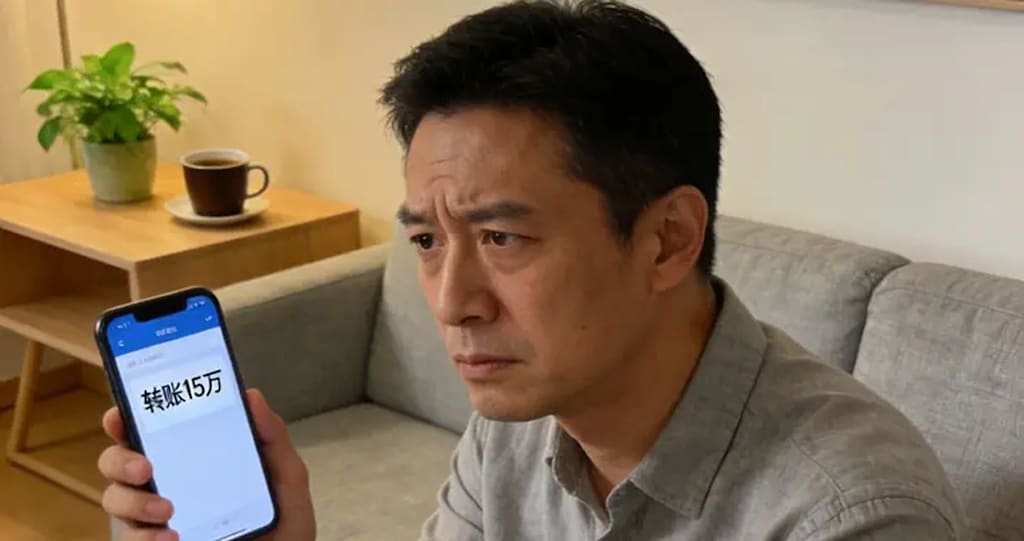
Ultimately, I used my own phone to transfer 15,000 from my Alipay—the last of my liquid cash—and 5,000 from my WeChat. I paid the deposit myself. The nurse looked at the screen, then at Liu Yun, and walked away without a word.
I spent that night in the observation ward. Liu Yun sat on a folding bed. Neither of us spoke. The green light of the monitor blinked like an eye that refused to close. I wondered: what did I do wrong? Was it wrong to care for my parents? Was it wrong to hide money from my wife? Was it wrong to take from the company?
Everything felt wrong, and yet everything felt necessary.
At 3:00 AM, I heard Liu Yun crying. She thought I was asleep. She buried her face in her knees, her shoulders heaving with suppressed sobs. I wanted to reach out and touch her hair, but I stopped halfway and pulled my hand back.
The next morning, the doctor said my troponin levels were high and my heart muscle was damaged. We couldn't wait. Liu Yun stood behind him, arms crossed, expressionless.
After the doctor left, she walked to the bedside. "Zhiyuan, I called my brother. He can lend us 20,000. You call your brother yourself."
I called my brother, who works in a factory in Suzhou. He earns about 6,000 a month and has a kid; his life is just as tight. He panicked and said he’d send 10,000 immediately.
"Don't tell Mom and Dad," I said.
"Brother, you're in the hospital and you won't tell them?"
"Don't. Mom just had surgery. Don't worry her."
He was silent for a moment. "Fine. But you... sigh." That sigh said everything. He knew about the money I’d sent home. He knew exactly why I couldn't speak up now.
The surgery was scheduled for the third day. The angiogram showed an 85% blockage in my left anterior descending artery. They placed a stent. The procedure took forty minutes and went smoothly.
The total bill for seven days was 58,000. Between her brother's 20,000, my brother's 10,000, 20,000 from our savings, and the remainder of the deposit I’d paid, we covered it.
On the day I was discharged, Liu Yun drove me home. We were silent until we were almost there.
"Chen Zhiyuan, are you hiding something from me?"
My heart tightened. "Like what?"
"Your parents didn't call once while you were in the hospital. Your brother called, but you always went into the hallway to talk to him. And your chat history with your father is empty."
I started to sweat. "You went through my phone?"
"I didn't have to. When the nurse asked for your emergency contact info, I saw your WeChat list. The chat with your dad was blank. You deleted the history. Why?"
I remained silent. We were in the underground garage. The engine was off. Finally, I said, "Yun, let me tell you something. Just don't get angry."
I told her everything—the 150,000, the secret stash, the "borrowed" company funds. I waited for the explosion.
It never came.
She simply pulled the key from the ignition, got out, and opened the passenger door for me. "Let's go inside. You just got out of the hospital; don't catch a cold."
Her voice was terrifyingly calm. She walked ahead of me, her back straight, but each step was heavy. Inside, she turned to face me.
"Zhiyuan, do you know why I said I wouldn't treat you?"
I was stunned. I expected her to scream about the money or the theft.
"It wasn't because of the money," she said, and finally, the tears began to fall—slowly, one by one. "I was afraid. I was afraid that if you died, I couldn't carry this family alone. I thought it was better to keep some money so the kid and I could survive, rather than spending everything and being left with nothing but debt and a dead husband."
She wiped her face. "I know I'm selfish. I sat in that hallway all night thinking about how to survive, not how to save you. I thought: how can I handle the mortgage and our daughter alone? And then I wondered—why don't you have insurance? I checked your card and saw you hadn't paid into the social medical insurance for three months. You told me the company was tight on cash, but you didn't tell me they stopped paying the benefits. You kept it all from me to 'protect' me."
She became more agitated, her voice rising. "You kept your parents' illness from me. You kept the company's troubles from me. You kept 80,000 yuan from me. You carried it all until you literally had a heart attack, and then you lay there without a cent for your own surgery. Chen Zhiyuan, do you even see me as your wife?!"
That question cut deeper than the heart attack ever could.
She was right. My greatest flaw was my insistence on carrying everything alone. I thought that’s what being a man meant—holding up the sky so your wife doesn't have to worry. I thought my parents' care was my burden alone. I thought I was being responsible. In reality, I was being selfish. I had excluded her from my reality, leaving her in a bubble of false security. When that bubble burst, she realized our life was already full of holes. Her fear, her anger, and that "no treatment" comment—I had driven her to that.
That night, we sat in the living room and laid out all the accounts. How much was left at my parents', how much I owed the company, the mortgage, the car, the tutoring fees. We were like two bankrupt merchants liquidating their final assets.
Finally, Liu Yun leaned on my shoulder. "Zhiyuan, can we stop hiding things? No matter what happens, even if the sky falls, let's carry it together. If you carry it alone, it'll kill you."
I nodded.
The next day, I called my father and asked if we could delay my mom’s second surgery. I told him I’d had a "situation." He didn't ask what it was. He just said, "Okay."
That afternoon, he transferred 80,000 back to me. I knew that was my mother’s "life-saving money." She had given back the cost of her second knee. I told my father I was sorry.
"Silly child," he said. "Don't apologize to your father. Your mom's leg can wait. Your life is what matters."
I cried on the balcony for a long time. Liu Yun came out and put her hand on my shoulder.
Later, I settled things with the company. I confessed to my boss and signed a guarantee to have 2,000 yuan deducted from my salary every month for two and a half years. He cursed me out but didn't call the police. He gave me a second chance.
My mother’s second surgery finally happened this spring. Liu Yun suggested we use 20,000 from our savings and some from my brother to get it done. Now, she calls my mother every week to check on her. My mother tells everyone, "My daughter-in-law is better than my own son."
Three months after I was discharged, Liu Yun sent me a long WeChat message during my lunch break.
"Zhiyuan," it read, "saying 'no treatment' in the hospital was the most shameful thing I’ve ever said. I’ll remember that day for the rest of my life. It wasn't that I didn't love you; I was paralyzed by fear. Please don't hold a grudge against a woman who was scared out of her mind."
I replied: "I forgot it long ago."
But I haven't forgotten. How could I?
But some things aren't for holding grudges; they are for remembering. I remember how I almost drove myself to death. I remember the harsh words spoken in despair. I remember the afternoon my parents sent back their medical fund. I remember how close this family came to falling apart.
And so, I live. I live well, alongside them.
(End)
About the Creator
Water&Well&Page
I think to write, I write to think
Enjoyed the story? Support the Creator.
Subscribe for free to receive all their stories in your feed.
Comments
There are no comments for this story
Be the first to respond and start the conversation.