
The Last Man to Believe in Dragons
How a Childhood Creation Found Its Way into the World

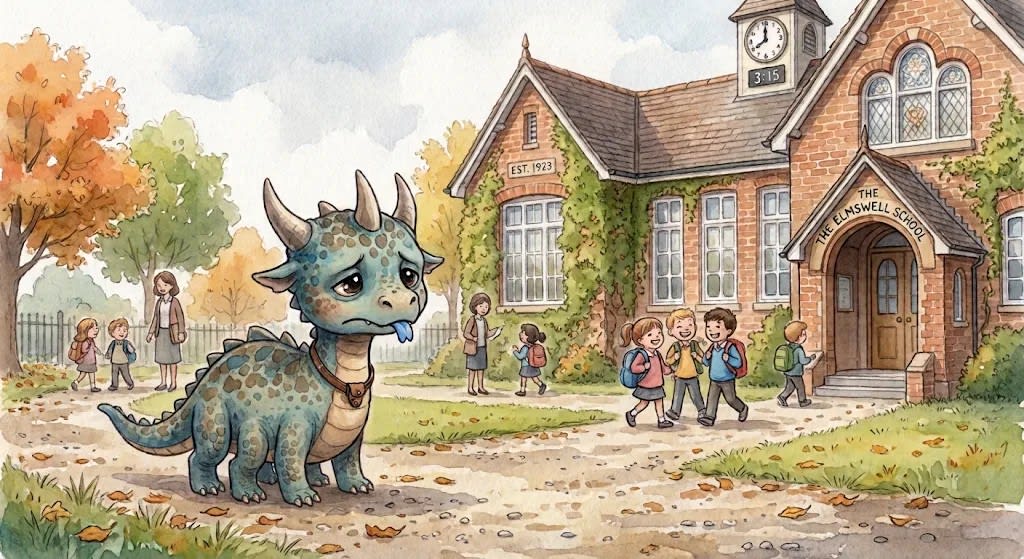
At eleven years old, Walter Burns submitted a complaint to the Ministry of Wildlife concerning the disappearance of dragons from the countryside. The Ministry replied that dragons had never been classified as wildlife, and therefore an investigation could not be opened. Walter considered this an administrative failure and wrote again, enclosing a drawing of a dragon with six legs, three horns, and a rather unfortunate expression. His teacher gave the drawing a mark of distinction for imagination, although she suggested that he devote more attention to his arithmetic.
Forty years later, Walter was still writing letters, although his correspondence had expanded considerably beyond complaints to government departments. He had written to universities, zoological societies, television stations, and one particularly unhelpful gentleman who operated a company selling garden ornaments. His efforts had produced three invitations to speak at amateur fantasy conventions, a Christmas card from a man in Wales, and a threatening letter from a woman who believed dragons were responsible for her missing chickens.
Walter had never actually seen a dragon, although he had spent much of his life collecting accounts from people who claimed to have encountered one. His collection occupied an entire room above his bookshop, where newspaper clippings, handwritten statements, old drawings, and recordings filled several cabinets. He had accounts from shepherds, fishermen, railway workers, and a retired schoolteacher who insisted that a dragon had eaten her husband's bicycle. Walter took every account seriously, although he had developed a healthy suspicion of men who described extraordinary creatures after consuming several pints of beer.
His most treasured possession was a letter from a child named Amelia, who had written to him when she was seven years old. The letter was written in uneven handwriting, with several words crossed out and a drawing of a small creature occupying most of the lower half of the page.
Dear Mr. Burns,
I saw a dragon behind our school. It was very small and had a blue tongue. My teacher says it was a lizard, but I think she is wrong because lizards don't look sad.
Walter had kept the letter for twenty-three years, along with the envelope and the little drawing Amelia had included. He had written back, thanking her for the report and asking whether she could describe the creature's eyes, although she never replied. From time to time, he wondered whether she had grown up and forgotten all about her discovery, as children often do when the demands of adulthood begin to occupy their attention.
One afternoon, a woman entered his bookshop carrying a cardboard box, explaining that her daughter had discovered it in the attic while sorting through her grandmother's belongings. She thought Walter might be interested because the box contained drawings of imaginary creatures, several of which resembled the dragons featured in his book. Walter opened it on the counter and discovered dozens of pictures, each depicting the same peculiar little animal with six legs, three horns, and a blue tongue.
He examined the bottom of the box, where somebody had written Amelia Finch, Class 2 in faded pencil. Recognizing the name, he immediately retrieved the old letter from his collection and placed it beside the drawings, finding the resemblance remarkable. The woman explained that her mother had been a schoolteacher, and that Amelia had been one of her pupils many years earlier.
Walter asked whether the box contained anything else, and the woman produced a folded sheet of paper from the bottom. It showed the school grounds, with a small creature hiding behind the old science building, while a sentence written beneath the drawing read, He comes back when nobody believes in him.
Walter studied the picture for several minutes before returning to his collection. Something about the creature seemed familiar, although he couldn't immediately identify the source of the feeling. He retrieved an old notebook from a cabinet and began turning its pages, eventually finding a drawing that made him sit back in astonishment.
It was his own childhood creation.
At eleven, Walter had drawn a creature remarkably similar to the one Amelia had depicted, complete with six legs, three horns, and a blue tongue. He had called it Brindle and invented an elaborate history involving a family of dragons who lived beneath the school playing field. His original story described Brindle as a lonely creature who had become separated from his family and taken refuge near the school, where he watched children playing and secretly wished he could join them.
Walter had forgotten Brindle for decades, although the drawing had remained in his exercise book. He compared the original illustration with Amelia's pictures and began laughing at the remarkable journey his imaginary creature had apparently taken.
He telephoned the woman and asked whether Amelia still lived in the area, learning that she was now an adult with children of her own and had moved several hundred miles away. Walter requested her address, explaining that he believed he had discovered something interesting about the drawings, and promised to write as soon as he had gathered his thoughts.
Several weeks later, a letter came from Amelia, who remembered writing to him although she had forgotten his reply. She explained that her mother had kept the original drawings in a box, and that she had recently rediscovered them while helping clear the family attic. Her brother Thomas had apparently given her the idea for the creature after finding an old illustration in a discarded schoolbook.
Walter read the letter twice before searching through his own collection of childhood papers. He found an old school newsletter containing the names of former pupils, and Thomas Finch appeared among the students who had participated in an annual art exhibition. Walter wrote to Amelia again, explaining that the original drawing might have belonged to him, and included a copy of his illustration for her brother to examine.
The reply came several weeks later, and Thomas remembered the drawing immediately. He explained that he had copied it from an exercise book belonging to an older pupil, although he had forgotten the boy's name. Thomas had taken the picture home, invented a story around it, and passed the idea along to his younger sister, who had continued drawing the creature for several years.
Walter sat for a long time after reading the letter, considering the journey his imaginary dragon had taken. A boy had drawn a creature during a school lesson, another boy had copied it, and a little girl had given it a personality and an entirely new history. Eventually, those drawings had found their way into a cardboard box, remained forgotten for years, and returned to the man who had first put pencil to paper.
He began wondering how many other ideas had traveled through childhood classrooms, family homes, and forgotten notebooks, changing a little each time somebody added something of their own. An illustration that had once occupied the back of a school exercise book had become a collection of drawings, a correspondence between strangers, and a story that had crossed several generations.
Walter decided to write a book about Brindle, although he wanted to do something different from the usual collections of dragon legends and mythical creatures. He called it Brindle and the Children Who Believed, telling the story of a little dragon who wanted to understand why humans were so determined to deny the existence of creatures they had never encountered. He dedicated the book to every child who had ever been told that something couldn't possibly exist.
The book sold several hundred copies through his shop and attracted letters from young readers who had invented dragons of their own. One child sent him a drawing of a creature with seven legs and an impressive collection of teeth, while another insisted that dragons preferred strawberry jam to their usual diet. Walter answered every letter, often including a small drawing of Brindle at the bottom of his replies.
He eventually began visiting schools, where he spoke about imagination, drawing, and the curious journey a childhood idea could take through the years. He never claimed to have discovered a real dragon, and when children asked whether he believed in them, he explained that he believed a good story deserved the chance to grow beyond its original creator. His visits became popular, particularly after one school invited him to judge a drawing competition in which the winning entry depicted a dragon wearing spectacles and riding a bicycle.
Years later, while sorting through his correspondence, Walter discovered a small envelope addressed in unfamiliar handwriting. Inside was a drawing of a creature with six legs, three horns, and a blue tongue, although its expression was considerably happier than the one in his original illustration. The accompanying letter came from a little girl who had read his book and decided to invent a dragon of her own, which she had named Brindle the Second.
Walter pinned the drawing above his desk beside the original illustration from his school exercise book, then added the letter to his growing collection. He had spent forty years searching for evidence that dragons existed, yet the most convincing evidence had been arriving in his post for decades, drawn by children who had never met one another. His imaginary creature had passed from one young mind to another, acquiring new adventures and new personalities along the way.
As Walter grew older, he began to understand that Brindle had become something rather different from the creature he had invented during a school lesson. The original drawing belonged to a boy who had enjoyed making up stories, while the later drawings belonged to children who had taken that invention and made it their own. Walter kept every illustration, every letter, and every little account of a dragon sighting, finding considerable pleasure in the knowledge that his childhood creation had outlived the exercise book in which it first appeared.
And whenever another letter came through the post, Walter opened it with the same enthusiasm he had felt at eleven, when a pencil drawing and an unfinished story had first convinced him that dragons deserved a place in the world.
What I Borrowed and Why:
The part I borrowed from my childhood writing was a dragon I invented at eleven years old named Brindle. In my original school composition, Brindle was a small creature with six legs, three horns, and a blue tongue who lived near a school after becoming separated from his family. I took that character and gave him a new life through Walter Burns, a man who spends decades collecting information about dragons and eventually discovers that his childhood creation has traveled through the imaginations of other children.
I chose Brindle because I liked the idea of a creature I invented as a child continuing to exist long after I had forgotten about him. What began as a drawing in a school exercise book became the inspiration for a much larger story about imagination, creativity, and how one person's idea can take on a life of its own.
About the Creator
Nolan Reed
I write true stories, including unsolved mysteries and events that actually happened.
Enjoyed the story? Support the Creator.
Subscribe for free to receive all their stories in your feed.
Comments
There are no comments for this story
Be the first to respond and start the conversation.