
The Hidden Truth About SaaS Development Costs in Australia
Discover the real investment required to build, launch, and grow a successful SaaS product in Australia beyond the initial development quote.

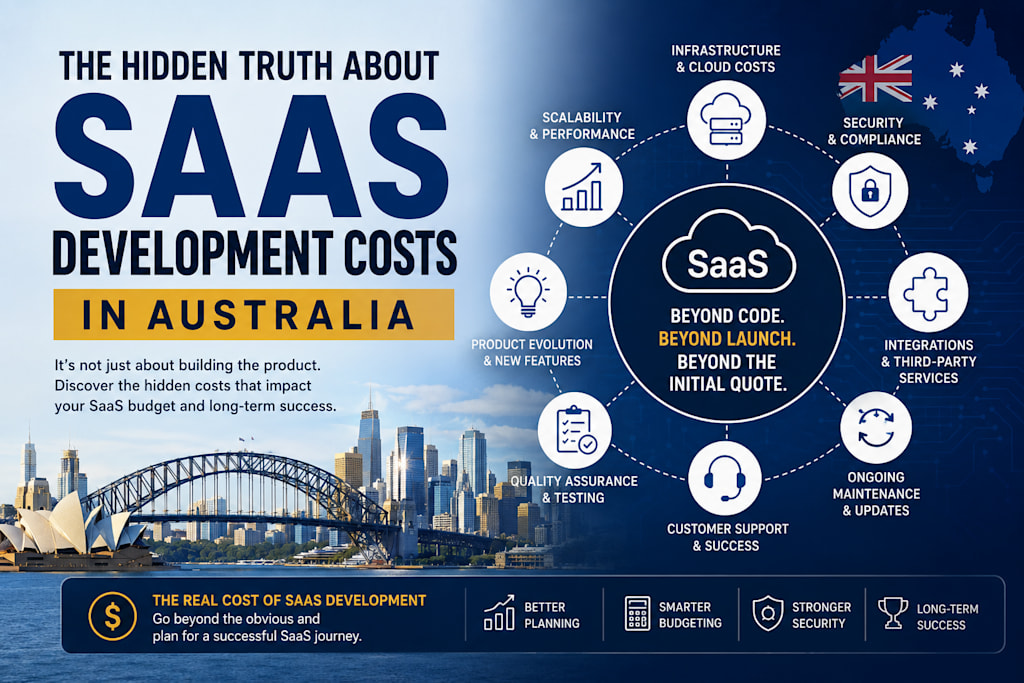
Software-as-a-Service (SaaS) has transformed how businesses deliver products, serve customers, and generate recurring revenue. Across Australia, startups and established organizations alike are investing heavily in SaaS solutions to improve operational efficiency and create scalable digital businesses.
Yet one misconception continues to affect founders, entrepreneurs, and decision-makers: the belief that the quoted development price represents the total cost of building a SaaS product.
In reality, the visible development budget often accounts for only a portion of the overall investment. Behind every successful SaaS platform lies a collection of ongoing expenses, strategic decisions, and operational commitments that rarely appear in initial project estimates.
Understanding these hidden costs can help businesses plan more effectively, avoid financial surprises, and create products that remain competitive for years to come.
Why SaaS Development Costs Are Often Misunderstood
When companies begin exploring SaaS development, they typically focus on tangible deliverables such as user interface design, application development, testing, and deployment.
While these elements are essential, they represent only the foundation of a much larger ecosystem.
A SaaS platform is not simply software that gets built and forgotten. It is a continuously evolving service that requires constant maintenance, infrastructure management, feature enhancements, customer support, security monitoring, and performance optimization.
The difference between a thriving SaaS business and a struggling one often comes down to how well these ongoing costs are anticipated.
The Cost of Product Validation
Many organizations rush into development without adequately validating their concept.
The excitement of bringing a new idea to market can sometimes overshadow the importance of understanding customer needs, competitive positioning, and market demand.
Before development begins, businesses should invest time and resources into:
- Market research
- Customer interviews
- Competitor analysis
- User journey mapping
- Prototype testing
- Feature prioritization
Although validation requires an upfront investment, it significantly reduces the risk of building a product that fails to solve a meaningful problem.
The cost of early research is almost always lower than the cost of rebuilding an unsuccessful product later.
Scalability Comes at a Price
One of the most overlooked aspects of SaaS development is scalability planning.
A platform that performs well with a few hundred users may encounter serious challenges when thousands of customers begin using the service simultaneously.
As growth occurs, businesses often need to invest in:
- Database optimization
- Load balancing
- Infrastructure upgrades
- Microservices architecture
- Performance monitoring tools
- Application scaling strategies
These investments may not seem necessary during the early stages, but ignoring scalability can result in expensive redevelopment projects in the future.
Building with growth in mind is often more cost-effective than rebuilding after growth arrives.
Cloud Infrastructure Expenses Add Up
Cloud computing has made SaaS development more accessible than ever. However, cloud services introduce ongoing operational expenses that increase alongside customer growth.
Many founders underestimate how quickly these costs can expand as user activity rises.
Common infrastructure expenses include:
- Data storage
- Virtual servers
- Content delivery networks
- Database services
- Backup solutions
- Disaster recovery systems
A successful SaaS platform typically experiences increasing infrastructure requirements, making cloud costs an ongoing financial consideration rather than a one-time expense.
Security Is No Longer Optional
Cybersecurity has become one of the most important investments for modern software companies.
Users trust SaaS providers with sensitive information ranging from customer records and financial data to proprietary business information. Protecting that data requires a proactive security strategy.
Organizations frequently invest in:
- Data encryption
- Access control systems
- Security audits
- Penetration testing
- Threat detection tools
- Incident response planning
Unfortunately, many businesses view security as an optional upgrade rather than a core requirement.
The financial consequences of a security breach can far exceed the cost of preventative measures, making cybersecurity one of the most valuable investments a SaaS company can make.
Compliance Requirements Continue to Grow
As digital regulations evolve, compliance has become a significant factor in SaaS development costs.
Businesses serving industries such as healthcare, finance, education, and legal services often face strict requirements regarding data handling, privacy protection, and operational transparency.
Meeting these standards may involve:
- Legal consultation
- Security assessments
- Compliance documentation
- Certification processes
- Internal audits
- Risk management procedures
While compliance initiatives may not directly generate revenue, they often determine whether a company can enter specific markets or secure enterprise-level clients.
Integration Challenges Are Frequently Underestimated
Modern businesses rely on a wide range of digital tools. As a result, customers increasingly expect SaaS platforms to integrate with existing software ecosystems.
Whether connecting with accounting systems, payment processors, customer relationship management platforms, communication tools, or analytics software, integrations introduce additional complexity.
Each integration requires:
- Development effort
- Testing
- Documentation
- Monitoring
- Maintenance
- Version updates
What initially appears to be a straightforward feature can evolve into a long-term commitment requiring continuous support.
The Ongoing Cost of Quality Assurance
Software quality is not something that can be achieved through a single testing phase before launch.
Every new feature, update, and enhancement introduces the possibility of bugs, performance issues, and compatibility problems.
Successful SaaS companies typically invest in:
- Automated testing frameworks
- Manual testing processes
- Performance testing
- Security testing
- User acceptance testing
Continuous quality assurance helps maintain customer satisfaction while reducing the likelihood of costly disruptions.
In many cases, the cost of poor quality far exceeds the investment required to prevent issues in the first place.
Customer Support Is a Growth Investment
Many businesses focus heavily on acquiring customers but underestimate the resources required to retain them.
A SaaS product can have exceptional functionality, but without effective customer support, user satisfaction and retention may suffer.
As customer numbers grow, organizations often need:
- Support teams
- Knowledge bases
- Onboarding programs
- Help desk software
- Training materials
- Customer success initiatives
Strong support systems contribute directly to customer loyalty, making them an essential component of long-term business growth.
Technical Debt: The Hidden Financial Burden
In the pursuit of faster product launches, development teams occasionally make compromises that create technical debt.
Technical debt refers to shortcuts, outdated code, incomplete documentation, or architectural decisions that eventually require correction.
While these shortcuts may accelerate early development, they often increase future costs by making the platform more difficult to maintain and expand.
Over time, unresolved technical debt can slow development, increase bug frequency, and reduce overall system reliability.
Businesses that consistently invest in code quality and modernization typically experience lower maintenance costs and greater product stability.
Innovation Never Stops
One of the greatest misconceptions about SaaS development is the belief that the product is "finished" after launch.
In reality, launch day marks the beginning of an ongoing cycle of improvement.
Customer expectations evolve rapidly, competitors introduce new capabilities, and technology continues to advance.
To remain relevant, SaaS businesses must continually invest in:
- Feature enhancements
- User experience improvements
- Automation capabilities
- Artificial intelligence integrations
- Performance optimization
- Market-driven innovation
Sustained innovation is not simply a competitive advantage—it is often necessary for survival.
Final Thoughts
The hidden truth about SaaS development costs in Australia is that building the product is only part of the journey.
While design and development form the foundation of a SaaS platform, long-term success depends on numerous additional investments, including infrastructure, security, compliance, scalability, customer support, quality assurance, and continuous innovation.
Organizations that understand these realities are better equipped to create sustainable products, manage financial expectations, and position themselves for long-term growth.
The most successful SaaS companies do not view development as a one-time project. They recognize it as an ongoing commitment to delivering value, maintaining trust, and adapting to an ever-changing digital landscape.
About the Creator
DZ Insights
Best Guest Blogging for Authors to share their stories and ideas.
Enjoyed the story? Support the Creator.
Subscribe for free to receive all their stories in your feed.
Comments
There are no comments for this story
Be the first to respond and start the conversation.