

The Harvest of Despair grew from my earlier story, The Devil's Bargain. I returned to the original premise of a desperate farmer who trades the future of his bloodline for prosperity, then explored the bargain from a different perspective. What began as a story about making a deal with the devil became a story about the moment a person begins making that deal within himself.
The autumn rain in Oakhaven no longer felt like water. It felt like ash.
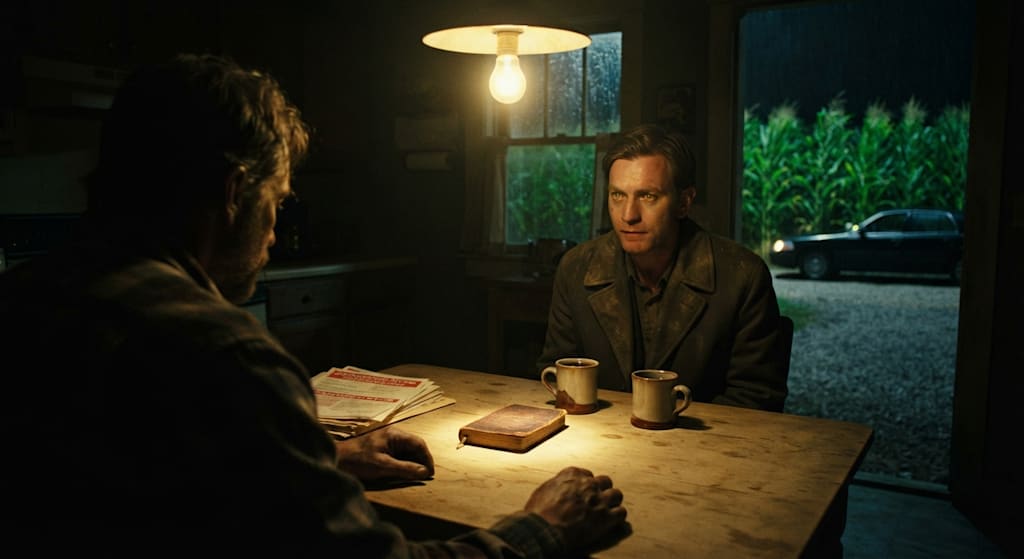
Arthur sat alone at his kitchen table beneath a single yellow bulb, studying the foreclosure notices spread before him. The ink had begun to blur where rainwater dripped from his coat onto the paper. Across the gravel road, Miller's fields glowed an unnatural emerald beneath the midnight fog. Two months earlier, his corn had been as gray and brittle as Arthur's. Now, green stalks stood taller than a man, their heavy ears bending beneath the weight of impossible abundance.
Miller had a new combine, a new truck, and a smile Arthur had never quite understood.
A knock sounded at the back door.
Three measured taps.
Arthur glanced at the clock. The bank wasn't sending anyone until Monday. Besides, creditors didn't knock like that. They hammered on doors, shouted through windows, and left notices nailed to the frame.
He opened the door.
Thomas Miller stood on the porch with a covered ceramic dish in one hand and a bottle of dark bourbon in the other.
"Thought you could use something warm, Artie."
His voice was smooth. Too smooth. The tobacco-rough rasp Arthur had known for a decade was gone, leaving behind something polished and strangely hollow.
"I'm not much for company tonight, Thomas."
"That's all right."
Miller stepped inside anyway.
He placed the dish on the counter and set the bourbon directly atop the foreclosure notices. He didn't glance at the red ink. He didn't need to. Everyone in the county knew Arthur's wife had taken the boys to Omaha three weeks ago, unable to watch another harvest fail and another dollar disappear into the soil.
Miller poured bourbon into two mismatched coffee mugs.
"You're wondering how I did it," he said.
Arthur lowered himself into a chair. "I figured you found an investor."
"An investor." Miller smiled faintly. "I suppose that's one way to describe him."
"Then what is he? Some banker from out of state?"
"A man who doesn't care about credit scores or market prices. He deals in legacy. He fixes things that are broken at the root."
Miller raised his mug, then stopped before drinking.
"He doesn't accept money."
Arthur laughed. It was a dry, exhausted sound.
"Then what does he take? My soul?"
For the first time, Miller's smile disappeared.
The kitchen grew warm. Not comfortably warm, but stifling, as though someone had sealed the windows and lit a furnace beneath the floorboards. Arthur caught the smell of scorched insulation.
Miller's eyes reflected the overhead bulb. Then, for an instant, they didn't.
"Not yours," he whispered. "Your boys. Just one of them, perhaps. The oldest. Or a claim on the bloodline you haven't even brought into the world yet."
Arthur stood so abruptly his chair scraped across the linoleum.
"Get out of my house."
"Listen to me."
"Get out!"
Miller slammed his mug onto the table. Ceramic cracked against wood, and bourbon spilled across the foreclosure notices.
"Six years ago, I sat exactly where you're sitting. My fields were dead. The bank had given me thirty days. My wife was talking about leaving, and I had nothing left to offer her but promises."
He looked toward the window.
"Then a black sedan pulled into my driveway."
Arthur glanced toward the dark glass. Beyond it, the rain continued falling.
"The man who stepped out knew things no stranger could know. He knew the balance in my accounts. He knew which acres my father had mortgaged before he died. He knew the name of the little girl my wife and I had spent years praying for."
Miller's fingers tightened around the broken handle of his mug.
"He told me I could have everything back. The land. The money. My future. All he wanted was a claim on what came after me."
"And you agreed?"
"I was desperate."
"You agreed to give away your child?"
Miller flinched as though Arthur had struck him.
"My daughter wasn't born yet."
The words settled between them.
"I signed the ledger. A year later, she was born. The farm recovered. Every season afterward was better than the last. I told myself the man had been a fool's superstition, that I'd gotten lucky."
He swallowed.
"Then last month, he came back."
Outside, a gust of wind pushed rain against the window. Arthur watched a bead of water crawl down the glass, stop halfway, and begin climbing back toward the top.
He looked away.
"What happened?"
Miller's voice dropped.
"He came to collect his principal."
Arthur felt his stomach tighten.
"What does that mean?"
"It means he wants my daughter."
For a moment, Miller looked less like the richest farmer in Oakhaven than an old man who had not slept in weeks.
"I begged him. I offered him my own life. I told him to take the farm, the money, every acre I'd ever owned. He wouldn't listen. I told him I'd signed when I was desperate, that I hadn't understood what I was agreeing to."
Miller laughed bitterly.
"He said desperation was the only honest thing about the agreement."
Arthur said nothing.
"He gave me another way out. Three men. Three men drowning in the same mud I was drowning in. If I brought them to him—if they willingly accepted his offer—he would erase my debt. My daughter would be free."
The kitchen clock ticked once.
Then stopped.
Arthur stared at it.
Miller continued as though he hadn't noticed.
"The Petersons signed. Their farm went from ruin to record yields in a matter of weeks. The old place down by the creek followed. Both families have money now. Both have futures."
"And both have children."
Miller lowered his eyes.
"Yes."
Arthur felt something cold move through him.
"The Petersons," he whispered. "You brought him to the Petersons."
"I showed them a door. They walked through it themselves."
"You knew what was waiting on the other side."
"I knew what was waiting for me!"
Miller's voice broke. He pressed both hands against the table, his knuckles whitening.
"You think I haven't tried to find another way? I've driven to the city. I've spoken to lawyers. I've gone to the church and prayed until my knees bled against the floor. I've burned every scrap of paper I had from the man."
He looked up.
"Every scrap except the ledger."
"Why?"
"Because it doesn't burn."
Miller reached into his coat.
Arthur recoiled, but Miller drew out no weapon. Only a small, leather-bound book, its cover darkened by age and something that looked disturbingly like dried blood.
The ledger.
It was smaller than Arthur expected. No grand contract. No wax seals. Just worn leather, a narrow spine, and a brass clasp tarnished almost black.
Miller laid it on the table.
Arthur heard a faint sound from inside it.
A soft, irregular scratching.
Like a pencil moving across paper.
Miller kept his hands away from the cover.
"I need one more man, Artie. Just one. Then the debt is settled, and my little girl gets to grow up."
Arthur stared at the book.
"Why me?"
"Because I know what you're facing. Because you love your family. Because you would do anything to get them back."
Miller paused.
"And because you have something left to lose."
The words landed harder than a threat.
Arthur thought of his sons sleeping on a borrowed floor in Omaha. He pictured the youngest curled against his mother's side, still expecting his father to come through the door. He imagined his wife waking in the morning, checking her phone for a message that never arrived.
He hated Miller for knowing exactly where to press.
He hated him more because he understood.
"If I sign," Arthur said, "the bank leaves me alone?"
"By sunrise."
"The fields recover?"
"By the end of the week."
"My wife brings the boys home?"
Miller hesitated.
"She'll have a reason to."
Arthur looked at him sharply.
"What does that mean?"
"It means the money will be there. The house will be standing. The farm will be worth saving. The rest will be up to you."
A bitter silence followed.
Miller had offered him everything except a guarantee that his family would forgive him for what he became.
Arthur pushed the ledger away.
"And if I refuse?"
Miller stared at the table.
"Then he takes my daughter tonight. On Monday, the bank takes your land."
"And you can live with that?"
"No."
The answer came so quietly that Arthur almost missed it.
Miller rubbed his face with both hands. When he lowered them, his eyes were wet.
"I can't live with it. That's why I'm here."
For a moment, the mask fell away completely. Arthur saw a father terrified of an empty bedroom, a man who had spent six years building a life he now knew had been purchased with a promise he could never repay.
Then Miller looked at the ledger.
The mask returned.
"If you sign, we both keep our land. We keep our families. We get another chance."
"And when he comes back for my boys?"
Miller said nothing.
Arthur leaned forward.
"When he comes back, Thomas, will you be sitting at another man's kitchen table? Telling him how much you love your daughter?"
Miller's jaw tightened.
"I don't have a choice."
"You had one six years ago."
Miller rose so quickly his chair toppled backward.
"Don't you dare judge me!"
The room shuddered with the force of his voice. The overhead bulb flickered, and for an instant the walls seemed to draw inward. The smell of scorched insulation thickened until Arthur could taste it.
Miller stood breathing hard, his hands clenched at his sides.
Then, in a voice scarcely above a whisper, he said, "You don't understand what it sounds like when your child is crying in the next room and you know you can't save her."
Arthur's anger faltered.
Miller looked toward the window.
"I hear her every night. Even when she's asleep. I hear her calling for me, and I know what I've done. I know exactly what I've done."
He looked back at Arthur.
"But knowing doesn't make me willing to let her die."
Outside, two headlights appeared beyond the dead treeline.
Arthur hadn't heard an engine.
The black sedan sat on the shoulder of the highway, its long silhouette barely visible through the rain. Its headlights illuminated the road but cast no light upon the fog around it.
Arthur watched the vehicle.
"How long has it been there?"
Miller followed his gaze.
His face drained of color.
"Since I arrived."
"Why didn't you tell me?"
"Because I was hoping you'd sign before you noticed."
Arthur turned toward him.
Miller didn't look away this time.
The headlights flickered twice.
The sedan began rolling down the gravel driveway.
There was no engine noise. No crunch of tires against stone. The vehicle simply moved, drawing nearer, while the rain fell around it without touching its black hood.
Arthur stepped away from the window.
"Tell him to leave."
"I can't."
"Tell him!"
Miller shook his head.
"He doesn't come for people who refuse him, Artie. He comes for people who have already agreed."
Arthur looked at the ledger.
The scratching inside had stopped.
Slowly, the brass clasp lifted by itself.
The book opened.
Its pages were filled with names written in faded iron-gall ink. Some were so old that the letters had browned into the paper. Others looked freshly written, their black strokes still glistening.
Arthur found the Petersons.
Below their names was the name of the family from the creek.
At the bottom of the page, a blank line waited.
Arthur reached toward it, then stopped.
A name appeared on the paper.
His own.
He snatched his hand back.
The ink continued spreading, forming the letters with the slow certainty of a wound opening beneath the skin.
Miller began to cry.
"I'm sorry, Artie."
Arthur stared at him.
"You said I had to sign."
"I did."
"Then why is my name already there?"
Miller covered his mouth.
"Because he knows what you're thinking."
The sedan reached the porch.
Its headlights passed through the kitchen window, sweeping across the table, the spilled bourbon, and the foreclosure notices. For a moment, the red ink on the bank letters seemed to rise from the paper like tiny, dark roots.
Then came three measured knocks at the back door.
Arthur looked at the ledger.
He thought of his boys.
He thought of his wife.
He thought of the century of family tradition buried beneath the stubborn soil outside, the land his father had worked and his grandfather had cleared, the place he'd sworn he'd never surrender.
The knock came again.
Miller stood beside the table, trembling.
"If you sign," he whispered, "you can save them."
Arthur looked into the man's desperate, hollow eyes.
"No," he said. "I can save them for now."
Miller's face crumpled.
The door handle began to turn.
Arthur reached for the ledger. His fingers brushed the cold leather, and somewhere inside the book, a page turned.
The sedan's headlights flickered twice.
Then, from the other side of the door, a voice spoke in the same smooth, tobacco-free whisper Miller had brought into the house.
"Arthur? I believe we have some business to discuss."
Arthur's fingers tightened around the cover.
And the rain outside began to fall upward.
About the Creator
K-jay
I weave stories from social media,and life, blending critique, fiction, and horror. Inspired by Hamlet, George R.R. Martin, and Stephen King, I craft poetic, layered tales of intrigue and resilience,
Enjoyed the story? Support the Creator.
Subscribe for free to receive all their stories in your feed. You could also become a paid subscriber, letting them know you appreciate their work.
Comments
There are no comments for this story
Be the first to respond and start the conversation.